
Featuring market attractiveness scoring, total addressable market sizing, company benchmarking matrices, interactive Excel dashboards, deeper supply chain intelligence, emerging startup tracking, and granular product-level insights, The Business Research Company’s 2026 market reports are built to deliver research that is both more actionable and more strategically valuable.
#Full Flight Simulator Market CAGR Outlook And Future Development#_x000D_
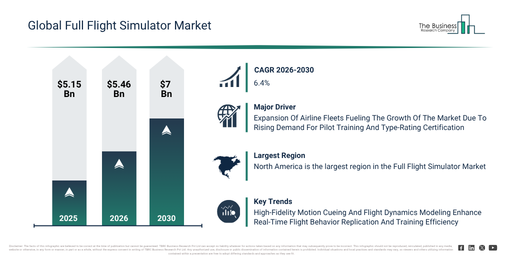
The full flight simulator market has demonstrated significant expansion in recent years. Its value is expected to climb from $5.15 billion in 2025 to $5.46 billion in 2026, exhibiting a compound annual growth rate (CAGR) of 6.2%. This historical growth can be attributed to several factors, including the escalating demand for pilot training spurred by the expanding aviation industry, the increasing adoption of flight simulators for their cost-effectiveness in training, a heightened focus on aviation safety and pilot proficiency, stricter regulatory requirements for simulator-based instruction, and the growing needs of military aviation training programs._x000D_
_x000D_
The full flight simulator market size is projected to undergo significant expansion in the next few years. It is forecast to grow to $7 billion in 2030 at a compound annual growth rate (CAGR) of 6.4%. This anticipated growth can be attributed to the increasing uptake of advanced simulation technologies, a rising need for commercial aircraft pilot training, the ongoing development of next generation aircraft simulators, an intensified focus on immersive and realistic training settings, and the growing requirement for simulator-based certification and evaluation programs. Noteworthy trends during the forecast period encompass an increasing demand for high fidelity flight simulation environments, the wider integration of advanced motion and visual systems for lifelike pilot training, a stronger emphasis on reducing aircraft training costs through simulation solutions, a growing need for certification compliant full flight simulator systems, and the progressive creation of modular and upgradeable simulator platforms._x000D_
_x000D_
#Get A Free Sample Report With In-Depth Market Insights:#_x000D_
_x000D_
#Full Flight Simulator Market Growth Catalysts And Demand Drivers#_x000D_
The increasing size of airline fleets globally is projected to drive the growth of the full flight simulator market in the future. Airline fleets encompass all commercial aircraft owned or managed by airlines for transporting passengers and freight on both domestic and international routes. The growth in airline fleets stems from airlines acquiring new aircraft to meet rising passenger demand, extend their route networks, and substitute older planes with models that are more fuel-efficient. Full flight simulators assist airline fleets through standardized pilot training, type-rating certification, and ensuring operational readiness for new aircraft, thereby allowing airlines to safely incorporate more aircraft into their services. For example, as reported by the International Air Transport Association (IATA), an aviation industry organization located in Canada, the worldwide commercial aircraft fleet amounted to 35,550 aircraft in August 2025 as of June 2025, comprising 30,300 active aircraft and 5,250 aircraft in storage. Consequently, the global expansion of airline fleets is fueling the growth of the full flight simulator market._x000D_
_x000D_
#Full Flight Simulator Market Segment Trends And Revenue Contributors#_x000D_
The full flight simulator market covered in this report is segmented – _x000D_
_x000D_
1) By Component: Hardware, Software, Services_x000D_
2) By Qualification Level: Level A, Level B, Level C, Level D_x000D_
3) By Aircraft Type: Fixed Wing, Rotary Wing_x000D_
4) By Application: Commercial Aviation Training, Military And Defense, Private And Recreational Aviation, Operational Evaluation Or Certification_x000D_
_x000D_
Subsegments:_x000D_
1) By Hardware: Motion Systems, Visual Display Systems, Cockpit Replication Systems, Control Loading Systems, Projection Systems, Computing And Processing Units_x000D_
2) By Software: Flight Simulation Software, Flight Dynamics Modeling Software, Training Management Software, Scenario Generation Software, Maintenance Management Software, Simulation Database Software_x000D_
3) By Services: Pilot Training Services, Installation And Integration Services, Maintenance And Support Services, Certification Services, Consulting Services, Software And Hardware Upgrade Services_x000D_
_x000D_
#Full Flight Simulator Market Trends Shaping Long-Term Demand#_x000D_
Companies operating within the full flight simulator market are concentrating on developing improvements in motion cueing and flight dynamics modeling, including advanced motion cueing systems, to enhance simulation realism, pilot training effectiveness, aircraft handling fidelity, and overall flight safety. Motion cueing systems are sophisticated control mechanisms utilized in full flight simulators to replicate the sensations of aircraft movement by coordinating the responses of the motion platform with the simulated flight dynamics. For instance, in July 2024, Canadian North, a Canada-based aviation company, unveiled a cutting-edge Boeing 737NG full-flight simulator and aviation training facility at Edmonton International Airport, with the goal of improving pilot training capabilities, enhancing simulation realism, supporting type-rating and recurrent training, and strengthening aviation safety and operational efficiency. This launch is notable for integrating a latest-generation CAE 7000XR Boeing 737NG full-flight simulator within a 30,000-square-foot aviation training facility, significantly expanding in-country Boeing 737NG pilot training capacity._x000D_
_x000D_
#Full Flight Simulator Market Key Participants And Competitive Landscape#_x000D_
Major companies operating in the full flight simulator market are The Boeing Company, RTX Corporation, Airbus SE, Lockheed Martin Corporation, BAE Systems plc, Thales S.A., Singapore Technologies Engineering Ltd, Leonardo S.p.A., Textron Inc., Rheinmetall AG, Indra Sistemas S.A., Elbit Systems Ltd., CAE Inc., Korea Aerospace Industries Ltd., HAVELSAN Hava Elektronik Sanayi ve Ticaret A.S., Reiser Simulation and Training GmbH, L3Harris Technologies Inc., FlightSafety International Inc. _x000D_
_x000D_
#View The Full Full Flight Simulator Market Report:#_x000D_
_x000D_
#Full Flight Simulator Market Geographic Analysis: Where Is Demand Rising Fastest?#_x000D_
North America was the largest region in the full flight simulator market in 2025. Asia-Pacific is expected to be the fastest-growing region in the forecast period. The regions covered in the full flight simulator market report are Asia-Pacific, South East Asia, Western Europe, Eastern Europe, North America, South America, Middle East, Africa._x000D_
_x000D_
#Reach Out To Our Team:#_x000D_
_x000D_
The Business Research Company: https://www.thebusinessresearchcompany.com/_x000D_
Americas: +1 310-496-7795_x000D_
Asia: +44 7882 955267 & +91 8897263534_x000D_
Europe: +44 7882 955267_x000D_
Email us at: marketing@tbrc.info_x000D_
_x000D_
#Follow us on:#_x000D_
_x000D_
LinkedIn: https://in.linkedin.com/company/the-business-research-company_x000D_
YouTube: https://www.youtube.com/channel/UC24_fI0rV8cR5DxlCpgmyFQ_x000D_
Global Market Model: https://www.thebusinessresearchcompany.com/global-market-model

Wasay has over a decade of experience in market research, data modelling, and analytics, with prior experience at GlobalData and Decision Tree Consulting Services. At The Business Research Company , he leads research operations across syndicated studies, customized consulting engagements, and the Global Market Model platform. His professional experience includes supporting organizations such as Boston Consulting Group, KPMG, and Ernst & Young. Wasay holds a degree in Electronics and Communications Engineering, postgraduate management qualifications from International Management Institute Belgium and Indian School of Business and Entrepreneurship, and completed the Integrated Program in Business Analytics from Indian Institute of Management Indore.