The Business Research Company’s 2026 market reports are designed to deliver research that is more actionable and strategically valuable. Key offerings include market attractiveness scoring, total addressable market sizing, company benchmarking matrices, interactive Excel dashboards, deeper supply chain intelligence, emerging startup tracking, and granular product-level insights.
Geostationary Earth Orbit (GEO) Life-Extension Tug Market Size 2026: Valuation, Growth Rate And Forecast To 2030
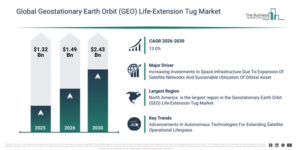
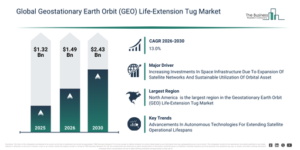
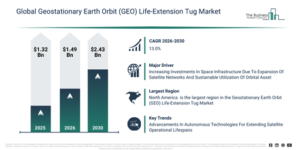
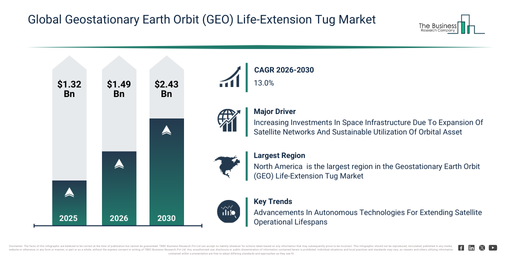
The geostationary earth orbit (geo) life-extension tug market has experienced rapid expansion in recent years. Its valuation is projected to rise from $1.32 billion in 2025 to $1.49 billion in 2026, indicating a compound annual growth rate (CAGR) of 12.9%. This historical growth can be attributed to several factors, including the increasing number of geostationary satellites nearing their end-of-life, improvements in spacecraft docking and propulsion technologies, a heightened demand for cost-effective satellite servicing, the advancement of in-orbit refueling and station-keeping capabilities, and a growing interest from commercial satellite operators in extending the operational lifespan of their assets.
The geostationary earth orbit (geo) life-extension tug market is anticipated to experience rapid expansion in the coming years. It is projected to reach $2.43 billion in 2030, demonstrating a compound annual growth rate (CAGR) of 13.0%. This growth during the forecast period is attributable to several factors, including the proliferation of commercial satellite servicing contracts and mission extension services, the integration of autonomous navigation and docking systems for tugs, the adoption of efficient fuel transfer and propulsion technologies, escalating investments in geostationary orbit satellite maintenance infrastructure, and strategic collaborations between satellite operators and tug manufacturers for customized life-extension solutions. Significant trends observed throughout the forecast period involve the increasing adoption of unmanned on-orbit servicing tugs, a heightened focus on in-orbit refueling and propellant transfer, the expansion of satellite relocation and repositioning services, the rising demand for an extended operational life for commercial geo satellites, and the integration of modular docking and servicing systems for satellite fleets.
Get A Free Sample Of The Geostationary Earth Orbit (GEO) Life-Extension Tug Market Report 2026:
What Is Driving The Growth Of The Geostationary Earth Orbit (GEO) Life-Extension Tug Market?
The escalating investments in space infrastructure are projected to drive the future expansion of the geostationary earth orbit life-extension tug market. Space infrastructure refers to a comprehensive network of physical systems, facilities, and technologies, including satellites, launch vehicles, ground stations, and orbital platforms, that facilitate space exploration, communication, navigation, observation, and related endeavors. The surge in space infrastructure investments arises from governments and private organizations aiming to expand satellite networks and ensure the sustainable utilization of orbital assets. A geostationary earth orbit life-extension tug enhances the value derived from space infrastructure investments by extending the operational lifespan of geostationary Earth orbit satellites, thereby decreasing the need for frequent satellite replacements and enabling a more cost-effective and sustainable growth of satellite networks and services. For instance, in March 2025, according to Space Economy, the European Space Agency, a France-based intergovernmental organization, reported a consolidated public space budget of $14.71 billion (€12.6 billion) in 2024, which represented a 2% increase compared to 2023. Therefore, the rising investments in space infrastructure are fueling the growth of the geostationary Earth orbit life-extension tug market.
How Is The Geostationary Earth Orbit (GEO) Life-Extension Tug Market Segmented?
The geostationary earth orbit (geo) life-extension tug market covered in this report is segmented –
1) By Product Type: Manned Geostationary Earth Orbit Life-Extension Tugs, Unmanned Geostationary Earth Orbit Life-Extension Tugs
2) By Service Type: On-Orbit Servicing, Refueling, Relocation, De-Orbiting, Other Service Types
3) By Application: Commercial Satellites, Military Satellites, Scientific Satellites, Other Applications
4) By End-User: Satellite Operators, Government And Defense, Space Agencies, Other End-Users
Subsegments:
1) By Manned Geostationary Earth Orbit Life-Extension Tugs: Crew Transport Tugs, Servicing And Refueling Tugs, Maintenance And Repair Tugs
2) By Unmanned Geostationary Earth Orbit Life-Extension Tugs: Autonomous Rendezvous And Docking Tugs, Teleoperated Servicing Tugs, Propellant Resupply Tugs, Deorbit And Disposal Tugs
What Are The Latest Trends In The Geostationary Earth Orbit (GEO) Life-Extension Tug Market?
Major companies operating in the geostationary Earth orbit life-extension tug market are prioritizing technological advancements, such as autonomous rendezvous and docking, to gain a competitive advantage. This capability allows life-extension tugs to autonomously approach, dock with, and service satellites in orbit, thereby extending operational lifespans and improving mission flexibility. For instance, in April 2025, Intelsat S.A., a Luxembourg-based satellite communications services provider, developed an advanced satellite life-extension solution. This innovation, known as the Mission Extension Vehicle (MEV), enables in-orbit docking with geostationary satellites to provide additional years of operational service by supplying propellant and maneuvering capabilities, extending satellite lifespans, enhancing sustainability, ensuring continuous connectivity for customers, and reducing the need for costly replacement launches.
Who Are The Key Players In The Geostationary Earth Orbit (GEO) Life-Extension Tug Market?
Major companies operating in the geostationary earth orbit (geo) life-extension tug market are The Boeing Company, Airbus Group, Lockheed Martin Corporation, General Dynamics Corporation, Northrop Grumman Corporation, Thales Alenia Space, Intelsat S.A., OHB SE, Clearspace SA, D-Orbit S.p.A., Starfish Space Inc., Exotrail SAS, Orbit Fab Inc., Turion Space Inc., Katalyst Space Technologies Inc., SkyCorp Inc., Infinite Orbits SAS, Rogue Space Systems Inc., Epic Aerospace Inc., Quantum Space Systems Inc.
Read The Complete Geostationary Earth Orbit (GEO) Life-Extension Tug Market Report 2026:
Which Region Is The Largest In The Geostationary Earth Orbit (GEO) Life-Extension Tug Market?
North America was the largest region in the geostationary earth orbit (GEO) life-extension tug market in 2025. Asia-Pacific is expected to be the fastest-growing region in the forecast period. The regions covered in the geostationary earth orbit (geo) life-extension tug market report are Asia-Pacific, South East Asia, Western Europe, Eastern Europe, North America, South America, Middle East, Africa.
Reach Out To Our Team:
The Business Research Company: https://www.thebusinessresearchcompany.com/
Americas: +1 310-496-7795
Asia: +44 7882 955267 & +91 8897263534
Europe: +44 7882 955267
Email us at: marketing@tbrc.info
Follow us on:
LinkedIn: https://in.linkedin.com/company/the-business-research-company
YouTube: https://www.youtube.com/channel/UC24_fI0rV8cR5DxlCpgmyFQ
Global Market Model: https://www.thebusinessresearchcompany.com/global-market-model

Wasay has over a decade of experience in market research, data modelling, and analytics, with prior experience at GlobalData and Decision Tree Consulting Services. At The Business Research Company , he leads research operations across syndicated studies, customized consulting engagements, and the Global Market Model platform. His professional experience includes supporting organizations such as Boston Consulting Group, KPMG, and Ernst & Young. Wasay holds a degree in Electronics and Communications Engineering, postgraduate management qualifications from International Management Institute Belgium and Indian School of Business and Entrepreneurship, and completed the Integrated Program in Business Analytics from Indian Institute of Management Indore.