Designed to make market research more actionable and strategically valuable, The Business Research Company’s 2026 market reports feature market attractiveness scoring, total addressable market sizing, company benchmarking matrices, interactive Excel dashboards, deeper supply chain intelligence, emerging startup tracking, and granular product-level insights.
How Big Is The Global Navigation Satellite System (GNSS)-Independent Positioning, Navigation, And Timing (PNT) Constellation Market In 2026, And How Fast Will It Grow?
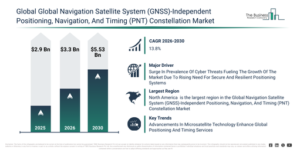
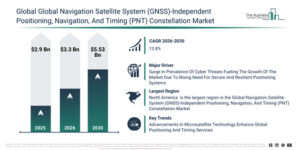
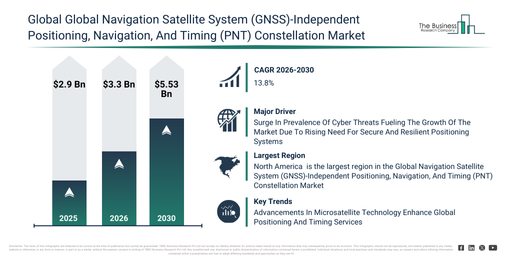
The global navigation satellite system (gnss)-independent positioning, navigation, and timing (pnt) constellation market has experienced significant growth in recent years. This market is projected to expand from $2.9 billion in 2025 to $3.3 billion in 2026, exhibiting a compound annual growth rate (CAGR) of 13.8%. Historically, this expansion was driven by factors such as a greater dependence on GNSS for essential navigation and timing, increasing military and defense interest in GNSS-independent solutions, the development of ground-based transmitters and pseudolites, the rise of commercial applications needing high-precision timing, and innovations in inertial navigation and synchronization technologies.
The global navigation satellite system (GNSS)-independent positioning, navigation, and timing (PNT) constellation market is poised for significant growth over the next few years. It is forecast to expand to $5.53 billion in 2030, demonstrating a compound annual growth rate (CAGR) of 13.8%. This expansion in the projected timeframe can be attributed to the broadening of GNSS-independent navigation services for resilient operations, the incorporation of AI-driven positioning and timing analytics, its adoption in sectors prone to signal jamming or disruption, increasing investments in ground-based infrastructure and pseudolite networks, and collaborations between technology providers and defense agencies aimed at enhancing PNT solutions. Major trends anticipated during this period include the deployment of hybrid multi-sensor navigation systems, the integration of pseudolite networks for urban and indoor navigation, the wider implementation of advanced inertial navigation systems (INS) in GNSS-denied environments, the expansion of quantum navigation technologies, and the growth in ground-based alternative positioning and timing networks.
Download A Free Global Navigation Satellite System (GNSS)-Independent Positioning, Navigation, And Timing (PNT) Constellation Market Sample Report With Size And Forecast Data:
Global Navigation Satellite System (GNSS)-Independent Positioning, Navigation, And Timing (PNT) Constellation Market Growth Driver: The Key Factor Behind Rising Demand
The global navigation satellite system (GNSS)-independent positioning, navigation, and timing (PNT) constellation market is projected for growth due to the rising occurrence of cyber threats. These threats encompass malicious actions like hacking, spoofing, data manipulation, or denial-of-service (DoS) attacks targeting PNT systems. The increase in cyber threats is a direct consequence of greater reliance on digital networks and critical infrastructure, emphasizing the necessity for secure and resilient positioning solutions. GNSS-independent PNT systems play a crucial role in mitigating these threats by ensuring reliable navigation and timing even when traditional GNSS signals face jamming, spoofing, or compromise. For instance, in November 2024, the Australian Signals Directorate’s Australian Cyber Security Centre, which serves as Australia’s technical authority on cyber security, reported that in March 2024, during FY2023–24, the ASD received over 36,700 calls to the Australian Cyber Security Hotline, representing a 12% rise from the preceding financial year. This escalating prevalence of cyber threats is thus a key factor propelling the expansion of the global navigation satellite system (GNSS)-independent positioning, navigation, and timing (PNT) constellation market.
Global Navigation Satellite System (GNSS)-Independent Positioning, Navigation, And Timing (PNT) Constellation Market Segmentation: Key Segments And Subsegments Covered
The global navigation satellite system (gnss)-independent positioning, navigation, and timing (pnt) constellation market covered in this report is segmented –
1) By Technology: Terrestrial, Space-Based, Quantum, Inertial, Other Technologies
2) By Platform: Ground, Airborne, Naval, Space
3) By Application: Defense, Aviation, Maritime, Automotive, Critical Infrastructure, Other Applications
4) By End-User: Government, Commercial, Military, Other End-Users
Subsegments:
1) By Terrestrial: Long Range Navigation, Enhanced Long Range Navigation, Ground-Based Radio Navigation Systems, Pseudolite Systems
2) By Space-Based: Low Earth Orbit (LEO) Satellites, Medium Earth Orbit (MEO) Satellites, Geostationary Earth Orbit (GEO) Satellites, Hybrid Satellite Systems
3) By Quantum: Quantum Accelerometers, Quantum Gyroscopes, Quantum Gravimeters
4) By Inertial: Strapdown Inertial Navigation Systems (SINS), Ring Laser Gyroscope (RLG) Systems, Fiber Optic Gyroscope (FOG) Systems, Micro-Electro-Mechanical Systems (MEMS) Inertial Navigation System (INS)
5) By Other Technologies: Visual Odometry Systems, Magnetic-Based Navigation Systems, Acoustic-Based Navigation Systems, Hybrid Multi-Sensor Systems
Global Navigation Satellite System (GNSS)-Independent Positioning, Navigation, And Timing (PNT) Constellation Market Trends: Key Developments Shaping 2026 And Beyond
Leading companies within the global navigation satellite system (GNSS)-independent positioning, navigation, and timing (PNT) constellation market are concentrating on creating sophisticated solutions, such as positioning, navigation, and timing (PNT) microsatellites, to improve PNT functionalities for various applications. Positioning, navigation, and timing (PNT) microsatellites are defined as compact, economical satellites built to deliver precise location and timing data, particularly in environments where conventional GNSS signals are compromised or nonexistent. For instance, in April 2023, TrustPoint, a US-based global positioning system (GPS) technology firm, launched its positioning, navigation, and timing (PNT) microsatellite constellation. These compact satellites offer distinct advantages including high-accuracy positioning, quick signal transmission, and robustness against interference, making them ideal for defense applications, autonomous vehicles, and monitoring essential infrastructure. Designed for flexibility, these microsatellites can be rapidly deployed and seamlessly integrated into current systems, ensuring dependable, autonomous, and uninterrupted positioning, navigation, and timing (PNT) services across a variety of operational settings.
Leading Companies Operating In The Global Navigation Satellite System (GNSS)-Independent Positioning, Navigation, And Timing (PNT) Constellation Market
Major companies operating in the global navigation satellite system (gnss)-independent positioning, navigation, and timing (pnt) constellation market are RTX Corporation, General Dynamics Corporation, Honeywell International Inc., BAE Systems Plc, Safran S.A., Thales S.A., Equinix Inc., Trimble Inc., Adtran Inc., Iridium Communications Inc., Spirent Communications Plc, OneWeb Ltd., Telehouse Corp., HawkEye 360 Inc., UrsaNav Inc., NextNav Inc., Locata Corporation, Hoptroff London Ltd., Satelles Inc., OPNT B.V.
Access The Full Global Navigation Satellite System (GNSS)-Independent Positioning, Navigation, And Timing (PNT) Constellation Market Research Report:
Global Navigation Satellite System (GNSS)-Independent Positioning, Navigation, And Timing (PNT) Constellation Market Regional Analysis: Largest Region And Key Geographies Covered
North America was the largest region in the global navigation satellite system (GNSS)-independent positioning, navigation, and timing (PNT) constellation market in 2025. Asia-Pacific is expected to be the fastest-growing region in the forecast period. The regions covered in the global navigation satellite system (gnss)-independent positioning, navigation, and timing (pnt) constellation market report are Asia-Pacific, South East Asia, Western Europe, Eastern Europe, North America, South America, Middle East, Africa.
Reach Out To Our Team:
The Business Research Company: https://www.thebusinessresearchcompany.com/
Americas: +1 310-496-7795
Asia: +44 7882 955267 & +91 8897263534
Europe: +44 7882 955267
Email us at: marketing@tbrc.info
Follow us on:
LinkedIn: https://in.linkedin.com/company/the-business-research-company
YouTube: https://www.youtube.com/channel/UC24_fI0rV8cR5DxlCpgmyFQ
Global Market Model: https://www.thebusinessresearchcompany.com/global-market-model

Wasay has over a decade of experience in market research, data modelling, and analytics, with prior experience at GlobalData and Decision Tree Consulting Services. At The Business Research Company , he leads research operations across syndicated studies, customized consulting engagements, and the Global Market Model platform. His professional experience includes supporting organizations such as Boston Consulting Group, KPMG, and Ernst & Young. Wasay holds a degree in Electronics and Communications Engineering, postgraduate management qualifications from International Management Institute Belgium and Indian School of Business and Entrepreneurship, and completed the Integrated Program in Business Analytics from Indian Institute of Management Indore.