
Market attractiveness scoring, total addressable market sizing, company benchmarking matrices, interactive Excel dashboards, deeper supply chain intelligence, emerging startup tracking, and granular product-level insights are among the key offerings featured in The Business Research Company’s 2026 market reports, designed to deliver more actionable and strategically valuable research.
Laser Guide Star System Market Size Overview: From Historical Performance To The 2030 Forecast
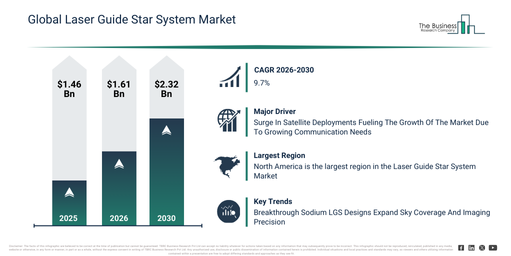
The laser guide star system market size has experienced strong growth in recent years. It is projected to increase from $1.46 billion in 2025 to $1.61 billion in 2026, representing a compound annual growth rate (CAGR) of 9.9%. The expansion observed in the historic period can be attributed to the early implementation of high-power laser modules for adaptive optics, the adoption of beam steering mechanisms in telescopes, the development of wavefront sensors for atmospheric correction, the initial integration of optical calibration tools, and the expansion of observatory installations using laser guide stars.
The market size for laser guide star systems is projected to experience robust expansion over the next few years. It is expected to grow to $2.32 billion in 2030, demonstrating a compound annual growth rate (CAGR) of 9.7%. This anticipated growth can be attributed to several factors, including advancements in next-generation adaptive optics systems, a rising need for ultra-precise astronomical imaging, the development of high-stability laser projection systems, the increasing adoption of automated calibration and alignment tools, and the expansion of global astronomical research infrastructure. Significant trends during this forecast period encompass enhanced laser power and beam quality, the miniaturization of adaptive optics components, the integration of real-time wavefront correction algorithms, the broadening of space situational awareness applications, and a growing demand for multi-wavelength guide star systems.
Get A Free Sample Of The Business Research Company’s Laser Guide Star System Market Report:
What Factor Is Increasing Demand In The Laser Guide Star System Market?
The anticipated growth of the laser guide star system market is directly linked to the increasing number of operational satellites. These operational satellites are actively functioning spacecraft fully deployed in orbit, carrying out their intended missions such as communication, navigation, earth observation, scientific research, or defense activities, all while transmitting data or services as planned. The surge in operational satellites is driven by the escalating demand for worldwide connectivity, prompting more nations and companies to launch satellites to broaden broadband access and strengthen communication networks globally. Laser guide star systems support this expanding fleet of operational satellites by enhancing ground-based tracking and monitoring capabilities. They enable clearer imaging and more precise navigation through effective correction of atmospheric distortions. For example, in May 2025, the Satellite Industry Association (SIA), a US-based trade association, released its 28th annual State of the Satellite Industry Report, stating that 11,539 satellites were operational in Earth orbit by the end of 2024, following 259 launches that deployed 2,695 satellites during that year. Hence, the rising number of operational satellites is a key factor propelling the growth of the laser guide star system market.
Which Segments Make Up The Laser Guide Star System Market?
The laser guide star system market covered in this report is segmented –
1) By Type: Rayleigh Guide Stars, Sodium Guide Stars
2) By Component: Laser Sources, Optical Components, Control Systems, Detection Systems
3) By Technology: Adaptive Optics Technology, Wavefront Sensing Technology, Photonics Technology, Control Software
4) By Application: Astronomy, Space Situational Awareness, Laser Communication, Other Applications
5) By End-User: Research Institutes, Defense And Military, Space Agencies, Other End-Users
Subsegments:
1) By Rayleigh Guide Stars: Low Altitude, High Altitude
2) By Sodium Guide Stars: Continuous Wave, Pulsed, Hybrid
Laser Guide Star System Market Emerging Trends: What Are Industry Leaders Focusing On?
Leading companies within the laser guide star system market are concentrating on developing innovative solutions, including next-generation sodium laser guide star (LGS) systems, to address the increasing demand for higher-resolution adaptive optics in astronomy, space surveillance, and defense applications. Advanced LGS systems create artificial reference stars in the upper atmosphere to correct atmospheric distortion, delivering superior imaging performance compared with traditional ground-based optical systems that rely on natural stars and have limited sky coverage. For example, in September 2025, Areté, a U.S.-based defense and advanced sensing technology company, introduced its “SLGS” (Sodium Laser Guide Star) system, which is based on an Optically Pumped Semiconductor Laser (OPSL). This design marks reportedly the first instance of OPSL technology being used for sodium guide-star generation. The system is more compact than conventional lasers and attaches directly to the telescope, eliminating the necessity for a separate laser room, and uses a hollow-core photonic crystal fiber to transmit light to the launch telescope.
Major Companies To Know In The Laser Guide Star System Market
Major companies operating in the laser guide star system market are Northrop Grumman Corporation, Coherent Corp, Lumentum Operations LLC, Hamamatsu Photonics K.K., IPG Photonics Corporation, JENOPTIK AG, Thorlabs Inc., Edmund Optics Inc., Demcon Focal, TOPTICA Photonics AG, Bertin Technologies, MPB Communications Inc., EKSPLA, OptoSigma Corporation, Shanghai Optics, Laser Components, Holo/Or Ltd, Boston Micromachines Corporation, Imagine Optic, AeroDIODE.
Read The In-Depth Laser Guide Star System Market Report:
Laser Guide Star System Market Regional Landscape: Largest Region In 2025
North America was the largest region in the laser guide star system market in 2025. Asia-Pacific is expected to be the fastest-growing region in the forecast period. The regions covered in the laser guide star system market report are Asia-Pacific, South East Asia, Western Europe, Eastern Europe, North America, South America, Middle East, Africa.
Reach Out To Our Team:
The Business Research Company: https://www.thebusinessresearchcompany.com/
Americas: +1 310-496-7795
Asia: +44 7882 955267 & +91 8897263534
Europe: +44 7882 955267
Email us at: marketing@tbrc.info
Follow us on:
LinkedIn: https://in.linkedin.com/company/the-business-research-company
YouTube: https://www.youtube.com/channel/UC24_fI0rV8cR5DxlCpgmyFQ
Global Market Model: https://www.thebusinessresearchcompany.com/global-market-model

Wasay has over a decade of experience in market research, data modelling, and analytics, with prior experience at GlobalData and Decision Tree Consulting Services. At The Business Research Company , he leads research operations across syndicated studies, customized consulting engagements, and the Global Market Model platform. His professional experience includes supporting organizations such as Boston Consulting Group, KPMG, and Ernst & Young. Wasay holds a degree in Electronics and Communications Engineering, postgraduate management qualifications from International Management Institute Belgium and Indian School of Business and Entrepreneurship, and completed the Integrated Program in Business Analytics from Indian Institute of Management Indore.


