
Featuring market attractiveness scoring, total addressable market sizing, company benchmarking matrices, interactive Excel dashboards, deeper supply chain intelligence, emerging startup tracking, and granular product-level insights, The Business Research Company’s 2026 market reports are built to deliver research that is both more actionable and more strategically valuable.
Military Simulation And Training Market Set To Climb From $15.11 Billion In 2026 To $19.58 Billion By 2030
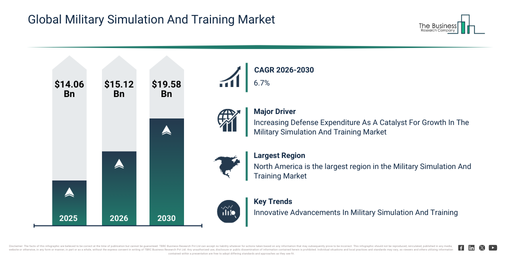
The military simulation and training market size has demonstrated robust growth in recent years. It is forecast to expand from $14.06 billion in 2025 to $15.12 billion in 2026, at a compound annual growth rate (CAGR) of 7.5%. The expansion witnessed in the past can be ascribed to the increasing adoption of virtual and constructive training environments by armed forces, the rising need to minimize operational costs tied to live training exercises, advancements in simulation hardware and software facilitating higher-fidelity military training, an increase in the procurement of complex military platforms that demand advanced simulation systems, and the early integration of simulation into pilot and vehicle crew training programs.
The military simulation and training market is projected to experience substantial expansion over the upcoming years, reaching $19.58 billion by 2030, driven by a compound annual growth rate (CAGR) of 6.7%. This anticipated growth during the forecast period is fueled by several factors, including the expansion of defense modernization initiatives that are boosting the demand for advanced simulation solutions. Additionally, the increasing application of artificial intelligence and data analytics is improving the realism of simulations and the accuracy of readiness assessments. A growing emphasis on interoperability and integrated joint-force training settings, along with the rising implementation of cloud-based and distributed simulation architectures, are also contributing. Furthermore, the surging demand for immersive technologies like augmented and virtual reality for mission rehearsal and operational training is a significant driver. Key trends expected during this period involve a greater uptake of virtual battlefields for real-time training and the incorporation of simulation technology into initial (ab-initio) training. There will also be a heightened focus on mission rehearsal and scenario-based training, an increasing need for multi-domain training platforms covering land, air, and maritime operations, and a general move towards more cost-effective and labor-efficient training methodologies.
Get A Free Sample Report With In-Depth Market Insights:
Military Simulation And Training Market Growth Catalysts And Demand Drivers
Elevated defense spending is projected to advance the expansion of the military simulation and training market. Defense expenditure refers to the funds allocated by governments for military measures or resources. This spending is escalating due to increasing security threats, including violent extremism and separatist insurgencies, which mandate effective military training, specifically synthetic or virtual training, known for its numerous advantages. For example, in April 2024, the Stockholm International Peace Research Institute, a Sweden-based international institute, indicated that global military spending in 2023 saw a real-term increase of 6.8% to $2443 billion when compared to 2022. Consequently, the rising defense expenditure is set to propel the growth of the military simulation and training market.
Military Simulation And Training Market Segment Breakdown: Which Categories Lead On Revenue?
The military simulation and training market covered in this report is segmented –
1) By Type: Live, Virtual, Constructive
2) By Environment: Synthetic, Gaming
3) By Technology: IoT (Internet Of Things), 5G (5th Generation Mobile Network), Big Data Analytics, Artificial Intelligence, Cloud Computing And Master Data Management, AR (Augmented Reality) And VR (Virtual Reality), Digital Twin, Robotic Process Automation
4) By Platform: Land, Maritime, Airborne
5) By Application: Army, Aviation, Naval
Subsegments:
1) By Live: Field Training Exercises, Joint Exercises, Combat Training Centers
2) By Virtual: Desktop-Based Training, Full Mission Simulators, Virtual Environments And Serious Games
3) By Constructive: Command And Staff Training, Tactical Decision-Making Exercises, War Games And Operational Planning Simulations
Military Simulation And Training Market Trends Shaping Long-Term Demand
Leading companies operating in the military simulation and training market are developing innovative virtual battle space (VBS) products to achieve larger customer bases, increase sales, and boost revenue. Virtual Battle Space (VBS) products refer to a suite of military simulation and training software. For instance, in June 2023, Bohemia Interactive Simulations (BISim), a US-based training and simulation software company, launched VBS4 and VBS Blue IG. VBS4 stands out as an accessible and comprehensive virtual and constructive simulation host, offering seamless support for a diverse array of military-specific training and mission rehearsal applications across the entire globe. On the other hand, VBS Blue IG distinguishes itself as a high-performance, CIGI-compliant, 3D whole-earth image generator specifically crafted to cater to a wide spectrum of use cases, encompassing land, sea, air, and space scenarios. The latest versions, VBS4 and VBS Blue IG 23.1, come equipped with numerous new features, enhancements in user-friendliness, and performance improvements. These updates are readily accessible for download through the customer portal. Significant features introduced in VBS4 version 23.1 include customizable radio antennas, damage charring, a redesigned mission briefing, a fresh weather panel, and various other enhancements.
Military Simulation And Training Market Leading Players And Competitive Positioning
Major companies operating in the military simulation and training market are BAE Systems PLC, Cubic Corporation, FAAC Incorporated, Israel Aerospace Industries Ltd., L-3 Communications Holdings Inc., Lockheed Martin Corporation, Meggitt PLC, Northrop Grumman Corporation, Raytheon Technologies, Rheinmetall AG, Rockwell Collins Inc., SAAB AB, Textron Inc., Thales Group, Aechelon Technology Inc., Antycip Simulation, Barco NV, Bohemia Interactive Simulations, CAE Inc., DiSTI Corporation, Elbit Systems Ltd., Epic Games Inc., General Dynamics Corporation, Intelligent Decisions Inc., Presagis Canada Inc., Quantum3D Inc., Scalable Display Technologies, SimCentric Technologies Pty Ltd., Unity Technologies, Virtual Heroes Inc., MAK Technologies
View The Full Military Simulation And Training Market Report:
Military Simulation And Training Market Top Region By Revenue And Market Share
North America was the largest region in the military simulation and training market in 2025. The regions covered in the military simulation and training market report are Asia-Pacific, South East Asia, Western Europe, Eastern Europe, North America, South America, Middle East, Africa.
Reach Out To Our Team:
The Business Research Company: https://www.thebusinessresearchcompany.com/
Americas: +1 310-496-7795
Asia: +44 7882 955267 & +91 8897263534
Europe: +44 7882 955267
Email us at: marketing@tbrc.info
Follow us on:
LinkedIn: https://in.linkedin.com/company/the-business-research-company
YouTube: https://www.youtube.com/channel/UC24_fI0rV8cR5DxlCpgmyFQ
Global Market Model: https://www.thebusinessresearchcompany.com/global-market-model

Wasay has over a decade of experience in market research, data modelling, and analytics, with prior experience at GlobalData and Decision Tree Consulting Services. At The Business Research Company , he leads research operations across syndicated studies, customized consulting engagements, and the Global Market Model platform. His professional experience includes supporting organizations such as Boston Consulting Group, KPMG, and Ernst & Young. Wasay holds a degree in Electronics and Communications Engineering, postgraduate management qualifications from International Management Institute Belgium and Indian School of Business and Entrepreneurship, and completed the Integrated Program in Business Analytics from Indian Institute of Management Indore.
