
Enhanced with market attractiveness analysis, total addressable market evaluation, company benchmarking matrices, interactive Excel dashboards, expanded supply chain intelligence, emerging startup coverage, and detailed product insights, The Business Research Company’s 2026 market reports deliver more actionable and strategically valuable research.
Military Simulation And Training Market Growth From $15.11 Billion In 2026 To $19.58 Billion By 2030 At A CAGR Of 6.69%
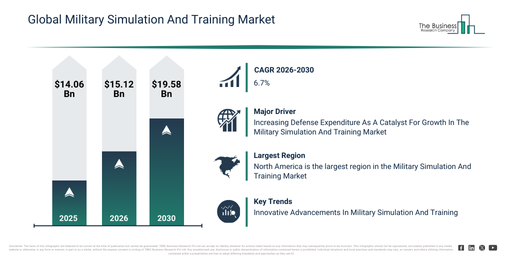
The military simulation and training market has experienced robust expansion over the past few years. Projections indicate its size will increase from $14.06 billion in 2025 to $15.12 billion in 2026, demonstrating a compound annual growth rate (CAGR) of 7.5%. This historical growth is primarily attributable to several factors, including the increasing integration of virtual and constructive training environments by armed forces, a growing imperative to minimize operational expenditures linked to live training activities, advancements in simulation hardware and software facilitating more realistic military training, an increase in the acquisition of intricate military platforms that necessitate sophisticated simulation systems, and the early incorporation of simulation into pilot and vehicle crew training curricula.
The military simulation and training market is anticipated to expand considerably in the upcoming years, reaching a valuation of $19.58 billion by 2030, demonstrating a compound annual growth rate (CAGR) of 6.7%. This growth over the forecast period is primarily driven by the expansion of defense modernization initiatives necessitating next-generation simulation solutions, the increasing application of artificial intelligence and data analytics to enhance simulation realism and readiness assessments, a rising focus on interoperability and joint-force training environments, the growing adoption of cloud-based and distributed simulation architectures, and an escalating demand for immersive technologies such as augmented and virtual reality for mission rehearsal and operational training. Notable trends expected during this period include a greater embrace of virtual battlefields for real-time training, the integration of simulation technology in ab-initio training, a strong emphasis on mission rehearsal and scenario-based training, the demand for multi-domain training platforms (land, air, maritime), and a shift towards more cost and labor-efficient training solutions.
Download A Free Sample Report For Comprehensive Market Insights:
Military Simulation And Training Market Growth Momentum: Which Factors Are Influencing Demand?
The escalation in defense expenditure is poised to drive the growth of the military simulation and training market. Defense expenditure refers to the financial outlay by a government on military assets or measures. This spending is on the rise due to evolving security threats, such as violent extremism and separatist insurgencies, which demand effective military training methods, including synthetic or virtual training, offering numerous advantages. For instance, in April 2024, data from the Stockholm International Peace Research Institute, a Sweden-based international institute, revealed that global military spending in 2023 increased by 6.8% in real terms, reaching $2443 billion compared to 2022. Therefore, the upward trend in defense expenditure is anticipated to foster the expansion of the military simulation and training market.
Military Simulation And Training Market Segments: Where Are The Largest Growth Opportunities?
The military simulation and training market covered in this report is segmented –
1) By Type: Live, Virtual, Constructive
2) By Environment: Synthetic, Gaming
3) By Technology: IoT (Internet Of Things), 5G (5th Generation Mobile Network), Big Data Analytics, Artificial Intelligence, Cloud Computing And Master Data Management, AR (Augmented Reality) And VR (Virtual Reality), Digital Twin, Robotic Process Automation
4) By Platform: Land, Maritime, Airborne
5) By Application: Army, Aviation, Naval
Subsegments:
1) By Live: Field Training Exercises, Joint Exercises, Combat Training Centers
2) By Virtual: Desktop-Based Training, Full Mission Simulators, Virtual Environments And Serious Games
3) By Constructive: Command And Staff Training, Tactical Decision-Making Exercises, War Games And Operational Planning Simulations
Military Simulation And Training Market Industry Trends: What Changes Are Reshaping Demand?
Leading firms within the military simulation and training market are creating cutting-edge solutions, including virtual battle space (VBS) products, aimed at expanding their customer reach, boosting sales, and growing revenue. VBS products encompass a collection of software tailored for military simulation and training. For example, in June 2023, Bohemia Interactive Simulations (BISim), a US-headquartered training and simulation software provider, introduced VBS4 and VBS Blue IG. VBS4 is notable as an approachable and extensive virtual and constructive simulation platform, providing consistent support for a wide range of military training and mission rehearsal uses worldwide. Conversely, VBS Blue IG is recognized as a high-performance, CIGI-compliant, 3D global image generator specifically designed for numerous applications across land, sea, air, and space environments. The updated versions, VBS4 and VBS Blue IG 23.1, incorporate many new features, improved usability, and better performance. These advancements are readily available for download via the customer portal. Key functionalities added in VBS4 version 23.1 include customizable radio antennas, damage charring, a revamped mission briefing, a new weather panel, among other improvements.
Military Simulation And Training Market Major Participants And Competitive Dynamics
Major companies operating in the military simulation and training market are BAE Systems PLC, Cubic Corporation, FAAC Incorporated, Israel Aerospace Industries Ltd., L-3 Communications Holdings Inc., Lockheed Martin Corporation, Meggitt PLC, Northrop Grumman Corporation, Raytheon Technologies, Rheinmetall AG, Rockwell Collins Inc., SAAB AB, Textron Inc., Thales Group, Aechelon Technology Inc., Antycip Simulation, Barco NV, Bohemia Interactive Simulations, CAE Inc., DiSTI Corporation, Elbit Systems Ltd., Epic Games Inc., General Dynamics Corporation, Intelligent Decisions Inc., Presagis Canada Inc., Quantum3D Inc., Scalable Display Technologies, SimCentric Technologies Pty Ltd., Unity Technologies, Virtual Heroes Inc., MAK Technologies
Access The Complete Military Simulation And Training Market Report:
Military Simulation And Training Market Largest Region By Revenue And Market Share
North America was the largest region in the military simulation and training market in 2025. The regions covered in the military simulation and training market report are Asia-Pacific, South East Asia, Western Europe, Eastern Europe, North America, South America, Middle East, Africa.
Access a Customized Military Simulation And Training Market Report for Deeper Competitive Insights
https://www.thebusinessresearchcompany.com/customise?id=8179&type=smp
The Business Research Company: https://www.thebusinessresearchcompany.com/
Americas: +1 310-496-7795
Asia: +44 7882 955267 & +91 8897263534
Europe: +44 7882 955267
Email us at: marketing@tbrc.info
Follow us on:
LinkedIn: https://in.linkedin.com/company/the-business-research-company
YouTube: https://www.youtube.com/channel/UC24_fI0rV8cR5DxlCpgmyFQ
Global Market Model: https://www.thebusinessresearchcompany.com/global-market-model

Wasay has over a decade of experience in market research, data modelling, and analytics, with prior experience at GlobalData and Decision Tree Consulting Services. At The Business Research Company , he leads research operations across syndicated studies, customized consulting engagements, and the Global Market Model platform. His professional experience includes supporting organizations such as Boston Consulting Group, KPMG, and Ernst & Young. Wasay holds a degree in Electronics and Communications Engineering, postgraduate management qualifications from International Management Institute Belgium and Indian School of Business and Entrepreneurship, and completed the Integrated Program in Business Analytics from Indian Institute of Management Indore.
