Through market attractiveness analysis, total addressable market evaluation, company benchmarking matrices, interactive Excel dashboards, expanded supply chain intelligence, emerging startup coverage, and detailed product insights, The Business Research Company’s 2026 market reports provide more actionable and strategically valuable research.
Remote Sensing Satellite Market Growth Analysis: How Will Revenue Expand During The Forecast Period?
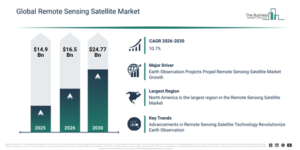
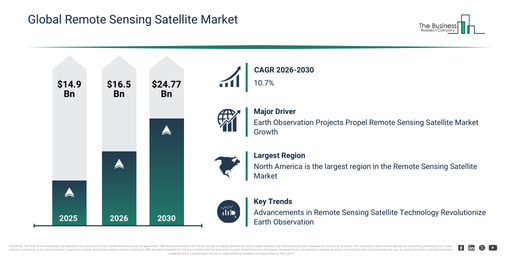
The remote sensing satellite market size has experienced swift expansion in recent years. It is projected to grow from $14.9 billion in 2025 to $16.5 billion in 2026, demonstrating a compound annual growth rate (CAGR) of 10.8%. This historical growth can be ascribed to a number of factors, including the escalating demand for earth observation and environmental monitoring, technological innovations in multispectral and hyperspectral sensors, government funding for space programs and satellite launches, the rising implementation of lidar and electromagnetic sensors for precise mapping, and the growth in agricultural and forestry monitoring applications utilizing remote sensing data.
The remote sensing satellite market size is anticipated to experience substantial growth in the upcoming years. It is projected to expand to $24.77 billion by 2030, showing a compound annual growth rate (CAGR) of 10.7%. This expansion during the forecast period is attributable to the increasing deployment of high-resolution and constellation remote sensing satellites, the incorporation of AI and machine learning for data analysis and predictive modeling, a heightened commercial need for geospatial intelligence and analytics, the creation of economical small and medium satellites for remote sensing, and the rising application of remote sensing satellites for climate change surveillance and disaster management. Significant developments expected in this period encompass the miniaturization of satellite sensors, the demand for high-resolution imaging, an uptick in government space programs, the enlargement of private space companies, and the integration of multi-sensor payloads.
Download A Free Sample Report For Comprehensive Market Insights:
#Remote Sensing Satellite Market Growth Factors: Which Forces Are Supporting Market Expansion?
The expanding scope of earth observation projects is anticipated to propel the remote sensing satellite market going forward. Earth observation projects are defined as initiatives or programs that utilize various technologies, such as satellites, aircraft, or ground-based sensors, to collect data and information concerning Earth’s surface, atmosphere, and oceans. Remote sensing satellites are vital for monitoring and assessing natural disasters including hurricanes, floods, wildfires, earthquakes, and tsunamis. They provide real-time or near-real-time imagery and data to assist in disaster response, evacuation planning, damage assessment, and recovery efforts. For instance, in January 2024, according to the Science of The Total Environment, a Netherland-based Peer-reviewed journal, the number of Earth Observation (EO) satellites has grown exponentially over the past decade, reaching a total of 1,193 as of January 2023. Consequently, the increase in earth observation projects is driving the growth of the remote sensing satellite market.
Remote Sensing Satellite Market Segment Analysis: What Are The Major Market Categories?
The remote sensing satellite market covered in this report is segmented –
1) By Type: Space-Based Radars, Space-Based Electro-Optical And Infrared (EO/IR)
2) By Payload: Less Than 500 Kg, 500 Kg To 1,000 Kg, Above 1,000 Kg
3) By Application: Agricultural And Soil Studies, Natural Resources Monitoring And Conservation, Cartography, Geology And Mineral Resources Mapping, Meteorology And Oceanic Studies, Other Applications
4) By End Use: Civil, Military, Government, Others End Uses
Subsegments:
1) By Space-Based Radars: Synthetic Aperture Radar (SAR), Ground Penetrating Radar (GPR), Weather and Environmental Monitoring Radars, Earth Observation and Surveillance Radars
2) By Space-Based Electro-Optical and Infrared (EO/IR): Electro-Optical Imaging Satellites, Infrared Sensing Satellites, Thermal and Multispectral Imaging Satellites
Remote Sensing Satellite Market Trends Reshaping Industry Growth
Leading companies within the remote sensing satellite market are increasingly concentrating on developing innovative products, such as earth observation nanosatellites, to secure a competitive advantage. Earth observation nanosatellites are compact satellites engineered for monitoring and gathering data concerning Earth’s surface, atmosphere, and oceans. For instance, in June 2023, Azista BST Aerospace Pvt. Ltd., an aerospace firm based in India, introduced the ABA First Runner (AFR), a remote sensing satellite designed to capture panchromatic images with a 5-meter resolution and a 70-kilometer swath. Weighing 80 kg, its objective is to provide remote sensing data to clients mainly in Southeast Asia and India, targeting strategic and agricultural sectors. The information gathered will support agriculture, forestry, water management, mining, maritime operations, and defense applications. These technological improvements boost satellite performance, allowing for more precise and thorough data collection, thereby extending its utility across various industries and applications.
Remote Sensing Satellite Market Leading Companies Driving Competitive Growth
Major companies operating in the remote sensing satellite market are Raytheon Technologies Corporation, The Boeing Company, Lockheed Martin Corporation, Airbus SE, Northrop Grumman, Mitsubishi Electric Corporation, Thales Group, L3Harris Technologies Inc., BALL CORPORATION, Hexagon AB, General Dynamics Mission Systems Inc., Maxar Technologies Inc., Environmental Systems Research Institute Inc.(Esri), AABSyS IT Pvt. Ltd, Planet Labs Inc., Orbital Insight, BlackSky Global LLC, Satellite Imaging Corporation, Mallon Technology, Antrix Corporation, Geo Sense, Remote Sensing Solutions GmbH, ImageSat International N.V.
Access The Complete Remote Sensing Satellite Market Report:
Remote Sensing Satellite Market Geographic Landscape: Which Region Dominates Industry Growth?
North America was the largest region in the remote sensing satellite market in 2025. Asia-Pacific is expected to be the fastest-growing region in the forecast period. The regions covered in the remote sensing satellite market report are Asia-Pacific, South East Asia, Western Europe, Eastern Europe, North America, South America, Middle East, Africa.
Access a Customized Remote Sensing Satellite Market Report for Deeper Competitive Insights
https://www.thebusinessresearchcompany.com/customise?id=14469&type=smp
The Business Research Company: https://www.thebusinessresearchcompany.com/
Americas: +1 310-496-7795
Asia: +44 7882 955267 & +91 8897263534
Europe: +44 7882 955267
Email us at: marketing@tbrc.info
Follow us on:
LinkedIn: https://in.linkedin.com/company/the-business-research-company
YouTube: https://www.youtube.com/channel/UC24_fI0rV8cR5DxlCpgmyFQ
Global Market Model: https://www.thebusinessresearchcompany.com/global-market-model

Wasay has over a decade of experience in market research, data modelling, and analytics, with prior experience at GlobalData and Decision Tree Consulting Services. At The Business Research Company , he leads research operations across syndicated studies, customized consulting engagements, and the Global Market Model platform. His professional experience includes supporting organizations such as Boston Consulting Group, KPMG, and Ernst & Young. Wasay holds a degree in Electronics and Communications Engineering, postgraduate management qualifications from International Management Institute Belgium and Indian School of Business and Entrepreneurship, and completed the Integrated Program in Business Analytics from Indian Institute of Management Indore.