Featuring market attractiveness scoring, total addressable market sizing, company benchmarking matrices, interactive Excel dashboards, deeper supply chain intelligence, emerging startup tracking, and granular product-level insights, The Business Research Company’s 2026 market reports are built to deliver research that is both more actionable and more strategically valuable.
Reusable Rocket Component Testing Market Size Forecast: How Big Could The Market Get By 2030?
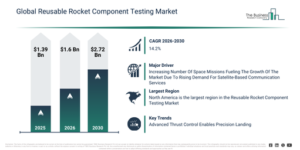
The reusable rocket component testing market size has experienced substantial growth in recent years. It is anticipated to expand from $1.39 billion in 2025 to $1.6 billion in 2026, exhibiting a compound annual growth rate (CAGR) of 15.1%. This historical expansion is attributable to several factors, including the increasing adoption of reusable rocket architectures, which has driven demand for component durability testing. Other contributors are the rising application of thermal resistance analysis to validate heat-shield and engine performance, greater reliance on vibration and shock testing to ensure structural integrity across numerous flights, the early integration of non-destructive evaluation methods for detecting micro-damage in reusable parts, and the expansion of post-flight inspection and diagnostics as the frequency of reusable launches increased.
The reusable rocket component testing market is projected to experience substantial growth in the upcoming years, reaching $2.72 billion by 2030, demonstrating a compound annual growth rate (CAGR) of 14.2%. This anticipated expansion over the forecast period is driven by several factors, including an increasing need for sophisticated reusability performance assessments to extend the operational lifespan of components, a greater integration of AI-enabled diagnostics for predicting component degradation prior to failure, a rising requirement for improved avionics and software testing within reusable booster systems, the broadening scope of testing protocols for advanced thermal protection systems and landing gear, and technological advancements that enable automated, high-fidelity testing environments to accelerate reuse certification processes. Significant trends during this period are expected to encompass a heightened emphasis on characterizing lifecycle wear and fatigue, an expansion in swift post-flight inspection services, a growing adoption of non-destructive evaluation and cutting-edge NDE techniques, an increase in avionics and software-in-loop reusability testing, and the establishment of standardized reusability metrics and certification protocols.
Get A Free Sample Report With In-Depth Market Insights:
Reusable Rocket Component Testing Market Growth Factors: What’s Supporting Expansion?
A rise in space missions is anticipated to fuel the expansion of the reusable rocket component testing market in the future. These missions involve planned activities outside Earth’s atmosphere, utilizing spacecraft or satellites for exploration, research, communication, observation, or defense. The uptick in space missions stems from an escalating demand for satellite communication services, driven by the global need for high-speed internet, remote access, and data transfer. By verifying the reliability and endurance of essential parts over multiple launches, reusable rocket component testing significantly improves space missions. This practice lowers mission expenses and reduces turnaround periods by validating components for reusability, thereby boosting operational efficiency and sustainability. As an illustration, a report from the US-based non-profit organization, Space Foundation, indicated in January 2025 that orbital launch attempts climbed by 16% in 2024, totaling 259 launches, equating to one launch every 34 hours, which marked a frequency five hours greater than in 2023. Consequently, the growing volume of space missions is a key factor propelling the expansion of the reusable rocket component testing market.
Reusable Rocket Component Testing Market Segment Performance And Emerging Opportunities
The reusable rocket component testing market covered in this report is segmented –
1) By Component Type: Engines, Fuel Tanks, Avionics, Landing Gear, Other Component Types
2) By Testing Type: Structural Testing, Propulsion Testing, Environmental Testing, Other Testing Types
3) By Application: Commercial, Military, Scientific
4) By End-User: Space Agencies, Private Space Companies, Research Institutions
Subsegments:
1) By Engine: Main Combustion Chamber, Turbopumps, Nozzles, Ignition Systems
2) By Fuel Tank: Cryogenic Tanks, Pressurant Tanks, Composite Overwrapped Pressure Vessels (COPVs), Insulation Systems
3) By Avionics: Flight Control Systems, Telemetry Systems, Navigation Systems, Power Distribution Units
4) By Landing Gear: Shock Absorbers, Retractable Legs, Actuators, Touchdown Sensors
5) By Other Component Types: Thermal Protection Systems, Fairings, Structural Frames, Separation Mechanisms
Reusable Rocket Component Testing Market Industry Trends: What’s Reshaping Demand?
Leading companies in the reusable rocket component testing market are dedicated to creating advanced solutions, such as reusable rocket landing tests, designed to confirm the performance and longevity of critical components like engines, landing legs, and control systems under authentic flight conditions. A reusable rocket landing test assesses a rocket’s capacity to return and land securely post-launch, thereby guaranteeing its structural integrity and functionality for multiple reuse cycles. For example, in June 2025, Honda R&D Co. Ltd., a Japan-based research company, successfully completed its inaugural launch and landing test of an experimental reusable rocket. This test highlighted sophisticated thrust control and accurate landing capabilities, capitalizing on Honda’s expertise in propulsion and automation technologies. The system integrates real-time adaptive control algorithms to ensure a stable descent and touchdown, substantially diminishing the risk of component failure during subsequent missions. This innovation intends to decrease operational expenses and bolster sustainability in space exploration by allowing the reuse of vital rocket components.
Reusable Rocket Component Testing Market Key Players: Which Companies Lead Industry Competition?
Major companies operating in the reusable rocket component testing market are The Boeing Company, Lockheed Martin Corporation, Northrop Grumman Corporation, Blue Origin Enterprises L.P., ArianeGroup SAS, Honda R&D Co. Ltd., Sierra Nevada Company LLC, Relativity Space Inc., iSpace (Beijing) Technology Co. Ltd., Rocket Lab USA Inc., Firefly Aerospace Inc., Gilmour Space Technologies Pty Ltd., Rocket Factory Augsburg AG, Deep Blue Aerospace Technology Co. Ltd., Pangea Aerospace SL, Equatorial Space Systems Pty Ltd., Hypersonix Launch Systems Pty Ltd., LinkSpace Technology Co. Ltd., PLD Space SL, Skyrora Ltd., Isar Aerospace GmbH.
View The Full Reusable Rocket Component Testing Market Report:
Reusable Rocket Component Testing Market Regional Breakdown: Where Is Demand Concentrated?
North America was the largest region in the reusable rocket component testing market in 2025. The regions covered in the reusable rocket component testing market report are Asia-Pacific, South East Asia, Western Europe, Eastern Europe, North America, South America, Middle East, Africa.
Reach Out To Our Team:
The Business Research Company: https://www.thebusinessresearchcompany.com/
Americas: +1 310-496-7795
Asia: +44 7882 955267 & +91 8897263534
Europe: +44 7882 955267
Email us at: marketing@tbrc.info
Follow us on:
LinkedIn: https://in.linkedin.com/company/the-business-research-company
YouTube: https://www.youtube.com/channel/UC24_fI0rV8cR5DxlCpgmyFQ
Global Market Model: https://www.thebusinessresearchcompany.com/global-market-model

Wasay has over a decade of experience in market research, data modelling, and analytics, with prior experience at GlobalData and Decision Tree Consulting Services. At The Business Research Company , he leads research operations across syndicated studies, customized consulting engagements, and the Global Market Model platform. His professional experience includes supporting organizations such as Boston Consulting Group, KPMG, and Ernst & Young. Wasay holds a degree in Electronics and Communications Engineering, postgraduate management qualifications from International Management Institute Belgium and Indian School of Business and Entrepreneurship, and completed the Integrated Program in Business Analytics from Indian Institute of Management Indore.