Backed by market attractiveness analysis, total addressable market sizing, company benchmarking matrices, interactive Excel dashboards, wider supply chain intelligence, emerging startup coverage, and detailed product-level insights, The Business Research Company’s 2026 market reports are designed to offer research that is more actionable and strategically valuable than ever.
Rice Husk Ash Market Value Analysis: What Growth Lies Ahead Over The Forecast Period?
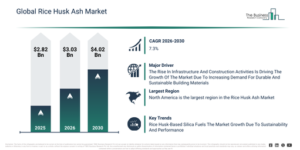
The rice husk ash market has experienced significant expansion in recent years. It is anticipated to increase from $2.82 billion in 2025 to $3.03 billion in 2026, demonstrating a compound annual growth rate (CAGR) of 7.4%. Historically, this growth has stemmed from several key factors: the expanding use of rice husk ash as a supplementary cementitious material in construction, the rising production of silica powder obtained from controlled combustion of rice husks, the increased adoption of RHA-based soil stabilizers in agricultural and rural infrastructure projects, the wider application of refractories incorporating RHA for enhanced thermal resistance, and the early utilization of RHA as a cost-effective industrial byproduct, thereby alleviating waste disposal challenges.
The rice husk ash market is projected to experience substantial expansion over the coming years. It is anticipated to reach $4.02 billion in 2030, exhibiting a compound annual growth rate (CAGR) of 7.3%. This anticipated growth during the forecast timeframe is attributable to several factors, including a surging demand for low-carbon cement additives, propelled by sustainability regulations, along with the increasing integration of high-purity RHA silica into advanced industrial uses. Further contributing factors include the expanding application of RHA in environmentally friendly construction materials and for green building certifications, the proliferation of RHA-based soil stabilization solutions within climate-resilient infrastructure initiatives, and improvements in technology enhancing combustion processes to yield consistent, premium-quality RHA. Key trends expected during this period encompass a greater utilization of high-purity RHA in green cement manufacturing, the rising incorporation of RHA in lightweight insulation products, its increasing role as a supplementary pozzolanic component, the broadening availability of RHA-based soil stabilization items, and the enhanced commercialization of high-silica RHA for various industrial additives.
Get A Free Sample Report With In-Depth Market Insights:
Rice Husk Ash Market Industry Drivers: What’s Behind The Revenue Growth?
The future expansion of the rice husk ash market is anticipated to be driven by rising infrastructure and construction endeavors. These activities encompass the design, establishment, and execution of various physical developments, including roads, bridges, structures, and essential public services, which are vital for societal and economic advancement. This increase in infrastructure and construction is a direct result of rapid urbanization, leading to an escalated need for residential spaces, transport networks, and utility services. Rice husk ash contributes positively to infrastructure and construction projects by offering an environmentally friendly and economical substitute for cement, thereby boosting the strength and longevity of concrete constructions. A case in point is the data from July 2023, reported by the Australian Bureau of Statistics, an Australian government body, indicating a rise in the count of dwellings being built, from 240,156 in March 2022 to 240,813 by the March quarter of 2023. Consequently, the expansion of infrastructure and construction initiatives is fueling the growth of the rice husk ash market.
Rice Husk Ash Market Segment Analysis Spotlighting Growth Areas
The rice husk ash market covered in this report is segmented –
1) By Product Type: Silica, Carbon, Other Product Types
2) By Process: Alkaline Extraction Method For Silica Gel, Silica Gel Extraction By Sol-Gel Method, Participated Silica Extraction Method, Mesoporous Silica Extraction Method
3) By Application: Concrete, Fertilizer, Ceramics, Additive, Oil Adsorbent, Insulation Material, Silicon Chips, Fuel, Rubber, Other Applications
4) By Distribution Channel: Direct Sales, Distributors, Online Sales
5) By End-Use Industry: Metallurgy, Oil And Gas, Building And Construction, Agriculture, Electrical And Electronics, Transportation, Other End-Uses
Subsegments:
1) By Silica: Amorphous Silica, Crystalline Silica, Silica Gel, Mesoporous Silica
2) By Carbon: Activated Carbon, Carbon Black, Carbon Nanotubes
3) By Other Product Types: Ash-Based Fertilizers, Pozzolanic Materials, Miscellaneous Mineral Compounds
#Rice Husk Ash Market Growth Trends: What’s Shaping The Future Outlook?
Leading companies within the rice husk ash market are prioritizing the development of innovative solutions, such as bio-based highly dispersible silica, to enhance sustainability and performance across various industrial applications. This type of highly dispersible silica, derived from renewable sources like rice husk, offers an eco-friendly option designed for easy integration into products such as tires, coatings, and plastics. For instance, in January 2023, Solvay, a specialty chemicals company from Belgium, introduced its bio-circular highly dispersible silica (HDS) product line at its Livorno, Italy site. This sustainable silicate is produced utilizing bio-based sodium silicate sourced from rice husk ash, employs a circular process that gives waste rice husks a second use, and incorporates renewable energy to decrease CO2 emissions per ton of silica by roughly 50%. The resulting high-performance HDS not only matches or surpasses conventional precipitated silica in uses like tires, personal care, and feed but also substantially lowers its environmental footprint through the use of lower-carbon feedstocks and energy.
Rice Husk Ash Market Leading Companies: Who Holds The Strongest Market Presence?
Major companies operating in the rice husk ash market are Yihai Kerry Investments Co. Ltd., Bisley And Company, Deelert Co. Ltd., Steelcon Industries Pvt. Ltd., Refratechnik Italia S.r.L., Rescon India Pvt. Ltd., Usher Agro Ltd., Astrra Chemicals, M.G. Industries, Global Recycling GmbH, B.D. Agrotech Pvt Ltd, Brisil Technologies Private Limited, Guru Metachem Pvt. Ltd., Jasoriya Rice Mill, Milin Environmental Inc, N K Enterprises, Pioneer Carbon Company Private Limited, J.M. Biotech Pvt Ltd, K V Metachem, Refsteel Solutions Private Limited,
View The Full Rice Husk Ash Market Report:
Rice Husk Ash Market Top Region: Where Does Most Revenue Come From?
North America was the largest region in the rice husk ash market in 2025. Asia-Pacific is expected to be the fastest-growing region in the forecast period. The regions covered in the rice husk ash market report are Asia-Pacific, South East Asia, Western Europe, Eastern Europe, North America, South America, Middle East, Africa.
Reach Out To Our Team:
The Business Research Company: https://www.thebusinessresearchcompany.com/
Americas: +1 310-496-7795
Asia: +44 7882 955267 & +91 8897263534
Europe: +44 7882 955267
Email us at: marketing@tbrc.info
Follow us on:
LinkedIn: https://in.linkedin.com/company/the-business-research-company
YouTube: https://www.youtube.com/channel/UC24_fI0rV8cR5DxlCpgmyFQ
Global Market Model: https://www.thebusinessresearchcompany.com/global-market-model

Wasay has over a decade of experience in market research, data modelling, and analytics, with prior experience at GlobalData and Decision Tree Consulting Services. At The Business Research Company , he leads research operations across syndicated studies, customized consulting engagements, and the Global Market Model platform. His professional experience includes supporting organizations such as Boston Consulting Group, KPMG, and Ernst & Young. Wasay holds a degree in Electronics and Communications Engineering, postgraduate management qualifications from International Management Institute Belgium and Indian School of Business and Entrepreneurship, and completed the Integrated Program in Business Analytics from Indian Institute of Management Indore.