With a focus on actionable insights and strategic value, The Business Research Company’s 2026 market reports include market attractiveness scoring, total addressable market sizing, company benchmarking matrices, interactive Excel dashboards, deeper supply chain intelligence, emerging startup tracking, and granular product-level insights.
Rocket Engine Combustion Chambers Market Size Outlook: A $1.79 Billion Market By 2030, Growing At 7.5% Annually
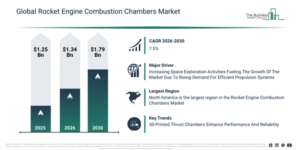
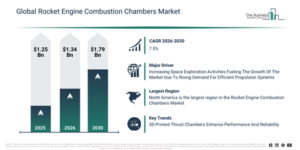
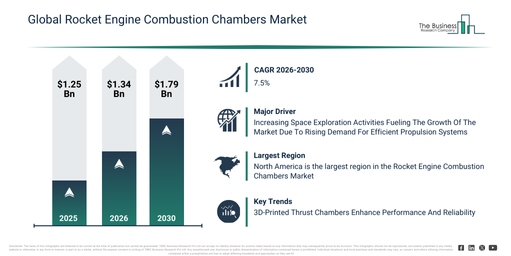
The rocket engine combustion chambers market size has experienced considerable expansion in recent years. Its size is projected to increase from $1.25 billion in 2025 to $1.34 billion in 2026, exhibiting a compound annual growth rate (CAGR) of 7.2%. The historical growth can be ascribed to several factors: advancements in high-temperature alloys leading to more durable combustion chambers, a rise in government space missions boosting the demand for thrust chamber assemblies, the development of regenerative cooling systems to handle extreme thermal loads, the initial implementation of precision injector plates to improve combustion efficiency, and the expansion of liquid propulsion programs requiring advanced chamber liners and ablative materials.
The rocket engine combustion chambers market is anticipated to show significant expansion in the upcoming years. It is predicted to reach $1.79 billion in 2030, demonstrating a compound annual growth rate (CAGR) of 7.5%. This growth over the forecast period can be attributed to the rise of reusable launch vehicles, which increases the need for long-life combustion chamber materials; advances in additive manufacturing, enabling intricate chamber geometries and cost reduction; increasing commercial launch activities, driving demand for scalable combustion chamber production; innovations in composite thermal protection materials, improving performance and reliability; and expanding deep-space and high-thrust mission profiles, requiring next-generation injector and chamber technologies. Major developments during this period are expected to include the use of advanced high-temperature alloys and ceramic matrix composites, additive manufacturing (metal 3D printing) for thrust chambers, supply-chain localization and dual-sourcing for critical components, reusable launch vehicle engine optimization and life-extension programs, as well as tightening export controls and prioritized defense procurement.
Make Data-Driven Decisions With A Free Rocket Engine Combustion Chambers Market Sample Report:
Key Demand Driver Expected To Lift Rocket Engine Combustion Chambers Market Revenue
The rocket engine combustion chambers market is projected to experience growth in the future due to the increasing volume of space exploration activities. These activities encompass the pursuit of scientific discovery, technological advancement, and commercial opportunities beyond Earth, facilitated by missions, research, and space-based operations. The expansion of space exploration is driven by a rising demand for advanced communication and Earth observation satellites, which are crucial for global connectivity, environmental monitoring, and improved security. Rocket engine combustion chambers are instrumental in supporting space exploration by providing efficient propulsion, making them indispensable for both launch vehicles and spacecraft. They are engineered to endure extreme conditions to deliver reliable thrust, thereby improving mission success and broadening access to space. For instance, in September 2023, Novaspace, a France-based consulting firm specializing in the space industry, stated that global government spending on space exploration reached $26 billion in 2023 and is anticipated to rise to nearly $33 billion by 2032. Thus, the increasing space exploration activities are a significant impetus for the growth of the rocket engine combustion chambers market.
Exploring The Rocket Engine Combustion Chambers Market Through Its Key Segments
The rocket engine combustion chambers market covered in this report is segmented –
1) By Engine Type: Liquid Rocket Engines, Solid Rocket Engines, Hybrid Rocket Engines
2) By Material Type: Nickel Alloys, Titanium Alloys, Stainless Steel, Other Material Types
3) By Application: Space Launch Vehicles, Missiles, Satellites, Other Applications
4) By End User: Aerospace And Defense, Commercial Space, Other End Users
Subsegments:
1) By Liquid Rocket Engines: Pressure-Fed Engines, Pump-Fed Engines, Cryogenic Engines, Hypergolic Engines, Bipropellant Engines
2) By Solid Rocket Engines: Single-Stage Solid Motors, Multi-Stage Solid Motors, Tactical Solid Motors, Boosters
3) By Hybrid Rocket Engines: Monopropellant-Based Hybrids, Bipropellant-Based Hybrids, Paraffin-Based Hybrids, Nitrous Oxide-Based Hybrids
New Trends Redefining Competition In The Rocket Engine Combustion Chambers Market
Companies operating in the rocket engine combustion chambers market are primarily focused on developing advanced products, such as 3D-printed thrust chambers, to boost manufacturing efficiency, lessen part complexity, and sustain optimal performance under extreme conditions. These 3D-printed thrust chambers refer to rocket engine combustion chambers produced using additive manufacturing techniques, which facilitate complex geometries, a lower part count, and enhanced cooling efficiency. For example, in November 2024, L3Harris Technologies Inc., a US-based aerospace and defense corporation, launched the RL10E-1 rocket engine. The RL10E-1 incorporates a fully 3D-printed copper thrust chamber with 98% fewer components, offering improved performance, quicker production, and greater reliability. This engine is engineered to power the upper stage of United Launch Alliance’s Vulcan rocket, supporting both commercial and national security space missions.
Rocket Engine Combustion Chambers Market Competition: Key Players And Industry Participants
Major companies operating in the rocket engine combustion chambers market are RTX Corporation, Boeing Company, Lockheed Martin Corporation, Northrop Grumman Systems Corporation, Mitsubishi Heavy Industries Ltd., Safran Aircraft Engines SAS, IHI Corporation, Space Exploration Technologies Corp., Blue Origin LLC, Rafael Advanced Defense Systems Ltd., ArianeGroup SAS, Rocket Lab USA Inc., Gilmour Space Technologies Pty Ltd., Stoke Space Inc., Orbex Limited, Roscosmos State Space Corporation, Virgin Galactic LLC, Indian Space Research Organisation, ISRO Propulsion Complex, PLD Space S.L.
Get The Detailed Rocket Engine Combustion Chambers Market Research Report Here:
Rocket Engine Combustion Chambers Market Regional Overview: Largest Market And Global Coverage
North America was the largest region in the rocket engine combustion chambers market in 2025. The regions covered in the rocket engine combustion chambers market report are Asia-Pacific, South East Asia, Western Europe, Eastern Europe, North America, South America, Middle East, Africa.
Reach Out To Our Team:
The Business Research Company: https://www.thebusinessresearchcompany.com/
Americas: +1 310-496-7795
Asia: +44 7882 955267 & +91 8897263534
Europe: +44 7882 955267
Email us at: marketing@tbrc.info
Follow us on:
LinkedIn: https://in.linkedin.com/company/the-business-research-company
YouTube: https://www.youtube.com/channel/UC24_fI0rV8cR5DxlCpgmyFQ
Global Market Model: https://www.thebusinessresearchcompany.com/global-market-model

Wasay has over a decade of experience in market research, data modelling, and analytics, with prior experience at GlobalData and Decision Tree Consulting Services. At The Business Research Company , he leads research operations across syndicated studies, customized consulting engagements, and the Global Market Model platform. His professional experience includes supporting organizations such as Boston Consulting Group, KPMG, and Ernst & Young. Wasay holds a degree in Electronics and Communications Engineering, postgraduate management qualifications from International Management Institute Belgium and Indian School of Business and Entrepreneurship, and completed the Integrated Program in Business Analytics from Indian Institute of Management Indore.