With a focus on actionable insights and strategic value, The Business Research Company’s 2026 market reports include market attractiveness scoring, total addressable market sizing, company benchmarking matrices, interactive Excel dashboards, deeper supply chain intelligence, emerging startup tracking, and granular product-level insights.
Rocket Launch Site Recovery Market Size Snapshot: 2026 Valuation, 2030 Projection And Key Growth Factors
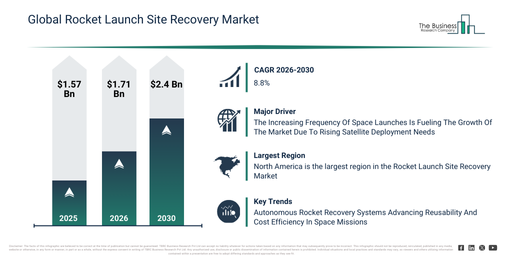
The rocket launch site recovery market has experienced robust expansion in recent years. This market is projected to expand from $1.57 billion in 2025 to $1.71 billion in 2026, demonstrating a compound annual growth rate (CAGR) of 9.1%. The historical growth of this market can be attributed to several key factors: the increasing adoption of reusable launch systems, which drives demand for post-launch recovery services; the development of pad refurbishment and cleaning procedures to restore launch sites after high-energy missions; the early integration of telemetry and sensor retrieval processes to support failure investigations and hardware reuse; the expansion of ground equipment inspection and maintenance operations improving launch site readiness; and the introduction of environmental remediation practices to manage debris and contamination after launches.
The rocket launch site recovery market is projected to experience robust expansion over the coming years. It will grow to $2.4 billion in 2030 at a compound annual growth rate (CAGR) of 8.8%. This anticipated growth stems from several factors, including an uptick in commercial launch frequency leading to a greater demand for swift recovery logistics. Furthermore, enhanced autonomous retrieval systems are boosting the efficiency of hardware recovery from both land and sea. The proliferation of reusable heavy-lift rockets necessitates more intricate structural integrity evaluations after landing. A rising focus on environmental sustainability is promoting wider acceptance of eco-friendly recovery methods, and the creation of integrated recovery management platforms is enabling synchronized coordination of operations at launch sites post-launch. Key trends identified for this period encompass the broadening of quick-turnaround launch site recovery procedures, an increase in marine and remote-area recovery capacities, and a growing embrace of protocols for retrieving reusable components. Additionally, there is a heightened focus on environmental remediation following launch activities and the incorporation of safety and hazard clearance teams into standard recovery operations.
Get A No-Cost Sample Of The Rocket Launch Site Recovery Market Study:
Major Factor Fueling The Rocket Launch Site Recovery Market Through 2030
The increasing frequency of space launches is projected to fuel the expansion of the rocket launch site recovery market moving forward. Space launches are defined as missions or occurrences where rockets are launched into space, typically to deploy satellites, transport cargo, or carry astronauts beyond Earth’s atmosphere. The heightened frequency of space launches is primarily driven by the escalating demand for satellite-based services like communication, earth observation, navigation, and broadband internet, which require the frequent deployment and replenishment of satellite constellations. Rocket launch site recovery enhances the sustainability and cost-efficiency of space launches by enabling the reuse of launch infrastructure and decreasing the turnaround time between missions. It also minimizes environmental impact, improves logistical efficiency, and supports a rapid launch cadence for both commercial and government space programs. For instance, in January 2025, according to a report published by the US-based non-profit organization Space Foundation, orbital launch attempts rose by 16% in 2024, totaling 259 launches, with an average frequency of one every 34 hours, which is five hours more frequent than the average in 2023. Thus, the increasing frequency of space launches is propelling the growth of the rocket launch site recovery market.
Rocket Launch Site Recovery Market Segment Landscape: Main Categories And Subcategories Covered
The rocket launch site recovery market covered in this report is segmented –
1) By Service Type: Debris Recovery, Environmental Remediation, Infrastructure Repair
2) By Launch Vehicle Type: Orbital, Suborbital
3) By End User: Commercial, Government, Military
Subsegments:
1) By Debris Recovery: Wreckage Tracking And Location Systems, Fragment Retrieval And Handling, Hazardous Material Containment, Reusable Component Salvage
2) By Environmental Remediation: Soil Decontamination, Water Pollution Control, Air Quality Monitoring And Cleanup, Ecological Restoration And Monitoring
3) By Infrastructure Repair: Launch Pad Structural Repairs: Ground Equipment Restoration, Power And Communication Systems Reinstatement, Safety And Security Systems Recovery
How Are Emerging Trends Influencing The Rocket Launch Site Recovery Market’s Growth Path?
Major companies operating in the rocket launch site recovery market are focusing on developing advanced solutions, such as autonomous recovery systems, to enhance reusability, reduce turnaround time, and lower the overall cost of space missions. Autonomous recovery systems are sophisticated technologies that allow rockets or their components to return to a designated location without human intervention, utilizing onboard sensors, navigation systems, and control algorithms. These systems help improve mission efficiency by reducing the need for manual recovery operations, minimizing human risk, and enabling faster turnaround for reusable launch vehicles. For instance, in January 2024, Rocket Lab USA, Inc., a US-based aerospace company, launched the Four of a Kind mission, during which it successfully deployed four space situational awareness satellites into orbit for NorthStar Earth & Space and autonomously recovered the Electron rocket’s first stage from the Pacific Ocean. The recovery was achieved using a combination of onboard guidance systems, parachutes, and a marine recovery vessel, enabling the booster to return safely just 17 minutes after liftoff. This operation demonstrated Rocket Lab’s commitment to reusability and innovation in autonomous recovery technologies. By reducing reliance on manual recovery efforts and enabling quicker turnaround times, the company aims to lower the overall cost of space missions and improve operational efficiency.
Rocket Launch Site Recovery Market Leading Players And Key Industry Participants In 2026
Major companies operating in the rocket launch site recovery market are Amentum Services Inc., Space Exploration Technologies Corp., Blue Origin LLC, Relativity Space Inc., Beijing Interstellar Glory Space Technology Co. Ltd., Rocket Lab USA Inc., Firefly Aerospace Inc., Swedish Space Corporation, Rocket Factory Augsburg AG, Stoke Space Technologies Inc., Galactic Energy (Beijing) Space Technology Co. Ltd, LandSpace Technology Corporation Ltd., Mist Mobility Integrated Systems Technology Inc, Astra Space Inc., HyImpulse Technologies GmbH, Payload Aerospace S.L., Exos Aerospace Systems And Technologies Inc., Apogee Components Inc., Masten Space Systems Inc., UP Aerospace Inc.
Check Out The Full Rocket Launch Site Recovery Market Report 2026:
Rocket Launch Site Recovery Market By Geography: Revenue Leaders Among Global Regions
North America was the largest region in the rocket launch site recovery market in 2025. Asia-Pacific is expected to be the fastest-growing region in the forecast period. The regions covered in the rocket launch site recovery market report are Asia-Pacific, South East Asia, Western Europe, Eastern Europe, North America, South America, Middle East, Africa.
Reach Out To Our Team:
The Business Research Company: https://www.thebusinessresearchcompany.com/
Americas: +1 310-496-7795
Asia: +44 7882 955267 & +91 8897263534
Europe: +44 7882 955267
Email us at: marketing@tbrc.info
Follow us on:
LinkedIn: https://in.linkedin.com/company/the-business-research-company
YouTube: https://www.youtube.com/channel/UC24_fI0rV8cR5DxlCpgmyFQ
Global Market Model: https://www.thebusinessresearchcompany.com/global-market-model

Wasay has over a decade of experience in market research, data modelling, and analytics, with prior experience at GlobalData and Decision Tree Consulting Services. At The Business Research Company , he leads research operations across syndicated studies, customized consulting engagements, and the Global Market Model platform. His professional experience includes supporting organizations such as Boston Consulting Group, KPMG, and Ernst & Young. Wasay holds a degree in Electronics and Communications Engineering, postgraduate management qualifications from International Management Institute Belgium and Indian School of Business and Entrepreneurship, and completed the Integrated Program in Business Analytics from Indian Institute of Management Indore.