The Business Research Company’s 2026 market reports are designed to deliver research that is more actionable and strategically valuable. Key offerings include market attractiveness scoring, total addressable market sizing, company benchmarking matrices, interactive Excel dashboards, deeper supply chain intelligence, emerging startup tracking, and granular product-level insights.
Which Factors Will Shape The Rocket Materials Recycling Market Size Through 2030?
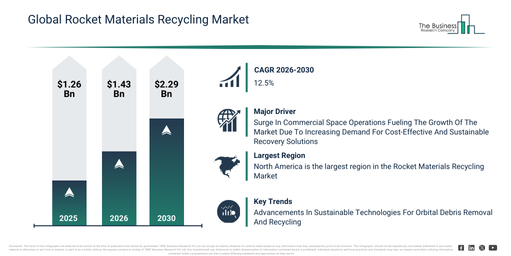
The rocket materials recycling market size has seen significant growth in recent years. It is projected to expand from $1.26 billion in 2025 to $1.43 billion in 2026, exhibiting a compound annual growth rate (CAGR) of 13.5%. The expansion witnessed in the historic period can be attributed to increasing cost pressures in launch vehicle manufacturing, which has driven interest in material recovery, along with the early adoption of structural disassembly processes to reclaim reusable components. Furthermore, the development of material sorting and cleaning techniques has enabled higher recycling yields, and there has been an expansion of non-destructive testing to evaluate recovered components for secondary use. A rising focus from both government and industry on reducing aerospace waste through component recovery assessments has also contributed to this growth.
The rocket materials recycling market is projected to experience substantial growth in the coming years, with its size forecast to reach $2.29 billion by 2030, exhibiting a compound annual growth rate (CAGR) of 12.5%. This expansion during the forecast period is fueled by several factors: the rise of reusable launch systems boosting the need for systematic materials recycling workflows, improvements in automated disassembly and sorting technologies enhancing recycling efficiency, increasing sustainability demands encouraging wider adoption of aerospace material circularity programs, developments in surface cleaning techniques allowing for higher-quality reclaimed materials, and the increase in commercial launch activities generating more recoverable rocket components. Key trends anticipated for this period include the expansion of programs for high-value alloy recovery, the development of composite material reclamation techniques, a greater embrace of automated rocket disassembly lines, an increasing reliance on non-destructive testing for material requalification, and the incorporation of closed-loop recycling models into launch operations.
Request A Free Rocket Materials Recycling Market Sample To Support Your Strategic Planning:
What Is Propelling The Rocket Materials Recycling Market Toward $2.29 Billion By 2030?
The increasing focus on commercial space activities is projected to drive expansion in the rocket materials recycling market over the next few years. These activities encompass profit-driven space operations and services undertaken by private or non-governmental organizations, such as launching satellites, space tourism, and exploring resources. The rise in commercial space endeavors is attributed to greater private sector investment, which in turn fosters innovation and lowers expenses for space technologies and services. Within space operations, rocket materials recycling entails the recovery and repurposing of rocket and spacecraft parts, aiming to minimize waste, cut expenses, and promote sustainable practices in space. Materials suitable for recycling, including metals and composites obtained from spent rocket stages or satellites, can be utilized for orbital repairs, construction, or manufacturing. For example, data from April 2024, provided by the Organisation for Economic Co-operation and Development, an international organization based in France, indicated that early in 2024, U.S.-based SpaceX had over 5,000 satellites and U.K.-based OneWeb had 600 satellites in their constellations, which together represented more than half of all operational satellites in Earth’s orbit. Consequently, the expanding engagement in commercial space operations is set to stimulate the expansion of the rocket materials recycling market.
What Are The Key Segments And Subsegments In The Rocket Materials Recycling Market?
The rocket materials recycling market covered in this report is segmented –
1) By Material Type: Metals, Composites, Polymers, Ceramics, Other Material Types
2) By Recycling Process: Mechanical Recycling, Chemical Recycling, Thermal Recycling, Other Recycling Processes
3) By Application: Aerospace, Defense, Space Exploration, Other Applications
4) By End-User: Government Agencies, Private Space Companies, Research Institutions, Other End-Users
Subsegments:
1) By Metals: Aluminum Alloys, Titanium Alloys, Stainless Steel, Inconel, Copper Alloys
2) By Composites: Carbon Fiber Composites, Glass Fiber Composites, Aramid Fiber Composites, Ceramic Matrix Composites, Hybrid Composites
3) By Polymers: Polyetheretherketone (PEEK), Polytetrafluoroethylene (PTFE), Polyimide (PI), Polyphenylene Sulfide (PPS), Polyamide-imide (PAI)
4) By Ceramics: Silicon Carbide (SiC), Aluminum Oxide (Al2O3), Zirconium Dioxide (ZrO2), Boron Carbide (B4C), Silicon Nitride (Si3N4)
5) By Other Material Types: Elastomers, Foams, Thermal Insulation Materials, Paints and Coatings, Ablative Materials
Rocket Materials Recycling Market Trends Behind The 12.5% CAGR Forecast
Leading firms within the rocket materials recycling market are concentrating on creating sophisticated solutions, including space debris recycling systems, to cut expenses and the requirement for new material launches. These space debris recycling systems involve technologies built to capture, process, and give new life to non-functional satellites and other orbital waste, thereby lessening space clutter and fostering sustainable activities in space. An example of this is seen in May 2025, when Paladin Space, an aerospace company based in Australia, introduced Triton. Triton is a recoverable payload specifically designed to gather space debris and safely remove it from orbit. This specialized payload was created to collect numerous pieces of space debris within one mission, incorporating a reusable capture system and an integrated containment unit. Triton is engineered to collaborate with orbital recycling hubs, thus advancing the reuse of valuable materials collected in space. The system possesses the capability to release the gathered debris onto specific targets, aiding in in-orbit recycling initiatives. With its design for long-term deployment, Triton stays in space following each operation, which renders subsequent debris removal missions more efficient and cost-effective.
Major Companies Profiled In The Rocket Materials Recycling Market Report
Major companies operating in the rocket materials recycling market are Veolia, Umicore, Aurubis, Sims Metal Management, Remondis, TOMRA, APChemi, JB Ecotex, Banyan Nation, Loop Industries, SpaceX, Blue Origin, ArianeGroup, United Launch Alliance, Sierra Space, Rocket Lab, Skyrora, Relativity Space, Firefly Aerospace, HyImpulse Technologies, Vaya Space, Astroscale, Redwire Space, Masten Space Systems, Resonac Holdings Corporation
Explore The Business Research Company’s Complete Rocket Materials Recycling Market Report:
Where Does The Rocket Materials Recycling Market Generate The Most Revenue?
North America was the largest region in the rocket materials recycling market in 2025. Asia-Pacific is expected to be the fastest-growing region in the forecast period. The regions covered in the rocket materials recycling market report are Asia-Pacific, South East Asia, Western Europe, Eastern Europe, North America, South America, Middle East, Africa.
Reach Out To Our Team:
The Business Research Company: https://www.thebusinessresearchcompany.com/
Americas: +1 310-496-7795
Asia: +44 7882 955267 & +91 8897263534
Europe: +44 7882 955267
Email us at: marketing@tbrc.info
Follow us on:
LinkedIn: https://in.linkedin.com/company/the-business-research-company
YouTube: https://www.youtube.com/channel/UC24_fI0rV8cR5DxlCpgmyFQ
Global Market Model: https://www.thebusinessresearchcompany.com/global-market-model

Wasay has over a decade of experience in market research, data modelling, and analytics, with prior experience at GlobalData and Decision Tree Consulting Services. At The Business Research Company , he leads research operations across syndicated studies, customized consulting engagements, and the Global Market Model platform. His professional experience includes supporting organizations such as Boston Consulting Group, KPMG, and Ernst & Young. Wasay holds a degree in Electronics and Communications Engineering, postgraduate management qualifications from International Management Institute Belgium and Indian School of Business and Entrepreneurship, and completed the Integrated Program in Business Analytics from Indian Institute of Management Indore.