
Enhanced with market attractiveness analysis, total addressable market evaluation, company benchmarking matrices, interactive Excel dashboards, expanded supply chain intelligence, emerging startup coverage, and detailed product insights, The Business Research Company’s 2026 market reports deliver more actionable and strategically valuable research.
Rocket Stage Assembly Market Revenue Outlook: What CAGR Is Expected Through 2030?
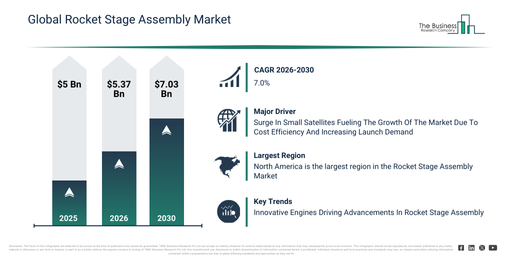
The rocket stage assembly market size has seen robust growth in recent years. It is forecast to increase from $5 billion in 2025 to $5.37 billion in 2026, exhibiting a compound annual growth rate (CAGR) of 7.4%. This historical expansion can be attributed to several factors, including the increasing complexity of multi-stage launch vehicles, which has driven demand for integrated stage assembly solutions. Other contributing elements include the development of reliable stage separation systems, enabling sequential propulsion stages, and the early adoption of thermal protection systems to safeguard structural integrity during ascent. Additionally, advancements in guidance, navigation, and control units have improved stage-to-stage flight accuracy, and the expansion of government space programs has necessitated sophisticated electrical harnessing and pressurization systems.
The rocket stage assembly market is projected to experience substantial growth over the coming years, with its valuation anticipated to reach $7.03 billion by 2030, demonstrating a compound annual growth rate (CAGR) of 7.0%. This projected expansion during the forecast period is fueled by several factors, including the rise of reusable rocket designs necessitating more durable and adaptable stage assembly components, breakthroughs in lightweight insulation and vibration dampening materials enhancing stage performance, an increasing frequency of commercial launches demanding scalable and automated assembly methods, improvements in sensor and telemetry technologies allowing for more accurate stage health monitoring, and the proliferation of deep-space and heavy-lift missions requiring more sophisticated and closely integrated stage assembly designs. Key developments expected during this period involve a greater incorporation of modular stage architectures, the adoption of advanced thermal protection materials for high-performance stages, an increase in automated wiring and harness assembly systems, the growing application of composite structures within stage frames, and the evolution of precise stage separation mechanisms for reusable rockets.
Download A Free Sample Report For Comprehensive Market Insights:
Rocket Stage Assembly Market Expansion Drivers: What Is Shaping Future Growth?
The increasing need for compact satellites is anticipated to drive expansion in the rocket stage assembly market moving ahead. Small satellites are defined as miniature spacecraft weighing less than 500 kg, utilized for purposes like Earth observation, communication, and scientific investigations, providing economical and adaptable mission choices. This escalating demand for small satellites stems from the requirement for quicker deployment, which allows operators to rapidly set up or enlarge satellite constellations to provide real-time data services and global connectivity. Rocket stage assembly facilitates accurate deployment and streamlined launch sequencing, ensuring small satellites are positioned precisely into their designated orbits while optimizing payload capacity and achieving successful missions. As an illustration, in September 2024, data from Nanosats Database, a UK-based nanosatellite and CubeSat database company, showed that 334 nanosatellites were launched in 2022, an increase from 329 in the preceding year, with this figure climbing to an unprecedented 390 in 2023. Consequently, the expanding demand for small satellites is fueling the development of the rocket stage assembly market.
Rocket Stage Assembly Market Segment Landscape: Which Areas Lead Market Development?
The rocket stage assembly market covered in this report is segmented –
1) By Component: Propellant Tanks, Engines, Avionics, Structural Components, Other Components
2) By Vehicle Type: Small-Lift Launch Vehicles, Medium-Lift Launch Vehicles, Heavy-Lift Launch Vehicles, Super-Heavy-Lift Launch Vehicles
3) By Application: Commercial, Military, Government
Subsegments:
1) By Propellant Tanks: Liquid Oxygen Tanks, Liquid Hydrogen Tanks, Methane Tanks, Kerosene Tanks, Composite Material Tanks
2) By Engines: Liquid Rocket Engines, Solid Rocket Motors, Hybrid Rocket Engines, Electric Thrusters, Methane-Fueled Engines
3) By Avionics: Guidance Systems, Navigation Systems, Telemetry Systems, Flight Control Systems, Communication Systems
4) By Structural Components: Interstage Structures, Payload Adapters, Fuel Lines And Valves, Fairings And Shrouds, Mounting Brackets And Frames
5) By Other Components: Thermal Protection Systems, Separation Systems, Electrical Wiring And Harnesses, Landing Gear Systems, Sensors And Instrumentation
#Rocket Stage Assembly Market Growth Trends: What Is Influencing The Future Outlook?
Leading companies within the rocket stage assembly market are concentrating on developing innovative solutions, such as the thrust methane-liquid oxygen engine, to enhance both efficiency and reusability. This type of engine, a thrust methane-liquid oxygen engine, functions by utilizing methane as its fuel source and liquid oxygen as the oxidizer to achieve high-efficiency propulsion. For example, LandSpace Technology Corporation, a China-based aerospace firm, successfully launched its Zhuque-2 rocket in December 2023, which was powered by methane and liquid oxygen. This mission successfully deployed multiple satellites into orbit, marking a significant milestone for China’s commercial space sector. The Zhuque-2 is currently able to deliver up to 1,500 kilograms to a 500-kilometer sun-synchronous orbit (SSO). An upgraded version is under development, aiming to increase this capacity to 4,000 kilograms. The subsequent launch will feature an enhanced second-stage engine, further improving performance and efficiency.
Rocket Stage Assembly Market Competitive Landscape And Leading Companies
Major companies operating in the rocket stage assembly market are The Boeing Company, Lockheed Martin Corporation, Northrop Grumman Corporation, Mitsubishi Heavy Industries Ltd., Blue Origin LLC, United Launch Alliance LLC, Magellan Aerospace Corporation, Japan Aerospace Exploration Agency, Relativity Space Inc., Rocket Lab USA Inc., Firefly Aerospace Inc., Avio S.p.A., Orbex Space Services Ltd., Space Exploration Technologies Corp., Antrix Corporation Limited, HyImpulse Technologies GmbH, Payload Aerospace S.L. (PLD Space), Skyrora Limited, Astra Space Inc., Indian Space Research Organisation.
Access The Complete Rocket Stage Assembly Market Report:
Rocket Stage Assembly Market Global Footprint: Which Region Holds Market Leadership?
North America was the largest region in the rocket stage assembly market in 2025. Asia-Pacific is expected to be the fastest-growing region in the forecast period. The regions covered in the rocket stage assembly market report are Asia-Pacific, South East Asia, Western Europe, Eastern Europe, North America, South America, Middle East, Africa.
Access a Customized Rocket Stage Assembly Market Report for Deeper Competitive Insights
https://www.thebusinessresearchcompany.com/customise?id=25539&type=smp
The Business Research Company: https://www.thebusinessresearchcompany.com/
Americas: +1 310-496-7795
Asia: +44 7882 955267 & +91 8897263534
Europe: +44 7882 955267
Email us at: marketing@tbrc.info
Follow us on:
LinkedIn: https://in.linkedin.com/company/the-business-research-company
YouTube: https://www.youtube.com/channel/UC24_fI0rV8cR5DxlCpgmyFQ
Global Market Model: https://www.thebusinessresearchcompany.com/global-market-model

Wasay has over a decade of experience in market research, data modelling, and analytics, with prior experience at GlobalData and Decision Tree Consulting Services. At The Business Research Company , he leads research operations across syndicated studies, customized consulting engagements, and the Global Market Model platform. His professional experience includes supporting organizations such as Boston Consulting Group, KPMG, and Ernst & Young. Wasay holds a degree in Electronics and Communications Engineering, postgraduate management qualifications from International Management Institute Belgium and Indian School of Business and Entrepreneurship, and completed the Integrated Program in Business Analytics from Indian Institute of Management Indore.
