Delivering more actionable and strategically valuable research, The Business Research Company’s 2026 market reports feature market attractiveness analysis, total addressable market evaluation, company benchmarking matrices, interactive Excel dashboards, expanded supply chain intelligence, emerging startup coverage, and detailed product insights.
Rocket Stage Manufacturing Market Size Forecast: How Large Could The Market Become By 2030?
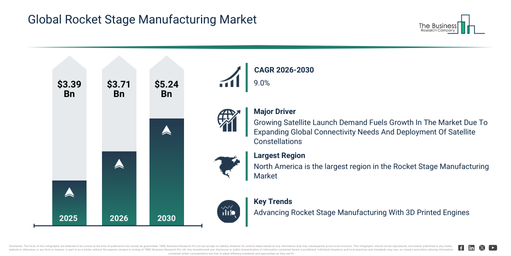
The rocket stage manufacturing market size has experienced robust expansion in recent years. Projections indicate an increase in its value from $3.39 billion in 2025 to $3.71 billion by 2026, demonstrating a compound annual growth rate (CAGR) of 9.4%. This historical growth is largely due to several factors: increasing demand for greater lift capabilities which has spurred the production of sophisticated first stage boosters; the creation of high-performance rocket engines facilitating multi-stage propulsion designs; a growing dependence on thrust vector control systems to enhance stage maneuverability; the expansion of government-backed launch initiatives that have boosted the production of full rocket stages; and the early implementation of precise fabrication methods that have improved structural integrity and engine alignment.
The rocket stage manufacturing sector is anticipated to experience robust expansion over the coming years. By 2030, its value is projected to reach $5.24 billion, expanding at a compound annual growth rate (CAGR) of 9.0%. This projected growth during the forecast period is fueled by several factors, including the increasing number of commercial launch providers, which in turn boosts the demand for scalable stage production. Further contributions come from innovations in additive and automated manufacturing, leading to reduced production times and expenses, along with the growing adoption of reusable stages that necessitate more resilient propulsion and control systems. Additionally, breakthroughs in lightweight composite materials are enhancing stage performance and payload capacity, while increased investments in deep-space and heavy-lift missions are propelling the development of advanced multi-stage manufacturing capabilities for future generations. Key developments expected during this period involve the integration of additive manufacturing for various stage components, the standardization and interchangeability of modular stages, the localization of supply chains for essential aerospace materials, the implementation of sophisticated quality assurance and certification methods, and the incorporation of materials compatible with cryogenic propellants.
Download A Free Sample Report For Comprehensive Market Insights:
Rocket Stage Manufacturing Market Growth Momentum: Which Factors Are Influencing Demand?
The expanding need for satellite deployments is projected to drive the expansion of the rocket stage manufacturing market in the coming years. These satellite launches involve sending artificial satellites into space via launch vehicles for diverse purposes, including communication, navigation, earth observation, and scientific investigation. The increase in such launches stems from the rising requirement for worldwide internet access, leading to a faster deployment of satellite constellations to improve connectivity in distant and neglected regions. Rocket stage manufacturing is crucial for satellite launches, providing the essential multi-stage propulsion systems necessary for precise and efficient placement of satellites into their planned orbits. For example, data from November 2023, reported by the US International Trade Commission, a US-based federal government agency, indicates that annual global space launches grew from 186 in 2022 to 197 in 2023. Consequently, the escalating demand for satellite launches is stimulating the growth of the rocket stage manufacturing market.
Rocket Stage Manufacturing Market Segment Outlook: Which Categories Are Expanding The Fastest?
The rocket stage manufacturing market covered in this report is segmented –
1) By Product Type: Liquid Propellant Stages, Solid Propellant Stages, Hybrid Propellant Stages
2) By Material: Aluminum Alloys, Titanium Alloys, Composite Materials, Other Material
3) By Application: Commercial, Military, Scientific, Other Application
4) By End-User: Aerospace, Defense, Research Organizations, Other End-User
Subsegments:
1) By Liquid Propellant Stages: Cryogenic Propellant Stages, Hypergolic Propellant Stages, Semi-Cryogenic Propellant Stages
2) By Solid Propellant Stages: Single-Use Solid Stages, Sustainer Stages, Boost Stages
3) By Hybrid Propellant Stages: Paraffin-Based Fuel Stages, Nitrous Oxide-Based Oxidizer Systems, Electrically-Ignited Hybrid Motors
Rocket Stage Manufacturing Market Transformation Trends: Which Innovations Are Driving Change?
Leading firms in the rocket stage manufacturing market are concentrating on creating novel solutions, including complete 3D-printed rocket engines, to address the increasing need for economical and quick satellite launches. These fully 3D-printed rocket engines are constructed via additive manufacturing processes, enabling the whole engine assembly to be produced as one piece. This considerably decreases part count, intricacy, and manufacturing durations when contrasted with conventional engines made of multiple components. An example is Agnikul Cosmos, an India-based private aerospace company, which unveiled Agnilet in May 2024. This engine is recognized as the world’s first single-piece 3D-printed rocket engine intended for small-lift orbital launch vehicles. The Agnilet engine is fabricated from a singular alloy piece, devoid of assembled components, thereby facilitating streamlined production and enhanced dependability. It is engineered for vacuum conditions and utilizes semi-cryogenic propellants, providing benefits such as compactness, cost-effectiveness, and greater mission adaptability.
Rocket Stage Manufacturing Market Key Players And Strategic Industry Positioning
Major companies operating in the rocket stage manufacturing market are Mitsubishi Heavy Industries Ltd., IHI Corporation, Lockheed Martin Corporation, Northrop Grumman Corporation, China Aerospace Science and Industry Corporation, L3Harris Technologies Inc., Avio S.p.A, Space Exploration Technologies Corporation, Blue Origin LLC., ArianeGroup SAS, United Launch Alliance LLC, Relativity Space Inc., Rocket Lab USA Inc., Firefly Aerospace Inc., Orbital Express Launch Limited, Yuzhnoye Design Office, PLD Space, Indian Space Research Organisation, China Academy of Launch Vehicle Technology, LandSpace Technology Corporation Ltd.
Access The Complete Rocket Stage Manufacturing Market Report:
Rocket Stage Manufacturing Market Geographic Analysis: Where Is Demand Growing The Fastest?
North America was the largest region in the rocket stage manufacturing market in 2025. The regions covered in the rocket stage manufacturing market report are Asia-Pacific, South East Asia, Western Europe, Eastern Europe, North America, South America, Middle East, Africa.
Access a Customized Rocket Stage Manufacturing Market Report for Deeper Competitive Insights
https://www.thebusinessresearchcompany.com/customise?id=25540&type=smp
The Business Research Company: https://www.thebusinessresearchcompany.com/
Americas: +1 310-496-7795
Asia: +44 7882 955267 & +91 8897263534
Europe: +44 7882 955267
Email us at: marketing@tbrc.info
Follow us on:
LinkedIn: https://in.linkedin.com/company/the-business-research-company
YouTube: https://www.youtube.com/channel/UC24_fI0rV8cR5DxlCpgmyFQ
Global Market Model: https://www.thebusinessresearchcompany.com/global-market-model

Wasay has over a decade of experience in market research, data modelling, and analytics, with prior experience at GlobalData and Decision Tree Consulting Services. At The Business Research Company , he leads research operations across syndicated studies, customized consulting engagements, and the Global Market Model platform. His professional experience includes supporting organizations such as Boston Consulting Group, KPMG, and Ernst & Young. Wasay holds a degree in Electronics and Communications Engineering, postgraduate management qualifications from International Management Institute Belgium and Indian School of Business and Entrepreneurship, and completed the Integrated Program in Business Analytics from Indian Institute of Management Indore.