
Designed to make market research more actionable and strategically valuable, The Business Research Company’s 2026 market reports feature market attractiveness scoring, total addressable market sizing, company benchmarking matrices, interactive Excel dashboards, deeper supply chain intelligence, emerging startup tracking, and granular product-level insights.
How Big Is The Satellite Propulsion System Market In 2026, And How Fast Will It Grow?
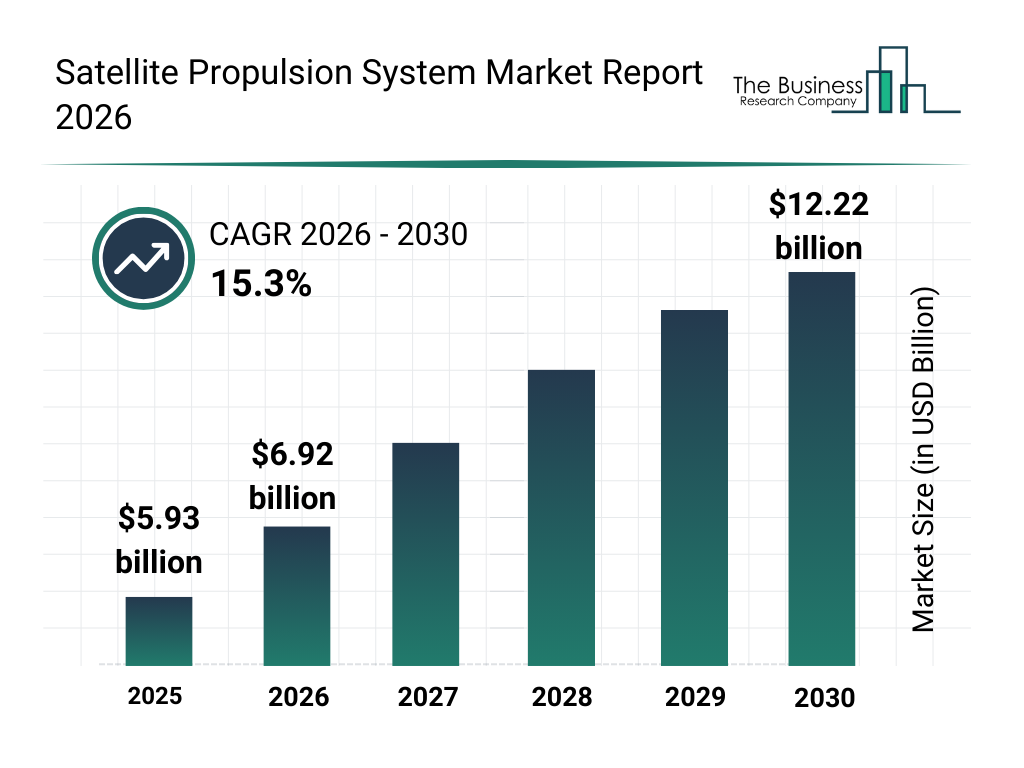
The satellite propulsion system market has experienced significant expansion recently. Its valuation is projected to increase from $5.93 billion in 2025 to $6.92 billion in 2026, demonstrating a compound annual growth rate (CAGR) of 16.6%. This historical upward trend can be ascribed to several factors, including the increasing number of satellites being launched that necessitate dependable station-keeping propulsion, a rise in the application of hydrazine monopropellant thrusters for orbital adjustments, continuous developments in chemical propulsion methods enhancing thrust efficiency, the widening scope of commercial and governmental satellite initiatives driving demand for propulsion parts like propellers and turbines, and the growing requirement for orbit modification and attitude control in satellites used for communication and earth observation.
The satellite propulsion system market is anticipated to experience substantial expansion in the coming years. It will grow to $12.22 billion in 2030 at a compound annual growth rate (CAGR) of 15.3%. This expansion during the forecast period can be attributed to the growing adoption of electric propulsion systems that offer improved fuel efficiency for both small and large satellites, a rising demand for lightweight and high-performance propulsion solutions supporting mega-constellations, the development of hybrid propulsion technologies facilitating flexible mission profiles, an increase in satellite launches driving the need for advanced propulsion subsystems, and the broadening of in-orbit servicing and debris mitigation initiatives, which in turn boosts the demand for precise and efficient maneuvering systems. Key trends expected over the forecast period include the increasing implementation of electric propulsion for high-efficiency orbital maneuvers, a growing need for green propellants as alternatives to hydrazine, the rising deployment of small satellites necessitating compact propulsion modules, the incorporation of modular propulsion subsystems for multi-orbit missions, and the growth of in-orbit servicing requiring sophisticated maneuvering capabilities.
Download A Free Satellite Propulsion System Market Sample Report With Size And Forecast Data:
Satellite Propulsion System Market Growth Driver: The Key Factor Behind Rising Demand
The future expansion in space exploration is expected to propel the growth of satellite propulsion systems. Space exploration involves the discovery and investigation of celestial bodies in space, leveraging continually evolving and expanding space technologies. The increase in space exploration is attributed to a growing demand for scientific discovery, commercial opportunities, and technological advancements that extend humanity’s reach beyond Earth. Advanced satellite propulsion systems are employed in space exploration to improve deep space capabilities by enabling travel through space and facilitating controlled landings. For instance, in January 2025, according to a report published by the Space Foundation, a US-based non-profit organization, orbital launch attempts increased 16% in 2024, with 259 launches occurring at an average of one every 34 hours, which is five hours more frequent than in 2023. Therefore, the growth in space exploration is driving the market for satellite propulsion systems.
Satellite Propulsion System Market Segmentation: Key Segments And Subsegments Covered
The satellite propulsion system market covered in this report is segmented –
1) By Type: Chemical Propulsion, Electric Propulsion, Hybrid Propulsion, Other Types
2) By Orbit: Low Earth Orbit (LEO), Medium Earth Orbit (MEO), Geostationary Earth Orbit (GEO), Beyond Geosynchronous Orbit
3) By Application: Commercial Use, Science And Environment, National Security And Military, Meteorology, Other Applications
Subsegments:
1) By Chemical Propulsion: Monomethyl Hydrazine (MMH), Hydrazine, Hypergolic Propellants, Solid Propellant Systems
2) By Electric Propulsion: Ion Thrusters, Hall Effect Thrusters, Pulsed Plasma Thrusters
3) By Hybrid Propulsion: Hybrid Rocket Motors, Hybrid Electric Propulsion Systems
4) By Other Types: Cold Gas Thrusters, Green Propulsion Systems, Solar Sail Propulsion
Satellite Propulsion System Market Trends: Key Developments Shaping 2026 And Beyond
Leading firms in the satellite propulsion systems market are innovating by creating novel propulsion technologies, including electric propulsion systems, to secure a market advantage. Electric propulsion systems define a category of propulsion technology employed in spacecraft and satellites that generate thrust through electric or electromagnetic methods. As an illustration, in January 2023, APT Satellite Holdings, a satellite telecommunications company from Hong Kong, launched its APSTAR-6E satellite from the Xichang Satellite Launch Center. The APSTAR-6E communication satellite incorporates a robust electric propulsion system. This system, notably China’s first fully electric satellite, employs sophisticated ion and Hall electric propulsion technology. Engineered for a 15-year lifespan, the satellite functions independently and discards all its rocket engines once it reaches near-earth orbit. Such a propulsion system provides enhanced efficiency and a prolonged operational duration. Furthermore, the satellite leverages artificial intelligence to deliver efficient and dependable high-speed communication services to users across Southeast Asia, offering a total bandwidth surpassing 30 Gbps.
Leading Companies Operating In The Satellite Propulsion System Market
Major companies operating in the satellite propulsion system market are Airbus SAS, Aerojet Rocketdyne Holdings Inc., Moog Inc., Busek Co Inc., Bellatrix Aerospace Private Limited, Exotrail SA, ENPULSION GmbH, Cobham Limited, Ball Corporation, The Boeing Company, Mitsubishi Electric Corporation, OHB System AG, Safran S A, Thales Group, Northrop Grumman Corporation, CU Aerospace, Rocket Lab, Rafael Advanced Defense Systems Ltd., Ariane Group, General Dynamics Mission Systems, Blue Origin, Lockheed Martin Corporation, Bradford Space, Sierra Nevada Corporation, Clyde Space Ltd., Comtech AeroAstro Inc., Dawn Aerospace, Deep Space Industries, Firefly Aerospace, General Atomics Electromagnetic Systems
Access The Full Satellite Propulsion System Market Research Report:
Satellite Propulsion System Market Regional Analysis: Largest Region And Key Geographies Covered
North America was the largest region in the satellite propulsion system market in 2025. The regions covered in the satellite propulsion system market report are Asia-Pacific, South East Asia, Western Europe, Eastern Europe, North America, South America, Middle East, Africa.
Reach Out To Our Team:
The Business Research Company: https://www.thebusinessresearchcompany.com/
Americas: +1 310-496-7795
Asia: +44 7882 955267 & +91 8897263534
Europe: +44 7882 955267
Email us at: marketing@tbrc.info
Follow us on:
LinkedIn: https://in.linkedin.com/company/the-business-research-company
YouTube: https://www.youtube.com/channel/UC24_fI0rV8cR5DxlCpgmyFQ
Global Market Model: https://www.thebusinessresearchcompany.com/global-market-model

Wasay has over a decade of experience in market research, data modelling, and analytics, with prior experience at GlobalData and Decision Tree Consulting Services. At The Business Research Company , he leads research operations across syndicated studies, customized consulting engagements, and the Global Market Model platform. His professional experience includes supporting organizations such as Boston Consulting Group, KPMG, and Ernst & Young. Wasay holds a degree in Electronics and Communications Engineering, postgraduate management qualifications from International Management Institute Belgium and Indian School of Business and Entrepreneurship, and completed the Integrated Program in Business Analytics from Indian Institute of Management Indore.

