Designed to make market research more actionable and strategically valuable, The Business Research Company’s 2026 market reports feature market attractiveness scoring, total addressable market sizing, company benchmarking matrices, interactive Excel dashboards, deeper supply chain intelligence, emerging startup tracking, and granular product-level insights.
How Fast Is The Software-Defined Satellite Market Growing? Market Size, CAGR And Forecast Insights
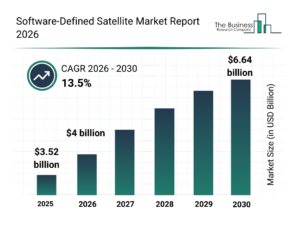
The software-defined satellite market has experienced rapid expansion in recent years. Its valuation is set to rise from $3.52 billion in 2025 to $4 billion in 2026, demonstrating a compound annual growth rate (CAGR) of 13.6%. This historical growth can be linked to the uptake of flexible payload satellites, the initial deployment of onboard software reconfiguration, the need for dynamic frequency allocation in communication satellites, the integration of software-defined radios within satellite systems, and the application of mission optimization tools for existing satellites.
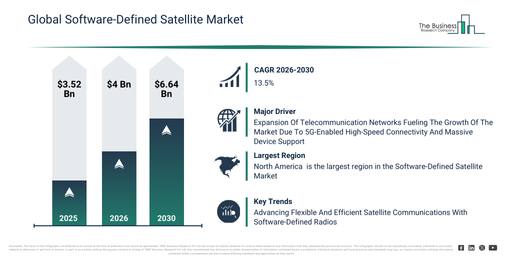
The software-defined satellite market is set for considerable expansion in the upcoming years. It is projected to achieve a market size of $6.64 billion by 2030, exhibiting a compound annual growth rate (CAGR) of 13.5%. This anticipated growth is primarily driven by factors such as the wider application of AI-driven in-orbit reconfiguration, the increased deployment of multi-mission software-defined satellites, the evolution of ground control integration platforms, a growing reliance on remote software updates and reprogramming, and the expansion of software services for commercial and defense satellites. Prominent trends for the forecast period include dynamic in-orbit reconfiguration, a rising demand for flexible payload architectures, the development of SDR-based satellite platforms, enhanced real-time beam steering capabilities, and the increasing adoption of cloud-controlled satellite operations.
Unlock Software-Defined Satellite Market Insights With A Free Sample Report:
Software-Defined Satellite Market Momentum: Key Driver Expected To Boost Growth Through 2030
The increasing scope of telecommunication networks is anticipated to drive the development of the software-defined satellite market in the future. These networks are defined as interconnected systems facilitating the transfer of voice, data, and video across varying distances between individuals and devices. The growth in telecommunication networks stems from the deployment of 5G technology, which offers enhanced data speeds, reduced latency, and support for extensive device connections. Software-defined satellites improve telecommunication networks by providing reconfigurable payloads, which makes them perfectly suited for adjusting to evolving bandwidth and coverage requirements. These satellites further enhance network efficiency through dynamic service modifications, thereby increasing connectivity and operational agility. As an illustration, in April 2025, the Office of Communications (Ofcom), a UK-based government entity, reported that fixed broadband lines totaled 29.2 million by the close of the fourth quarter of 2024, representing an annual increase of 691,000 (2.4%). Consequently, the growing reach of telecommunication networks is stimulating the expansion of the software-defined satellite market.
Software-Defined Satellite Market Segments: A Category-By-Category Overview
The software-defined satellite market covered in this report is segmented –
1) By Component: Hardware, Software, Services
2) By Orbit Type: Low Earth Orbit (LEO), Medium Earth Orbit (MEO), Geostationary Orbit (GEO)
3) By Technology: Software-Defined Radio, Artificial Intelligence (AI), Cloud Computation, Reconfigurable Payload
4) By Application: Communication, Earth Observation, Navigation, Scientific Research, Other Applications
5) By End-User: Commercial, Government, Defense, Other End-Users
Subsegments:
1) By Hardware: Antennas, Transponders, Power Amplifiers, Receivers, Onboard Processors
2) By Software: Network Management Software, Signal Processing Software, Payload Management Software, Ground Control Software, Data Analytics Software
3) By Services: Integration And Deployment Services, Consulting Services, Maintenance And Support Services, Managed Services, Training And Education Services
Which Emerging Trends Are Gaining Traction In The Software-Defined Satellite Market?
Leading firms within the software-defined satellite market are prioritizing the creation of novel solutions, including software-defined radios (SDRs), to facilitate adaptable, reconfigurable, and high-performance satellite communication capabilities. SDRs represent communication systems where signal processing is executed via software instead of dedicated hardware, allowing satellites to dynamically alter frequencies, protocols, and functions. This capability supports flexible, multi-standard communications, enhances efficiency, and prolongs satellite operational life compared to conventional fixed radio systems. An example of this is seen in May 2025, when Alén Space, an aerospace firm from Spain, launched its SATMAR nanosatellite, a 6U CubeSat aimed at accelerating the digital transformation within the maritime industry. This satellite, slated for deployment on a SpaceX Falcon 9 during the Transporter-14 mission from Vandenberg Space Force Base in California, seeks to evaluate the novel VHF Data Exchange System (VDES) standard in live operational settings, a system poised to improve maritime communications by superseding the existing Automatic Identification System (AIS). SATMAR is designed to enable two-way data transmission via satellite in the VHF band, thereby contributing to reduced network congestion and fostering enhanced efficiency, safety, and sustainability for worldwide maritime traffic.
Software-Defined Satellite Market Key Participants: Prominent Companies At A Glance
Major companies operating in the software-defined satellite market are The Boeing Company, Lockheed Martin Corporation, Airbus S.A.S., General Dynamics Mission Systems Inc., Northrop Grumman Corporation, Thales S.A., L3Harris Technologies Inc., SES S.A., Hughes Network Systems LLC, Eutelsat Communications S.A., Iridium Communications Inc., Inmarsat Global Limited, Spire Global Inc., Innoflight Inc., Vector Launch Inc., Muon Space Inc., Antwerp Space N.V., XDLINX Space Labs Inc., SatixFy Communications Ltd., ReOrbit Inc.
Get Detailed Software-Defined Satellite Market Forecasts In The Complete Report:
Top Region In The Software-Defined Satellite Market: A Global Perspective
North America was the largest region in the software-defined satellite market in 2025. Asia-Pacific is expected to be the fastest-growing region in the forecast period. The regions covered in the software-defined satellite market report are Asia-Pacific, South East Asia, Western Europe, Eastern Europe, North America, South America, Middle East, Africa.
Reach Out To Our Team:
The Business Research Company: https://www.thebusinessresearchcompany.com/
Americas: +1 310-496-7795
Asia: +44 7882 955267 & +91 8897263534
Europe: +44 7882 955267
Email us at: marketing@tbrc.info
Follow us on:
LinkedIn: https://in.linkedin.com/company/the-business-research-company
YouTube: https://www.youtube.com/channel/UC24_fI0rV8cR5DxlCpgmyFQ
Global Market Model: https://www.thebusinessresearchcompany.com/global-market-model

Wasay has over a decade of experience in market research, data modelling, and analytics, with prior experience at GlobalData and Decision Tree Consulting Services. At The Business Research Company , he leads research operations across syndicated studies, customized consulting engagements, and the Global Market Model platform. His professional experience includes supporting organizations such as Boston Consulting Group, KPMG, and Ernst & Young. Wasay holds a degree in Electronics and Communications Engineering, postgraduate management qualifications from International Management Institute Belgium and Indian School of Business and Entrepreneurship, and completed the Integrated Program in Business Analytics from Indian Institute of Management Indore.