With a focus on actionable insights and strategic value, The Business Research Company’s 2026 market reports include market attractiveness scoring, total addressable market sizing, company benchmarking matrices, interactive Excel dashboards, deeper supply chain intelligence, emerging startup tracking, and granular product-level insights.
Space-Based Climate Engineering Market Size Snapshot: 2026 Valuation, 2030 Projection And Key Growth Factors
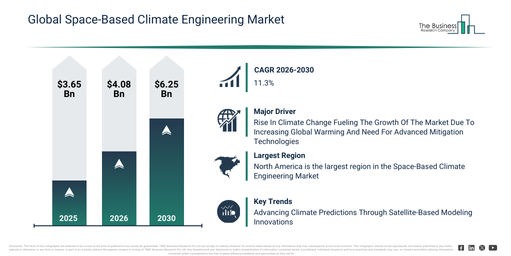
The space-based climate engineering market has experienced rapid growth in its size over recent years. It is projected to expand from $3.65 billion in 2025 to $4.08 billion in 2026, driven by a compound annual growth rate (CAGR) of 11.8%. This historical expansion can be attributed to early research into solar radiation management technologies, the development of prototype climate intervention satellites, increasing global awareness of climate change impacts, government and institutional funding for geoengineering projects, and advancements in orbital deployment and reflective material technologies.
The space-based climate engineering market is projected for significant expansion in the coming years. This market is predicted to reach $6.25 billion by 2030, exhibiting a compound annual growth rate (CAGR) of 11.3%. This growth over the forecast period is largely driven by factors such as the expansion of both commercial and governmental space-based climate intervention initiatives, the rollout of extensive orbital sunshades and reflective arrays, the incorporation of continuous Earth monitoring and climate modeling, the implementation of sophisticated thermal control and geoengineering mission equipment, and increased partnerships between aerospace and environmental technology companies. Key trends anticipated during this period involve breakthroughs in space-based solar reflectors, improved orbital climate monitoring and modeling capabilities, a rising need for carbon dioxide removal solutions, expanding private sector involvement in geoengineering, and the creation of modular and scalable orbital climate intervention hardware.
Get A No-Cost Sample Of The Space-Based Climate Engineering Market Study:
Major Factor Fueling The Space-Based Climate Engineering Market Through 2030
The increasing impact of climate change is anticipated to drive the expansion of the space-based climate engineering market in the foreseeable future. Climate change refers to the long-term shift in global weather patterns, predominantly caused by human activities like the consumption of fossil fuels. Its severity is heightened by human actions, especially the combustion of fossil fuels and the clearing of forests, which elevate greenhouse gas levels and capture additional heat within the atmosphere. Space-based climate engineering involves utilizing satellites or other space technologies for monitoring, reflecting, or managing Earth’s climate, aiming to mitigate the impacts of global warming. For example, data from May 2025 by the National Oceanic and Atmospheric Administration, a US-based scientific body, indicated that the global temperature anomaly in 2024 surpassed the prior record from 2023 by 0.18°F (0.10°C). Consequently, the escalation of climate change is a key factor propelling the expansion of the space-based climate engineering market.
Space-Based Climate Engineering Market Segment Landscape: Main Categories And Subcategories Covered
The space-based climate engineering market covered in this report is segmented –
1) By Technology: Solar Radiation Management, Carbon Dioxide Removal, Space Mirrors, Other Technologies
2) By Deployment: Satellites, Spacecraft, Other Deployments
3) By Application: Climate Change Mitigation, Weather Modification, Other Applications
4) By End-User: Government, Private Sector, Research Institutions, Other End Users
Subsegments:
1) By Solar Radiation Management: Stratospheric Aerosol Injection (SAI), Space-Based Reflectors, Surface Albedo Modification
2) By Carbon Dioxide Removal: Direct Air Capture and Storage (DACS),
3) By Space Mirrors: Large Deployable Mirrors, Thin Film Reflectors, Modular Mirror Arrays, Orbital Lens Systems
4) By Other Technologies: Space-Based Cloud Seeding, Atmospheric Shielding Systems, Hybrid Engineering Solutions
How Are Emerging Trends Influencing The Space-Based Climate Engineering Market’s Growth Path?
Companies operating within the space-based climate engineering market are prioritizing technological advancements, notably advanced climate modeling systems. These systems are sophisticated computer-based tools and simulations that employ mathematical equations and extensive datasets to replicate and predict the Earth’s climate patterns. For instance, in May 2024, the National Aeronautics and Space Administration (NASA), a US-based government space agency, launched the first satellite of its PREFIRE mission on Rocket Lab’s Electron rocket from New Zealand. This CubeSat is designed to measure heat radiated from the Arctic and Antarctica, aiming to improve understanding of how Earth’s polar regions influence global energy balance. The collected data will enhance climate models, assisting in predictions concerning sea ice loss, ice sheet melt, and rising sea levels. These crucial insights provide vital support for farmers, fishing fleets, and coastal communities as they adapt to the effects of climate change.
Space-Based Climate Engineering Market Leading Players And Key Industry Participants In 2026
Major companies operating in the space-based climate engineering market are Raytheon Technologies Inc., Lockheed Martin Corporation, Airbus SE, Northrop Grumman Corporation, L3Harris Technologies, Thales Alenia Space, OHB SE, Aidash, Pixxel, Ororatech, Space Forge, Albedo Space, Kuva Space, Near Space Labs, SpaceSolar, Stratosolar, Planetary Sunshade Foundation, Airmo, Orbify, Solaren Corporation.
Check Out The Full Space-Based Climate Engineering Market Report 2026:
Space-Based Climate Engineering Market By Geography: Revenue Leaders Among Global Regions
North America was the largest region in the space-based climate engineering market in 2025. The regions covered in the space-based climate engineering market report are Asia-Pacific, South East Asia, Western Europe, Eastern Europe, North America, South America, Middle East, Africa.
Reach Out To Our Team:
The Business Research Company: https://www.thebusinessresearchcompany.com/
Americas: +1 310-496-7795
Asia: +44 7882 955267 & +91 8897263534
Europe: +44 7882 955267
Email us at: marketing@tbrc.info
Follow us on:
LinkedIn: https://in.linkedin.com/company/the-business-research-company
YouTube: https://www.youtube.com/channel/UC24_fI0rV8cR5DxlCpgmyFQ
Global Market Model: https://www.thebusinessresearchcompany.com/global-market-model

Wasay has over a decade of experience in market research, data modelling, and analytics, with prior experience at GlobalData and Decision Tree Consulting Services. At The Business Research Company , he leads research operations across syndicated studies, customized consulting engagements, and the Global Market Model platform. His professional experience includes supporting organizations such as Boston Consulting Group, KPMG, and Ernst & Young. Wasay holds a degree in Electronics and Communications Engineering, postgraduate management qualifications from International Management Institute Belgium and Indian School of Business and Entrepreneurship, and completed the Integrated Program in Business Analytics from Indian Institute of Management Indore.