
The Business Research Company’s 2026 market reports are designed to deliver research that is more actionable and strategically valuable. Key offerings include market attractiveness scoring, total addressable market sizing, company benchmarking matrices, interactive Excel dashboards, deeper supply chain intelligence, emerging startup tracking, and granular product-level insights.
Space-Based Navigation Market Size 2026: Valuation, Growth Rate And Forecast To 2030
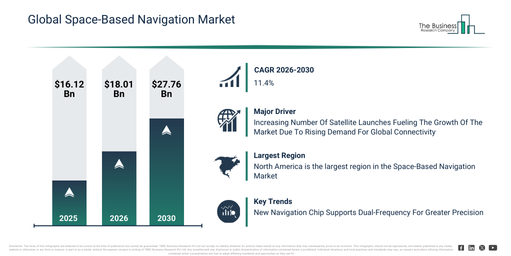
The space-based navigation market has experienced substantial expansion in recent years. It is projected to grow from $16.12 billion in 2025 to $18.01 billion in 2026, achieving a compound annual growth rate (CAGR) of 11.7%. Historically, this expansion has been driven by factors such as the introduction of initial global navigation satellite systems (GNSS), improvements in satellite signal transmission and reception, financial support from governments and military for space-based navigation initiatives, the creation of onboard navigation and timing devices, and the incorporation of signal enhancement technology for greater precision.
The space-based navigation market is projected for significant expansion in the coming years. It is anticipated to reach $27.76 billion by 2030, demonstrating a compound annual growth rate (CAGR) of 11.4%. This growth during the forecast period is fueled by several factors, including the enlargement of global navigation satellite constellations, the increasing need for accurate real-time positioning across commercial and defense industries, the uptake of sophisticated route optimization and geolocation tracking systems, advancements in next-generation navigation antennas and onboard technologies, and enhanced cooperation between satellite producers and navigation service providers. Key trends expected in this period encompass signal augmentation and enhancement innovations, the incorporation of multi-constellation GNSS receivers, real-time navigation data analysis and processing, the spread of satellite-based timing synchronization, and progress in miniaturizing space-based navigation hardware.
Get A Free Sample Of The Space-Based Navigation Market Report 2026:
What Is Driving The Growth Of The Space-Based Navigation Market?
The growing frequency of satellite launches is anticipated to boost the expansion of the space-based navigation market in the future. These launches involve deploying artificial satellites into orbit using spacecraft or rockets. The heightened demand for these launches stems from a growing global requirement for connectivity, as numerous areas seek dependable internet access via satellite broadband services. Space-based navigation facilitates satellite launches through its capability for accurate trajectory planning and in-orbit placement, thereby guaranteeing mission precision. This technology also improves launch efficiency by offering real-time tracking and timing data, which boosts the overall dependability of space operations. For example, data from January 2024, provided by the Space Foundation, a US-based nonprofit organization, indicated that global launch activity reached unprecedented heights for the third consecutive year, recording 223 launch attempts and 212 successes in 2023, with commercial launches experiencing a 50% increase compared to 2022. Consequently, the rising volume of satellite launches is a key factor propelling the expansion of the space-based navigation market.
How Is The Space-Based Navigation Market Segmented?
The space-based navigation market covered in this report is segmented –
1) By Component: Hardware, Software, Services
2) By Application: Military And Defense, Commercial, Scientific Research, Other Applications
3) By End-User: Government, Private Sector, Other End Users
Subsegments:
1) By Hardware: Receivers, Antennas, Processors, Transmitters, Sensors, Integrated Circuits (ICs)
2) By Software: Navigation Algorithms, Simulation And Modeling Software, Data Analytics And Processing Software, Mission Planning Software, User Interface Software, Security Software
3) By Services: System Integration, Consulting And Advisory, Maintenance And Support, Training And Education, Data Management Services, Upgradation And Modernization Services
What Are The Latest Trends In The Space-Based Navigation Market?
Leading companies within the space-based navigation market are prioritizing the development of advanced products, such as Navigation with Indian Constellation (NavIC) chipsets, to boost accuracy, lessen reliance on foreign systems, and foster self-sufficiency in global positioning technology. NavIC chipsets are sophisticated semiconductor components engineered to receive and process signals from India’s regional satellite navigation system, thereby delivering precise positioning and timing services. As an illustration, in April 2023, Elena Geo Systems, an India-based space technology enterprise, launched its NavIC chip. This compact, multi-core, ultra-low-power chip harnesses India’s own navigation satellite system, NavIC (IRNSS), while also supporting signals from GPS (USA) and GLONASS (Russia). The chipset supports dual-frequency operation on both L5 and S bands, which significantly enhances location accuracy even in demanding environments like urban canyons or remote areas. By incorporating NavIC into consumer and industrial applications, including smartphones, vehicle tracking systems, and precision agriculture, the chip strengthens India’s technological sovereignty and presents a competitive alternative to global navigation systems.
Who Are The Key Players In The Space-Based Navigation Market?
Major companies operating in the space-based navigation market are RTX Corporation, Airbus SE, Boeing Company, Lockheed Martin Corporation, Intel Corporation, China Aerospace Science and Technology Corporation, Qualcomm Technologies Inc., Northrop Grumman Corporation, Honeywell International Inc., Broadcom Inc., Thales Group, MediaTek Inc., L3Harris Technologies Inc., STMicroelectronics N.V., Infineon Technologies AG, NXP Semiconductors N.V., Roscosmos, SBG Systems, Indian Space Research Organisation, Aceinna.
Read The Complete Space-Based Navigation Market Report 2026:
Which Region Is The Largest In The Space-Based Navigation Market?
North America was the largest region in the space-based navigation market in 2025. Asia-Pacific is expected to be the fastest-growing region in the forecast period. The regions covered in the space-based navigation market report are Asia-Pacific, South East Asia, Western Europe, Eastern Europe, North America, South America, Middle East, Africa.
Reach Out To Our Team:
The Business Research Company: https://www.thebusinessresearchcompany.com/
Americas: +1 310-496-7795
Asia: +44 7882 955267 & +91 8897263534
Europe: +44 7882 955267
Email us at: marketing@tbrc.info
Follow us on:
LinkedIn: https://in.linkedin.com/company/the-business-research-company
YouTube: https://www.youtube.com/channel/UC24_fI0rV8cR5DxlCpgmyFQ
Global Market Model: https://www.thebusinessresearchcompany.com/global-market-model

Wasay has over a decade of experience in market research, data modelling, and analytics, with prior experience at GlobalData and Decision Tree Consulting Services. At The Business Research Company , he leads research operations across syndicated studies, customized consulting engagements, and the Global Market Model platform. His professional experience includes supporting organizations such as Boston Consulting Group, KPMG, and Ernst & Young. Wasay holds a degree in Electronics and Communications Engineering, postgraduate management qualifications from International Management Institute Belgium and Indian School of Business and Entrepreneurship, and completed the Integrated Program in Business Analytics from Indian Institute of Management Indore.

