Designed to make market research more actionable and strategically valuable, The Business Research Company’s 2026 market reports feature market attractiveness scoring, total addressable market sizing, company benchmarking matrices, interactive Excel dashboards, deeper supply chain intelligence, emerging startup tracking, and granular product-level insights.
How Big Is The Space-Based Navigation Control Market In 2026, And How Fast Will It Grow?
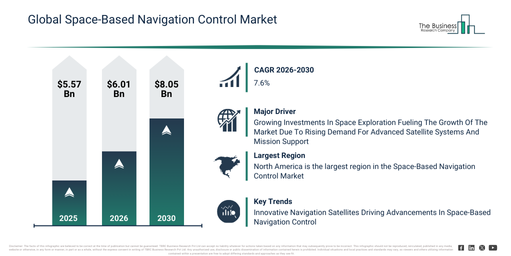
The space-based navigation control market size has experienced robust growth in recent years. This market is projected to expand from $5.57 billion in 2025 to $6.01 billion in 2026, demonstrating a compound annual growth rate (CAGR) of 7.9%. Historically, this expansion can be ascribed to several factors, including the initiation and deployment of early satellite navigation constellations, technological progress in timing synchronization and integrity monitoring, governmental funding for global navigation control infrastructure, the incorporation of satellite control and monitoring tools, and the initial implementation of augmentation systems to enhance positioning precision.
The space-based navigation control market size is anticipated to experience substantial growth in the coming years. It will grow to $8.05 billion in 2030 at a compound annual growth rate (CAGR) of 7.6%. This anticipated growth during the forecast period is driven by several factors, including the enlargement of satellite constellations to improve global coverage, a growing need for accurate positioning and velocity measurement services, the implementation of sophisticated asset and vehicle tracking devices, the creation of advanced augmentation and signal reliability systems, and increased partnerships between aerospace companies and navigation service providers for real-time global navigation control. Key trends anticipated in this period encompass the broadening of multi-constellation GNSS interoperability, an increasing requirement for high-precision PNT services, the evolution of satellite augmentation and correction systems, a greater rollout of robust and anti-jamming navigation technologies, and the expansion of commercial asset-tracking and location-based services.
Download A Free Space-Based Navigation Control Market Sample Report With Size And Forecast Data:
Space-Based Navigation Control Market Growth Driver: The Key Factor Behind Rising Demand
Increasing investments in space exploration are projected to drive the future expansion of the space-based navigation control market. These investments involve funding from both governments and private entities for the development of technologies and the execution of missions aimed at exploring and utilizing outer space. Such funding is on the rise, primarily because reusable rocket technology has significantly lowered launch costs, making space access more affordable and attracting greater financial support. Investments in space exploration bolster space-based navigation control by enabling the creation of advanced satellites and technologies that enhance the accuracy, coverage, and security of global positioning and timing services. For example, in June 2025, as stated by the Department for Business and Trade, a UK-based government agency, the UK government is strengthening its partnership with the European Space Agency (ESA) by committing a record $2.33 billion (£1.84 billion) over the next five years, which includes a $63.3 million (£50 million) investment through the UK Space Agency into a new Space Clusters and Infrastructure Fund. Thus, the escalating investment in space exploration is fueling the growth of the space-based navigation control market.
Space-Based Navigation Control Market Segmentation: Key Segments And Subsegments Covered
The space-based navigation control market covered in this report is segmented –
1) By Component: Hardware, Software, Services
2) By Platforms: Satellites, Spacecrafts, Ground Stations
3) By Application: Military And Defense, Commercial, Scientific Research, Other Applications
4) By End-User: Government, Private Sector, Research Organizations
Subsegments:
1) By Hardware: Satellite Navigation Receivers, Atomic Clocks, Antennas And Sensors, Ground Control Equipment, Onboard Processors
2) By Software: Navigation Algorithms And Software, Signal Processing Software, Data Analytics And Correction Software, Simulation And Modeling Software, Cybersecurity Software
3) By Services: System Integration And Testing, Satellite Launch And Deployment Services, Maintenance And Support Services, Navigation Data Management Services, Training And Consulting Services
Space-Based Navigation Control Market Trends: Key Developments Shaping 2026 And Beyond
Leading companies in the space-based navigation control market are concentrating on developing advanced solutions, such as navigation satellites, to improve the precision, dependability, and coverage of positioning, navigation, and timing (PNT) services. Navigation satellites are artificial satellites that transmit radio signals, allowing receivers on Earth to pinpoint their location with high accuracy. For instance, in May 2023, the Indian Space Research Organization, an India-based space agency, launched the NVS-01 satellite. This satellite was the first in its second-generation navigation series for the NavIC (Navigation with Indian Constellation) system, deployed using the GSLV-F12 rocket. Weighing approximately 2,232 kg, the NVS-01 was placed into a geosynchronous transfer orbit following a 19-minute flight and is designed to maintain and enhance India’s regional navigation services with new features, including L1 band signals and an indigenous rubidium atomic clock for improved accuracy. The satellite, with a mission life of up to 12 years, is expected to bolster the NavIC constellation, providing reliable and precise positioning services across India and up to 1,500 km beyond its borders.
Leading Companies Operating In The Space-Based Navigation Control Market
Major companies operating in the space-based navigation control market are RTX Corporation, Lockheed Martin Corporation, Qualcomm Incorporated, General Dynamics Corporation, Northrop Grumman Corporation, Honeywell International Inc., Broadcom Inc., BAE Systems plc, Safran S.A., L3Harris Technologies Inc., STMicroelectronics N.V., Leonardo S.p.A., Airbus Defence and Space GmbH, Elbit Systems Ltd., Hexagon AB, Garmin Ltd., Trimble Inc., Thales Alenia Space SAS, Topcon Corporation, SkyWater Technology
Access The Full Space-Based Navigation Control Market Research Report:
Space-Based Navigation Control Market Regional Analysis: Largest Region And Key Geographies Covered
North America was the largest region in the space-based navigation control market in 2025. The regions covered in the space-based navigation control market report are Asia-Pacific, South East Asia, Western Europe, Eastern Europe, North America, South America, Middle East, Africa.
Reach Out To Our Team:
The Business Research Company: https://www.thebusinessresearchcompany.com/
Americas: +1 310-496-7795
Asia: +44 7882 955267 & +91 8897263534
Europe: +44 7882 955267
Email us at: marketing@tbrc.info
Follow us on:
LinkedIn: https://in.linkedin.com/company/the-business-research-company
YouTube: https://www.youtube.com/channel/UC24_fI0rV8cR5DxlCpgmyFQ
Global Market Model: https://www.thebusinessresearchcompany.com/global-market-model

Wasay has over a decade of experience in market research, data modelling, and analytics, with prior experience at GlobalData and Decision Tree Consulting Services. At The Business Research Company , he leads research operations across syndicated studies, customized consulting engagements, and the Global Market Model platform. His professional experience includes supporting organizations such as Boston Consulting Group, KPMG, and Ernst & Young. Wasay holds a degree in Electronics and Communications Engineering, postgraduate management qualifications from International Management Institute Belgium and Indian School of Business and Entrepreneurship, and completed the Integrated Program in Business Analytics from Indian Institute of Management Indore.