
With a focus on actionable insights and strategic value, The Business Research Company’s 2026 market reports include market attractiveness scoring, total addressable market sizing, company benchmarking matrices, interactive Excel dashboards, deeper supply chain intelligence, emerging startup tracking, and granular product-level insights.
Space-Based Propellant Refueling Market Size Analysis: Historical Growth And Future Revenue Projections
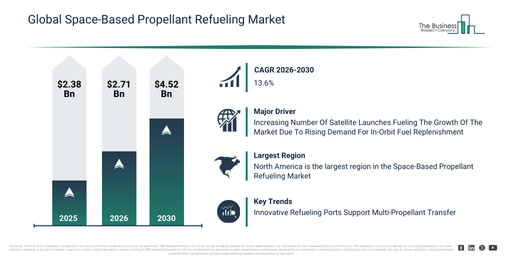
The space-based propellant refueling market has experienced considerable growth recently. Its size is expected to increase from $2.38 billion in 2025 to $2.71 billion in 2026, with a compound annual growth rate (CAGR) of 13.9%. This historical expansion can be traced back to early investigations and feasibility assessments regarding in-orbit refueling, the creation of prototype systems for fuel transfer and docking, financial support from both government and private sectors for spacecraft servicing technologies, advancements in cryogenic fuel storage and handling in space, and the initial deployment of robotic arms for orbital refueling tasks.
The space-based propellant refueling market is projected to experience substantial expansion in the coming years, reaching a valuation of $4.52 billion by 2030, demonstrating a compound annual growth rate (CAGR) of 13.6%. This anticipated growth is primarily driven by factors such as the increasing number of commercial in-orbit propellant depots, the escalating need for extended-duration satellite and spacecraft missions, advancements in autonomous navigation and transfer systems for refueling, the expansion of reusable spacecraft initiatives that necessitate orbital refueling, and enhanced partnerships between aerospace companies and fuel logistics providers for space-based propellant services. Key trends expected during this period involve the broadening of in-orbit fuel depot infrastructure, the establishment of standardized docking and transfer interfaces, an increase in commercial satellite life-extension offerings, a greater requirement for cryogenic propellant management technologies, and a boost in government funding for deep-space mission logistics.
Preview The Space-Based Propellant Refueling Market Report With A Free Sample:
Space-Based Propellant Refueling Market Drivers: What Is Fueling Demand Through 2030?
The increasing number of satellite launches is anticipated to drive the expansion of the space-based propellant refueling market going forward. Satellite launches refer to the process of deploying artificial satellites into space using launch vehicles or rockets. The escalating demand for satellite launches is attributed to the growing requirement for global connectivity, as more regions seek reliable internet access through satellite-based broadband services. Space-based propellant refueling aids satellite launches by enabling in-orbit fuel replenishment, thus reducing the need for fully fueled liftoffs. It enhances launch flexibility and extends the operational life of satellites, thereby improving overall space mission efficiency. For instance, in January 2024, according to the Space Foundation, a US-based nonprofit organization, global launch activity reached record levels for the third consecutive year, with 223 launch attempts and 212 successes in 2023, while commercial launches witnessed a 50% increase compared to 2022. Therefore, the rising volume of satellite launches is a key factor propelling the growth of the space-based propellant refueling market.
Space-Based Propellant Refueling Market Segmentation Analysis: Core Categories And Subcategories
The space-based propellant refueling market covered in this report is segmented –
1) By Propellant Type: Cryogenic Propellants, Non-Cryogenic Propellants
2) By Application: Satellite Refueling, Spacecraft Refueling, Space Station Refueling, Other Applications
3) By End-User: Commercial, Military, Government, Other End-Users
Subsegments:
1) By Cryogenic Propellants: Liquid Hydrogen (LH2), Liquid Oxygen (LOX), Liquid Methane, Liquid Nitrogen, Liquid Fluorine
2) By Non-Cryogenic Propellants: Monopropellants, Hypergolic Propellants, Solid Propellants, Green Propellants, Electric Propulsion Fuels
Which Trends Will Define The Space-Based Propellant Refueling Market Through 2030?
Leading companies within the space-based propellant refueling market are concentrating on developing advanced technological solutions, such as satellite refueling ports, to extend mission durations, reduce costs, and foster sustainable space exploration. Satellite refueling ports represent standardized interfaces that facilitate the in-orbit refueling of spacecraft, thereby prolonging their operational lifespan and decreasing the necessity for replacement missions. For example, in March 2024, Orbit Fab Inc., a US-based space refueling technology firm, introduced its Rapidly Attachable Fluid Transfer Interface (RAFTI). RAFTI is compatible with a broad array of satellite propulsion systems and supports the transfer of various propellants, including hydrazine, xenon, and green monopropellants. This port is engineered to allow for swift and secure refueling of satellites in orbit, supporting a wide spectrum of propellants and simplifying the refueling procedure. It also endeavors to cultivate a more sustainable space economy by enabling satellites to be serviced and reused instead of being decommissioned once their fuel reserves are exhausted.
Space-Based Propellant Refueling Market Major Companies And Industry Participants
Major companies operating in the space-based propellant refueling market are Airbus SE, Boeing Company, Lockheed Martin Corporation, Northrop Grumman Corporation, L3Harris Technologies Inc., Space Exploration Technologies Corp., Blue Origin Enterprises L.P., Argo Space Corporation, Maxar Technologies Inc., Rocket Lab USA Inc., Astroscale Holdings Inc., D-Orbit S.p.A., Impulse Space Inc., ClearSpace SA, Orbit Fab Inc., Tethers Unlimited Inc., Xplore Inc., Eta Space LLC, Ethos Space Inc., Momentus Inc., Obruta Space Solutions Corp., Infinite Composites Technologies Inc., Altius Space Machines Inc., Starfish Space Inc.
Buy The Full Space-Based Propellant Refueling Global Market Report 2026:
Space-Based Propellant Refueling Market Geographic Analysis: Which Region Accounts For The Biggest Share?
North America was the largest region in the space-based propellant refueling market in 2025. The regions covered in the space-based propellant refueling market report are Asia-Pacific, South East Asia, Western Europe, Eastern Europe, North America, South America, Middle East, Africa.
Reach Out To Our Team:
The Business Research Company: https://www.thebusinessresearchcompany.com/
Americas: +1 310-496-7795
Asia: +44 7882 955267 & +91 8897263534
Europe: +44 7882 955267
Email us at: marketing@tbrc.info
Follow us on:
LinkedIn: https://in.linkedin.com/company/the-business-research-company
YouTube: https://www.youtube.com/channel/UC24_fI0rV8cR5DxlCpgmyFQ
Global Market Model: https://www.thebusinessresearchcompany.com/global-market-model

Wasay has over a decade of experience in market research, data modelling, and analytics, with prior experience at GlobalData and Decision Tree Consulting Services. At The Business Research Company , he leads research operations across syndicated studies, customized consulting engagements, and the Global Market Model platform. His professional experience includes supporting organizations such as Boston Consulting Group, KPMG, and Ernst & Young. Wasay holds a degree in Electronics and Communications Engineering, postgraduate management qualifications from International Management Institute Belgium and Indian School of Business and Entrepreneurship, and completed the Integrated Program in Business Analytics from Indian Institute of Management Indore.

