
The Business Research Company’s 2026 market reports combine market attractiveness scoring, total addressable market sizing, company benchmarking matrices, interactive Excel dashboards, deeper supply chain intelligence, emerging startup tracking, and granular product-level insights to deliver research that is more actionable and strategically valuable.
What Is The Space-Based Oceanography Market Growth Rate? A 8.1% CAGR Outlook Through 2030
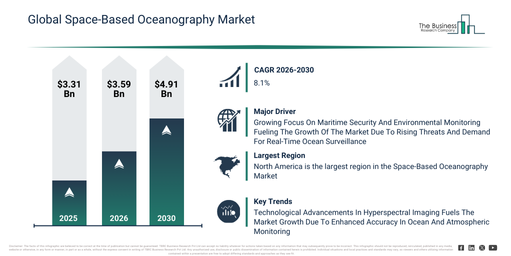
The space-based oceanography market has experienced robust expansion in recent years. It is projected to expand from $3.31 billion in 2025 to $3.59 billion in 2026, demonstrating a compound annual growth rate (CAGR) of 8.5%. Historically, this expansion was driven by factors such as the initial deployment of ocean observation satellites, the creation of remote sensing sensors for monitoring sea surfaces, financial support from governments and institutions for space-based oceanography research, improvements in satellite communication and data transmission technologies, and the integration of oceanographic analytics software for extensive data processing.
The space-based oceanography market size is projected to experience substantial growth in the coming years. It is anticipated to reach $4.91 billion in 2030, demonstrating a compound annual growth rate (CAGR) of 8.1%. This expansion during the forecast period can be attributed to factors such as the proliferation of satellite constellations for continuous ocean monitoring, an increasing demand for real-time sea surface temperature and current data, the adoption of advanced data processing and predictive ocean modeling systems, the development of next-generation remote sensing sensors and communication equipment, and increased collaboration between space agencies and marine research organizations for ocean resource management. Major trends anticipated in the forecast period include expanded satellite-based sea level and climate monitoring, growth in commercial satellite oceanography services, increased use of multispectral and hyperspectral ocean color imaging, a rising demand for advanced altimetry and scatterometry missions, and the integration of real-time marine data analytics into coastal management.
Access A Free Sample Of The Latest Space-Based Oceanography Market Analysis:
Why Is The Space-Based Oceanography Market Growing? The Key Demand Driver Explained
The increasing emphasis on maritime security and environmental observation is projected to drive the expansion of the space-based oceanography market in the future. Maritime security and environmental monitoring involve safeguarding oceanic interests and systematically observing ocean conditions to guarantee safe navigation, deter illicit activities, and oversee the ocean’s ecological well-being. This heightened focus on maritime security and environmental monitoring stems from escalating threats such as illegal fishing, piracy, and pollution, which demand sophisticated satellite-based instruments for real-time ocean surveillance and ecosystem safeguarding. The rising need for ocean surveillance and ecological oversight fuels the integration of space-based oceanography solutions. Such technologies offer precise, real-time data that directly aids maritime security, environmental preservation, and sustainable resource administration. For example, in January 2024, data from the 2023 annual report by the International Maritime Bureau Piracy Reporting Centre (IMB PRC), a Malaysia-based entity, indicated that 105 vessels were boarded, 9 attacks were attempted, 4 vessels were hijacked, and 2 vessels were fired upon. Consequently, the increased attention on maritime security and environmental monitoring is propelling the space-based oceanography market.
What Are The Main Segments Of The Space-Based Oceanography Market?
The space-based oceanography market covered in this report is segmented –
1) By Technology: Satellite Altimetry, Satellite Ocean Color, Satellite Scatterometry, Satellite Radiometry, Other Technologies
2) By Application: Climate Monitoring, Weather Forecasting, Marine Ecosystem Monitoring, Coastal Management, Other Applications
3) By End-User: Government, Research Institutions, Commercial, Other End-Users
Subsegments:
1) By Satellite Altimetry: Radar Altimeters, Laser Altimeters, Synthetic Aperture Radar Altimetry
2) By Satellite Ocean Color: Multispectral Imaging, Hyperspectral Imaging, Ocean Color Sensors
3) By Satellite Scatterometry: Ku-band Scatterometers, C-band Scatterometers, L-band Scatterometers
4) By Satellite Radiometry: Microwave Radiometers, Infrared Radiometers, Passive Radiometers
5) By Other Technologies: Global Navigation Satellite System Reflectometry, Lidar Systems, Gravity Field Mapping Instruments
Space-Based Oceanography Market Trend Analysis: Where Leading Companies Are Focusing
Companies operating in the space-based oceanography market are concentrating on developing technological advancements, such as hyperspectral ocean color imaging-based satellites, to improve the accuracy of ocean and atmospheric data collection and facilitate better identification of marine ecosystems. A hyperspectral ocean color imaging-based satellite is an Earth observation satellite equipped with a hyperspectral sensor, engineered to capture detailed information regarding ocean color across hundreds of narrow spectral bands. For instance, in February 2024, the National Aeronautics and Space Administration (NASA), a US-based independent space agency, launched the Plankton, Aerosol, Cloud, Ocean Ecosystem (PACE) satellite aboard a SpaceX Falcon 9 rocket from the Kennedy Space Center in Florida. This satellite is designed to enhance understanding of Earth’s oceans and atmosphere through advanced hyperspectral imaging and polarimetry technologies. It is equipped with instruments capable of detecting over 100 wavelengths of light. PACE allows scientists to monitor ocean health, track air pollution, and study the interactions between oceans, clouds, and atmospheric particles. The mission supports environmental monitoring, climate research, and weather forecasting by providing high-resolution global data to comprehend Earth’s dynamic systems.
Which Companies Are Major Players In The Space-Based Oceanography Market?
Major companies operating in the space-based oceanography market are Raytheon Technologies, Honeywell Aerospace Inc, Teledyne Technologies Incorporated, Thales Alenia Space SAS, Maxar Technologies Inc, OHB System AG, Airbus Defence and Space, ICEYE Ltd., Planet Labs PBC, Surrey Satellite Technology Limited, Spire Global Inc, Blacksky Technology Inc, The Tomorrow Companies Inc, Pixxel Space Technologies Pvt Ltd, AAC Clyde Space AB, HawkEye 360 Inc, Satellogic Inc, Changsha Spacety Co Ltd, Kleos Space SA, Umbra Lab Inc, GeoOptics Inc, isardSAT, Capella Space Corp
Get The Complete Space-Based Oceanography Market Analysis Here:
Which Region Held The Largest Share Of The Space-Based Oceanography Market In 2025?
North America was the largest region in the space-based oceanography market in 2025. Asia-Pacific is expected to be the fastest-growing region in the forecast period. The regions covered in the space-based oceanography market report are Asia-Pacific, South East Asia, Western Europe, Eastern Europe, North America, South America, Middle East, Africa.
Reach Out To Our Team:
The Business Research Company: https://www.thebusinessresearchcompany.com/
Americas: +1 310-496-7795
Asia: +44 7882 955267 & +91 8897263534
Europe: +44 7882 955267
Email us at: marketing@tbrc.info
Follow us on:
LinkedIn: https://in.linkedin.com/company/the-business-research-company
YouTube: https://www.youtube.com/channel/UC24_fI0rV8cR5DxlCpgmyFQ
Global Market Model: https://www.thebusinessresearchcompany.com/global-market-model

Wasay has over a decade of experience in market research, data modelling, and analytics, with prior experience at GlobalData and Decision Tree Consulting Services. At The Business Research Company , he leads research operations across syndicated studies, customized consulting engagements, and the Global Market Model platform. His professional experience includes supporting organizations such as Boston Consulting Group, KPMG, and Ernst & Young. Wasay holds a degree in Electronics and Communications Engineering, postgraduate management qualifications from International Management Institute Belgium and Indian School of Business and Entrepreneurship, and completed the Integrated Program in Business Analytics from Indian Institute of Management Indore.

