
Delivering more actionable and strategically valuable research, The Business Research Company’s 2026 market reports feature market attractiveness analysis, total addressable market evaluation, company benchmarking matrices, interactive Excel dashboards, expanded supply chain intelligence, emerging startup coverage, and detailed product insights.
Space Habitat Technology Market Forecast: What Market Value Is Expected By 2030?
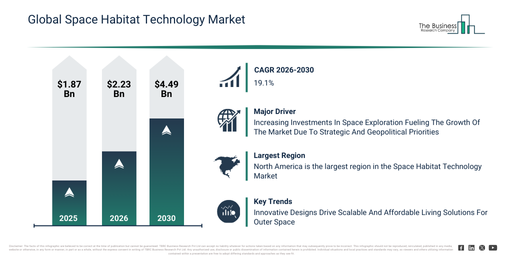
The space habitat technology market size is projected for significant expansion in the coming years. By 2030, its value is anticipated to reach $4.49 billion, demonstrating a compound annual growth rate (CAGR) of 19.1%. This expansion during the forecast period is fueled by several factors: increased funding for modular habitat systems tailored for lunar and Martian surface activities, the creation of highly efficient power generation units to sustain extended stays, the proliferation of commercial habitat simulation and testing services crucial for mission preparedness, breakthroughs in autonomous construction methods facilitating large-scale extraterrestrial structures, and an escalating need for transportation and logistics support as human presence in space becomes more extensive. Key trends during this period encompass sophisticated materials for constructing space habitats, improved radiation shielding capabilities, self-sustaining life support systems, the growth of modular and inflatable habitat designs, and novel approaches in space habitat simulation and testing.
Increased financial commitments to space exploration are projected to boost the future expansion of the space habitat technology market. Space exploration encompasses the examination and study of cosmic environments through methods such as astronomy, automated probes, and human-crewed missions. The rise in these investments is largely attributed to national security imperatives and geopolitical rivalries, as nations strive for strategic advantages in areas like space-based defense, monitoring, and technological supremacy. Space habitat technology facilitates space exploration by enabling a lasting human presence beyond our planet, achieved through sophisticated life support and structural systems. It improves the effectiveness of missions by guaranteeing the safety, comfort, and operational capability of crews in challenging extraterrestrial settings. For example, in September 2023, Novaspace, a France-based space governance provider, reported that government expenditures on space exploration reached $27 billion in 2024 and are expected to climb to nearly $31 billion by 2034. Consequently, the rising investments in space exploration are fueling the growth of the space habitat technology market.
Download A Free Sample Report For Comprehensive Market Insights:
Space Habitat Technology Market Demand Drivers: What Is Fueling Industry Growth?
Companies leading the space habitat technology market are concentrating on creating innovative solutions, including expandable space habitats, to support a sustainable and growing human presence in outer space. Expandable space habitats are inflatable constructions that enlarge once deployed in space, offering astronauts living environments that are lightweight, compact, and spacious. For example, in April 2024, Max Space Inc., an aerospace technology company based in the US, introduced its own expandable habitat architecture designed to provide lightweight, scalable orbital living and working environments. This system features an inflatable, adaptable design capable of expanding to stadium-sized or larger volumes, all while maintaining structural stability and reliability. This inventive approach considerably enhances usable interior space while decreasing mass and costs compared to conventional rigid modules, thus facilitating mass production and more affordable space habitation.
Space Habitat Technology Market Segment Breakdown: Which Categories Generate The Most Revenue?
The space habitat technology market covered in this report is segmented –
1) By Component: Life Support Systems, Habitat Structures, Power Systems, Thermal Control Systems, Communication Systems, Other Components
2) By Habitat Type: Orbital, Surface
3) By Application: Commercial, Government, Research
Subsegments:
1) By Life Support Systems: Atmosphere Control And Supply, Water Recycling And Management, Waste Management Systems, Food Production Systems, Environmental Monitoring Systems
2) By Habitat Structures: Modular Habitat Units, Inflatable Habitat Structures, Radiation Shielding Materials, Structural Frames And Panels, Interior Furnishings And Layout
3) By Power Systems: Solar Power Generation, Energy Storage Systems, Power Distribution Units, Backup Power Systems, Thermal-To-Electric Conversion Systems
4) By Thermal Control Systems: Active Thermal Control, Passive Thermal Control, Thermal Monitoring Sensors, Phase Change Materials, Heat Rejection Systems
5) By Communication Systems: Satellite Communication Terminals, Wireless Communication Networks, Data Transmission Equipment, Antennas And Transceivers, Communication Software And Protocols
6) By Other Components: Navigation And Guidance Systems, Robotics And Automation Components, Safety And Emergency Systems, Environmental Sensors And Instruments, Maintenance And Repair Tools
Space Habitat Technology Market Industry Trends: What Changes Are Reshaping Demand?
Companies leading the space habitat technology market are concentrating on creating innovative solutions, including expandable space habitats, to support a sustainable and growing human presence in outer space. Expandable space habitats are inflatable constructions that enlarge once deployed in space, offering astronauts living environments that are lightweight, compact, and spacious. For example, in April 2024, Max Space Inc., an aerospace technology company based in the US, introduced its own expandable habitat architecture designed to provide lightweight, scalable orbital living and working environments. This system features an inflatable, adaptable design capable of expanding to stadium-sized or larger volumes, all while maintaining structural stability and reliability. This inventive approach considerably enhances usable interior space while decreasing mass and costs compared to conventional rigid modules, thus facilitating mass production and more affordable space habitation.
Space Habitat Technology Market Key Players: Which Companies Shape Industry Competition?
Major companies operating in the space habitat technology market are RTX Corporation, Airbus SE, The Boeing Company, Lockheed Martin Corporation, Northrop Grumman Corporation, Honeywell International Inc., BAE Systems plc, Thales Group, Space Exploration Technologies Corp., ICON Technology Inc., Blue Origin LLC, Maxar Technologies Inc., Sierra Space Corporation, ILC Dover LP, Redwire Corporation, Axiom Space Inc., Bigelow Aerospace LLC, Vast Space LLC, NanoRacks LLC, AI SpaceFactory Inc.
Access The Complete Space Habitat Technology Market Report:
#Space Habitat Technology Market Largest Region: Which Geography Holds The Highest Market Share?
North America was the largest region in the space habitat technology market in 2025. The regions covered in the space habitat technology market report are Asia-Pacific, South East Asia, Western Europe, Eastern Europe, North America, South America, Middle East, Africa.
Access a Customized Space Habitat Technology Market Report for Deeper Competitive Insights
https://www.thebusinessresearchcompany.com/customise?id=25593&type=smp
The Business Research Company: https://www.thebusinessresearchcompany.com/
Americas: +1 310-496-7795
Asia: +44 7882 955267 & +91 8897263534
Europe: +44 7882 955267
Email us at: marketing@tbrc.info
Follow us on:
LinkedIn: https://in.linkedin.com/company/the-business-research-company
YouTube: https://www.youtube.com/channel/UC24_fI0rV8cR5DxlCpgmyFQ
Global Market Model: https://www.thebusinessresearchcompany.com/global-market-model

Wasay has over a decade of experience in market research, data modelling, and analytics, with prior experience at GlobalData and Decision Tree Consulting Services. At The Business Research Company , he leads research operations across syndicated studies, customized consulting engagements, and the Global Market Model platform. His professional experience includes supporting organizations such as Boston Consulting Group, KPMG, and Ernst & Young. Wasay holds a degree in Electronics and Communications Engineering, postgraduate management qualifications from International Management Institute Belgium and Indian School of Business and Entrepreneurship, and completed the Integrated Program in Business Analytics from Indian Institute of Management Indore.
