Delivering more actionable and strategically valuable research, The Business Research Company’s 2026 market reports feature market attractiveness analysis, total addressable market evaluation, company benchmarking matrices, interactive Excel dashboards, expanded supply chain intelligence, emerging startup coverage, and detailed product insights.
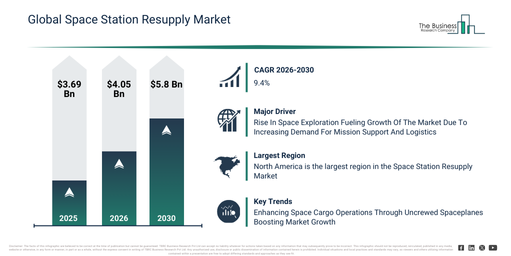
Space Station Resupply Market Expected To Reach $5.8 Billion By 2030 At 9.39% CAGR
The space station resupply market size is projected to demonstrate strong growth over the next few years, with expectations for it to reach $5.8 billion by 2030, maintaining a compound annual growth rate (CAGR) of 9.4%. This expansion during the forecast period can be attributed to the broader availability of commercial resupply services for various orbital platforms, the increasing deployment of sophisticated pressurized and modular cargo systems, a heightened demand for specialized research payload deliveries for scientific missions, the development of integrated upgrade and maintenance services for extended station operations, and the growth in training and simulation services aimed at optimizing crew and robotic resupply procedures. Key trends anticipated in the forecast period include the adoption of modular and reusable spacecraft components, enhanced payload customization and integration, the expansion of commercial space station operations, an increased emphasis on sustainability in space logistics, and the advancement of on-orbit servicing and maintenance.
The anticipated increase in space exploration is projected to drive the expansion of the space station resupply market in the future. Space exploration involves the investigation and study of outer space using astronomy, robotic spacecraft, and human spaceflight to broaden our understanding of the universe. This activity is growing primarily due to technological advancements that make space missions more feasible and cost-effective. Space station resupply supports space exploration by ensuring astronauts possess the essential resources and equipment necessary to conduct extended missions and scientific research in orbit. For instance, in November 2023, the United States International Trade Commission, a US-based government agency, reported that global space launches were estimated to reach 197 in 2023, an increase from 186 recorded in 2022. Consequently, the rise in space exploration is stimulating the growth of the space station resupply market.
Download A Free Sample Report For Comprehensive Market Insights:
Space Station Resupply Market Growth Drivers: What Factors Are Accelerating Expansion?
Companies operating in the space station resupply market are prioritizing technological advancements, particularly uncrewed lifting-body spaceplanes, to enhance cargo transport efficiency, allow runway landings for sensitive payload recovery, and support frequent, reusable missions to low Earth orbit. Uncrewed lifting-body spaceplanes are autonomous, reusable spacecraft constructed without an onboard crew that generate aerodynamic lift from their fuselage form to glide and land on runways once missions in space are completed. For example, in November 2023, the Sierra Space Corporation, a US-based aerospace and space technology company, finalized the assembly of its initial Dream Chaser spaceplane, Tenacity, at its Louisville, Colorado facility. This achievement represents a significant step towards its inaugural cargo mission to the International Space Station (ISS) anticipated for spring. The Dream Chaser spaceplane functions as a reusable, uncrewed lifting-body spacecraft specifically for delivering cargo to and from the International Space Station. It launches via a rocket and lands on a runway, facilitating the gentle retrieval of sensitive payloads.
Space Station Resupply Market Segment Analysis Highlighting Growth Areas
The space station resupply market covered in this report is segmented –
1) By Vehicle Type: Cargo Spacecraft, Reusable Rockets, Space Tugs
2) By Payload Type: Scientific Equipment, Food and Water, Spare Parts, Crew Supplies, Other Payload Types
3) By End-User: Government, Commercial, Defense
Subsegments:
1) By Cargo Spacecraft: Automated Cargo Vehicles, Pressurized Cargo Modules, Unpressurized Cargo Modules, Disposable Cargo Spacecraft, Reentry-Capable Cargo Spacecraft
2) By Reusable Rockets: First Stage Reusable Rockets, Partially Reusable Launch Systems, Fully Reusable Launch Systems, Vertical Takeoff And Landing (VTOL) Rockets
3) By Space Tugs: Orbital Transfer Vehicles (OTVs), Satellite Servicing Tugs, Debris Removal Tugs, In-Space Propulsion Modules
Space Station Resupply Market Innovation Trends: Which Developments Are Transforming The Industry?
Companies operating in the space station resupply market are prioritizing technological advancements, particularly uncrewed lifting-body spaceplanes, to enhance cargo transport efficiency, allow runway landings for sensitive payload recovery, and support frequent, reusable missions to low Earth orbit. Uncrewed lifting-body spaceplanes are autonomous, reusable spacecraft constructed without an onboard crew that generate aerodynamic lift from their fuselage form to glide and land on runways once missions in space are completed. For example, in November 2023, the Sierra Space Corporation, a US-based aerospace and space technology company, finalized the assembly of its initial Dream Chaser spaceplane, Tenacity, at its Louisville, Colorado facility. This achievement represents a significant step towards its inaugural cargo mission to the International Space Station (ISS) anticipated for spring. The Dream Chaser spaceplane functions as a reusable, uncrewed lifting-body spacecraft specifically for delivering cargo to and from the International Space Station. It launches via a rocket and lands on a runway, facilitating the gentle retrieval of sensitive payloads.
Space Station Resupply Market Leading Players Shaping Industry Direction
Major companies operating in the space station resupply market are The Boeing Company, Lockheed Martin Corporation, Airbus Defence and Space GmbH, Northrop Grumman Corporation, L3Harris Technologies Inc., Space Exploration Technologies Corp., Blue Origin LLC, Maxar Technologies Inc., Sierra Space Corporation, European Space Agency (ESA), Japan Aerospace Exploration Agency (JAXA), Rocket Lab USA Inc., Firefly Aerospace Inc., Redwire Corporation, Axiom Space Inc., State Corporation for Space Activities “Roscosmos”, The Exploration Company S.A.S., NanoRacks LLC, Orbital Sciences Corporation, SpaceChain Foundation Ltd.
Access The Complete Space Station Resupply Market Report:
Space Station Resupply Market Geographic Landscape: Which Region Dominates Industry Growth?
North America was the largest region in the space station resupply market in 2025. Asia-Pacific is expected to be the fastest-growing region in the forecast period. The regions covered in the space station resupply market report are Asia-Pacific, South East Asia, Western Europe, Eastern Europe, North America, South America, Middle East, Africa.
Access a Customized Space Station Resupply Market Report for Deeper Competitive Insights
https://www.thebusinessresearchcompany.com/customise?id=25607&type=smp
The Business Research Company: https://www.thebusinessresearchcompany.com/
Americas: +1 310-496-7795
Asia: +44 7882 955267 & +91 8897263534
Europe: +44 7882 955267
Email us at: marketing@tbrc.info
Follow us on:
LinkedIn: https://in.linkedin.com/company/the-business-research-company
YouTube: https://www.youtube.com/channel/UC24_fI0rV8cR5DxlCpgmyFQ
Global Market Model: https://www.thebusinessresearchcompany.com/global-market-model

Wasay has over a decade of experience in market research, data modelling, and analytics, with prior experience at GlobalData and Decision Tree Consulting Services. At The Business Research Company , he leads research operations across syndicated studies, customized consulting engagements, and the Global Market Model platform. His professional experience includes supporting organizations such as Boston Consulting Group, KPMG, and Ernst & Young. Wasay holds a degree in Electronics and Communications Engineering, postgraduate management qualifications from International Management Institute Belgium and Indian School of Business and Entrepreneurship, and completed the Integrated Program in Business Analytics from Indian Institute of Management Indore.