Through market attractiveness analysis, total addressable market evaluation, company benchmarking matrices, interactive Excel dashboards, expanded supply chain intelligence, emerging startup coverage, and detailed product insights, The Business Research Company’s 2026 market reports provide more actionable and strategically valuable research.
Space Surveillance Market Value Expansion And Long-Term Growth Outlook
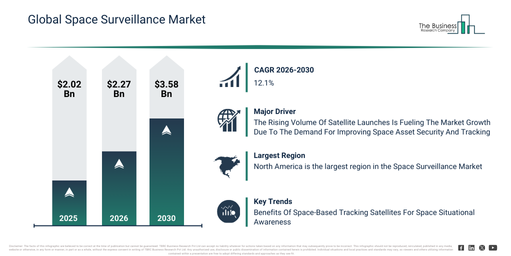
The space surveillance market is anticipated to experience significant growth over the next few years. It is projected to reach $3.58 billion by 2030, demonstrating a compound annual growth rate (CAGR) of 12.1%. This expansion during the forecast period can be attributed to the proliferation of integrated orbital debris tracking and management systems, the increasing adoption of phased array antennas for real-time surveillance, the creation of advanced electro-optical sensors for high-precision monitoring, a rising need for data sharing and analysis platforms supporting commercial and governmental space operations, and the growth in space weather monitoring services aimed at enhancing operational safety and asset protection. Key trends for the forecast period include improved space debris management, the integration of space weather monitoring with surveillance capabilities, an increase in commercial satellite traffic, the expansion of space situational awareness (SSA) software, and a growing demand for real-time collision avoidance.
A rising volume of satellite launches is projected to stimulate the expansion of the space surveillance market in the future. These launches involve deploying artificial satellites into space using launch vehicles, also known as rockets. This surge in satellite launches is attributed to the escalating demand for global connectivity, as more satellites are required to support broadband internet, communication networks, and data services across remote and underserved regions. Such launches enable the placement of advanced surveillance systems into orbit, thereby enhancing the capability to monitor space objects, track orbital debris, and ensure the security and functionality of space assets. For instance, in November 2023, The United States International Trade Commission, a US-based Government agency, reported that global space launches were estimated to reach 197 in 2023, marking an increase from the 186 recorded in 2022. Consequently, the increasing number of satellite launches is a primary driver for the growth of the space surveillance market.
Download A Free Sample Report For Comprehensive Market Insights:
Space Surveillance Market Demand Drivers: What Is Fueling Industry Growth?
Leading companies in the space surveillance market are focused on developing advanced solutions, such as space-based tracking satellites, to improve real-time monitoring and enhance orbital debris detection. These satellites are positioned in orbit to observe and track various objects in space, including debris, satellites, and spacecraft, utilizing onboard sensors and imaging systems. They significantly enhance space situational awareness by providing real-time data on the position, movement, and potential collisions of objects in orbit, thereby ensuring safer navigation and reducing the risk of space debris accidents. For instance, in January 2025, Digantara Research and Technologies Private Limited, an India-based aerospace company, launched SCOT (Space Camera for Object Tracking) aboard SpaceX’s Transporter-12 mission. SCOT stands as the world’s first commercial space-based space surveillance satellite, marking a substantial progression in global space situational awareness capabilities. This satellite is capable of detecting and tracking objects as small as five centimeters, enabling frequent revisits and high observation accuracy of low earth orbit (LEO). This capability is vital for preventing potential collisions, refining orbital traffic management, and providing satellite operators with more timely and actionable data.
Space Surveillance Market Segmentation Trends And Revenue Drivers
The space surveillance market covered in this report is segmented –
1) By Component: Software, Hardware, Services
2) By Orbit Type: Low Earth Orbit, Medium Earth Orbit, Geostationary Orbit, Other Orbit Types
3) By Application: Military, Commercial, Government, Other Applications
4) By End-User: Defense, Space Agencies, Satellite Operators, Other End-Users
Subsegments:
1) By Software: Orbit Determination Software, Collision Avoidance Software, Space Object Cataloging Software, Visualization Tools, Artificial Intelligence-Based Tracking Software
2) By Hardware: Ground-Based Radars, Optical Telescopes, Space-Based Sensors, Tracking Antennas, Signal Processors
3) By Services: Orbital Analysis Services, Space Object Tracking Services, Data Processing Services, Maintenance And Support Services, Advisory And Consulting Services
Space Surveillance Market Innovation Trends: Which Developments Are Transforming The Industry?
Leading companies in the space surveillance market are focused on developing advanced solutions, such as space-based tracking satellites, to improve real-time monitoring and enhance orbital debris detection. These satellites are positioned in orbit to observe and track various objects in space, including debris, satellites, and spacecraft, utilizing onboard sensors and imaging systems. They significantly enhance space situational awareness by providing real-time data on the position, movement, and potential collisions of objects in orbit, thereby ensuring safer navigation and reducing the risk of space debris accidents. For instance, in January 2025, Digantara Research and Technologies Private Limited, an India-based aerospace company, launched SCOT (Space Camera for Object Tracking) aboard SpaceX’s Transporter-12 mission. SCOT stands as the world’s first commercial space-based space surveillance satellite, marking a substantial progression in global space situational awareness capabilities. This satellite is capable of detecting and tracking objects as small as five centimeters, enabling frequent revisits and high observation accuracy of low earth orbit (LEO). This capability is vital for preventing potential collisions, refining orbital traffic management, and providing satellite operators with more timely and actionable data.
Space Surveillance Market Company Landscape And Strategic Competition
Major companies operating in the space surveillance market are The Boeing Company, Raytheon Technologies Corporation, Lockheed Martin Corporation, Northrop Grumman Corporation, L3Harris Technologies Inc., Thales Alenia Space S.A.S., Kratos Defense & Security Solutions Inc., Airbus Defence and Space S.A., Israel Aerospace Industries Ltd, Electro Optic Systems Pty Ltd, Swedish Space Corporation, Spire Global Inc., Astroscale Holdings Inc., Tekever S.A., Capella Space Inc., Millennium Space Systems Inc., HawkEye 360 Inc., Slingshot Aerospace Inc., Albedo Space, Turion Space
Access The Complete Space Surveillance Market Report:
Space Surveillance Market Regional Outlook: Where Are The Largest Opportunities Located?
North America was the largest region in the space surveillance market in 2025. Asia-Pacific is expected to be the fastest-growing region in the forecast period. The regions covered in the space surveillance market report are Asia-Pacific, South East Asia, Western Europe, Eastern Europe, North America, South America, Middle East, Africa.
Access a Customized Space Surveillance Market Report for Deeper Competitive Insights
https://www.thebusinessresearchcompany.com/customise?id=25609&type=smp
The Business Research Company: https://www.thebusinessresearchcompany.com/
Americas: +1 310-496-7795
Asia: +44 7882 955267 & +91 8897263534
Europe: +44 7882 955267
Email us at: marketing@tbrc.info
Follow us on:
LinkedIn: https://in.linkedin.com/company/the-business-research-company
YouTube: https://www.youtube.com/channel/UC24_fI0rV8cR5DxlCpgmyFQ
Global Market Model: https://www.thebusinessresearchcompany.com/global-market-model

Wasay has over a decade of experience in market research, data modelling, and analytics, with prior experience at GlobalData and Decision Tree Consulting Services. At The Business Research Company , he leads research operations across syndicated studies, customized consulting engagements, and the Global Market Model platform. His professional experience includes supporting organizations such as Boston Consulting Group, KPMG, and Ernst & Young. Wasay holds a degree in Electronics and Communications Engineering, postgraduate management qualifications from International Management Institute Belgium and Indian School of Business and Entrepreneurship, and completed the Integrated Program in Business Analytics from Indian Institute of Management Indore.