
With a focus on actionable insights and strategic value, The Business Research Company’s 2026 market reports include market attractiveness scoring, total addressable market sizing, company benchmarking matrices, interactive Excel dashboards, deeper supply chain intelligence, emerging startup tracking, and granular product-level insights.
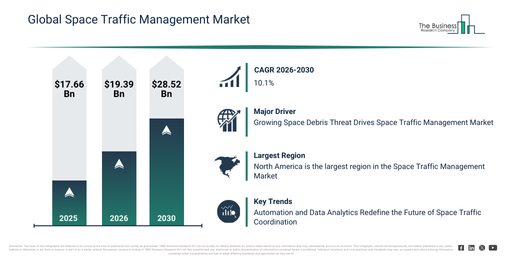
Space Traffic Management Market Size Forecast Points To $28.52 Billion In Revenue By 2030
The space traffic management market has experienced significant expansion recently. It is projected to increase from $17.66 billion in 2025 to $19.39 billion in 2026, demonstrating a compound annual growth rate (CAGR) of 9.8%. This historical growth can be linked to a rise in satellite deployments prompting the initial uptake of optical, thermal, and lidar sensors for orbital observation, alongside increasing governmental endeavors to tackle radio-frequency interference and ensure orbital safety. Further contributions came from the creation of essential regulatory frameworks for on-orbit coordination, the enlargement of ground-based and space-based tracking networks for monitoring spacecraft operations, and a heightened need for collision-risk assessment services as orbital congestion became more pronounced.
The space traffic management market is projected to experience significant expansion in the coming years. This market is forecast to reach $28.52 billion by 2030, exhibiting a compound annual growth rate (CAGR) of 10.1%. This growth during the forecast period is primarily driven by factors such as the increasing need for real-time space traffic surveillance to oversee the expanding number of satellite constellations, innovations in autonomous sensing and tracking systems for greater orbital accuracy, a rise in the incorporation of multi-sensor data fusion systems to improve overall situational awareness, the broadening of international regulatory alignment to ensure secure and sustainable space activities, and the growing commercial use of space traffic management solutions for private satellite operators. Key trends anticipated in this period encompass the enhanced deployment of sophisticated lidar and optical sensors for monitoring space traffic, the development of more robust regulatory structures for coordinating and preventing conflicts in space, an increase in services for active debris removal and deorbiting, the creation of unified platforms for predicting and avoiding collisions, and the adoption of satellite traffic management software for both commercial and governmental applications.
Get A Free Space Traffic Management Market Sample Covering Drivers, Trends And Key Players:
Space Traffic Management Market Driver Analysis: Key Factor Supporting Revenue Growth
The increasing danger from space debris is anticipated to fuel the expansion of the space traffic management market in the future. Space debris constitutes the defunct remnants of human-made items in orbit, especially those circulating Earth. Space traffic management aids in overseeing and tracking both active and inactive satellites, preventing impacts with space debris, and reducing the generation of new debris, thereby facilitating unimpeded movement for satellites. As an illustration, a report issued by the government of the United Kingdom through a UK-based information website in September 2024 indicated that statistical models estimate approximately one million items of space debris are between 1 cm and 10 cm in dimension, alongside an impressive 130 million more fragments between 1 mm and 1 cm in orbit. Among these, about 36,500 objects exceeding 10 cm are presently under surveillance, with more than 35,000 already documented. Consequently, the growing peril from space debris is propelling the space traffic management market.
Space Traffic Management Market Segmentation Framework: Major Segments At A Glance
The space traffic management market covered in this report is segmented –
1) By Activity: Space Situational Awareness, Space Debris Remediation, Space Orbit Management, Launch Vehicle Operation
2) By Orbit: LEO, MEO And Elliptical, GEO
3) By Application: Communication, Earth Observation, Navigation, Global Positioning System And Surveillance, Technology Development And Education, Other Applications
4) By End Use: Civil And Government, Commercial, Military
Subsegments:
1) By Space Situational Awareness: Collision Prediction and Avoidance, Tracking and Monitoring of Space Objects, Conjunction Assessment and Reporting
2) By Space Debris Remediation: Active Debris Removal, Debris Mitigation Technologies, Deorbiting Services
3) By Space Orbit Management: Orbital Slot Allocation, Satellite Positioning and Maneuvering, Orbit Deconfliction
4) By Launch Vehicle Operation: Launch Scheduling and Coordination, Traffic Management for Launch and Re-entry, Range Safety and Monitoring
Latest Space Traffic Management Market Developments And Emerging Trends
Leading companies within the space traffic management market are concentrating on developing innovative solutions, such as advanced orbital coordination and collision avoidance systems, to improve satellite safety and ensure sustainable operations in space. These advanced orbital coordination and collision avoidance systems are AI-driven platforms that track satellite positions, foresee potential close approaches, and automate maneuver planning, assisting operators in preventing collisions, minimizing service interruptions, and maintaining secure, efficient orbital activities. For instance, in September 2025, Kayhan Space Inc., a US-based space technology company, launched its enhanced Kayhan Platform, an inventive solution for space traffic management. This upgraded platform provides comprehensive predictive collision avoidance capabilities, customizable alert parameters, and automated maneuver suggestions through a scalable, AI-powered framework. It empowers satellite operators to proactively protect orbital assets, reduce downtime, and adhere to new space safety regulations. Built with sophisticated analytics and a user-friendly design, the upgraded Kayhan Platform also facilitates smooth data exchange among satellite operators, mission planners, and regulatory bodies, ensuring coordinated responses to potential conjunction events.
Which Companies Are Shaping The Space Traffic Management Market?
Major companies operating in the space traffic management market are Thales Group, L3Harris Technologies Inc., The Boeing Company, Airbus Group, BAE Systems plc, Lockheed Martin Corporation, Northrop Grumman Corporation, Raytheon Technologies Corporation, Saab AB, Kayhan Space, Exolaunch GmbH, HyImpulse Technologies GmbH, Slingshot Aerospace, Altitude Angel, Saber Astronautics LLC, Juniper Networks, Starfish Space, Creare Inc., Neuraspace, Transmetrics AD, Voyage Control, OKAPI: Orbits, COMSPOC Corp., ExoAnalytic Solutions, Kellogg Brown & Root Inc., NorthStar Earth & Space Inc., Space Data Association, Altius Space Machines, Analytical Graphics Inc.
Dive Deeper Into The Space Traffic Management Market With The Full Report:
Space Traffic Management Market Regional Distribution: Where Is Revenue Concentrated?
North America was the largest region in the space traffic management market in 2025. Asia-Pacific is expected to be the fastest-growing region in the space traffic management market share during the forecast period. The regions covered in the space traffic management market report are Asia-Pacific, South East Asia, Western Europe, Eastern Europe, North America, South America, Middle East, Africa.
Reach Out To Our Team:
The Business Research Company: https://www.thebusinessresearchcompany.com/
Americas: +1 310-496-7795
Asia: +44 7882 955267 & +91 8897263534
Europe: +44 7882 955267
Email us at: marketing@tbrc.info
Follow us on:
LinkedIn: https://in.linkedin.com/company/the-business-research-company
YouTube: https://www.youtube.com/channel/UC24_fI0rV8cR5DxlCpgmyFQ
Global Market Model: https://www.thebusinessresearchcompany.com/global-market-model

Wasay has over a decade of experience in market research, data modelling, and analytics, with prior experience at GlobalData and Decision Tree Consulting Services. At The Business Research Company , he leads research operations across syndicated studies, customized consulting engagements, and the Global Market Model platform. His professional experience includes supporting organizations such as Boston Consulting Group, KPMG, and Ernst & Young. Wasay holds a degree in Electronics and Communications Engineering, postgraduate management qualifications from International Management Institute Belgium and Indian School of Business and Entrepreneurship, and completed the Integrated Program in Business Analytics from Indian Institute of Management Indore.

