
The Business Research Company’s 2026 market reports are designed to deliver research that is more actionable and strategically valuable. Key offerings include market attractiveness scoring, total addressable market sizing, company benchmarking matrices, interactive Excel dashboards, deeper supply chain intelligence, emerging startup tracking, and granular product-level insights.
Space Weather Forecasting Market Historical Growth Vs. Forecast Growth: How Do The Numbers Compare?
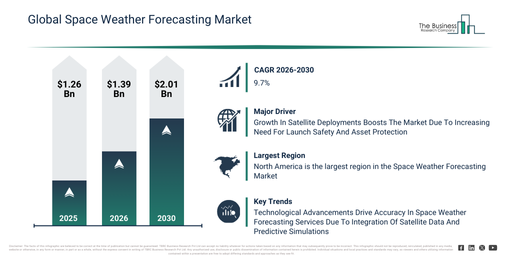
The space weather forecasting market has experienced significant expansion recently. This market is projected to expand from $1.26 billion in 2025 to $1.39 billion in 2026, demonstrating a compound annual growth rate (CAGR) of 10.3%. Historically, this growth was driven by factors such as the increasing dependence on satellite communication and navigation systems, the advent of initial solar observation satellites, heightened understanding of how geomagnetic storms affect power grids, governmental investments in space weather research, and improvements in computational models for predicting solar activity.
The space weather forecasting market is projected to experience robust expansion over the coming years. This market is anticipated to reach $2.01 billion in 2030, demonstrating a compound annual growth rate (CAGR) of 9.7%. This growth during the forecast period stems from factors such as increasing need for real-time space weather data services, the incorporation of AI and machine learning for more accurate predictive forecasting, the enlargement of commercial satellite constellations necessitating ongoing monitoring, the wider use of space weather forecasting in insurance and risk management, and enhanced cooperation between the aerospace and energy industries for mitigation strategies. Key trends anticipated for the same period encompass a heightened demand for radiation storm alerts essential for aviation safety, a greater dependency on satellite-based solar wind tracking, increased capital allocation for geomagnetic storm forecasting to bolster grid resilience, the proliferation of commercial space activities demanding immediate insights, and the consolidation of multiple observation networks to enhance precision.
Start With A Free Sample Of The Space Weather Forecasting Market Research Report:
The Leading Growth Driver In The Space Weather Forecasting Market Explained
The anticipated rise in satellite deployments is set to stimulate the expansion of the space weather forecasting market. Satellite launches involve sending artificial satellites into space using rockets, placing them into specific orbits for communication, observation, navigation, or scientific research. These launches are escalating due to increasing global demand for internet connectivity, leading companies to deploy large satellite constellations in low Earth orbit. Space weather forecasting aids satellite launches by predicting solar storms and radiation levels, allowing mission planners to identify safe launch windows and safeguard satellites from potential harm. For instance, in November 2023, The United States International Trade Commission, a US-based Government agency, reported that global space launches were estimated to reach 197 in 2023, an increase from the 186 recorded in 2022. Hence, the growing number of satellite launches is fueling the growth of the space weather forecasting market.
Key Segments Shaping The Space Weather Forecasting Market Landscape
The space weather forecasting market covered in this report is segmented –
1) By Forecast Type: Solar Flare Forecasting, Geomagnetic Storm Forecasting, Solar Radiation Storm Forecasting, Other Forecast Types
2) By Forecasting Method: Ground-Based Observations, Satellite-Based Observations, Other Forecasting Methods
3) By Application: Aerospace, Defense, Power Grid, Satellite Communication, Other Applications
4) By End-User: Government, Commercial, Research Institutions
Subsegments:
1) By Solar Flare Forecasting: X-Class Flare Prediction, M-Class Flare Prediction, C-Class Flare Prediction
2) By Geomagnetic Storm Forecasting: Kp-Index Prediction, Auroral Activity Modeling, Dst-Index Analysis
3) By Solar Radiation Storm Forecasting: Solar Energetic Particle (SEP) Event Prediction, Radiation Dose Estimation For Aviation And Space Missions, Proton Flux Monitoring
4) By Other Forecast Types: Coronal Mass Ejection (CME) Forecasting, Interplanetary Magnetic Field (IMF) Modeling, Solar Wind Speed And Density Prediction
Space Weather Forecasting Market Trend Spotlight: Key Shifts Shaping Future Demand
Major companies active in the space weather forecasting market are concentrating on developing innovative products, such as advanced space weather forecasting services, to improve the precision and timeliness of predictions related to solar storms, geomagnetic activity, and radiation hazards. Advanced space weather forecasting services are high-tech systems that utilize satellite data, artificial intelligence models, and simulations to predict and monitor solar activity and its impact on Earth’s infrastructure. For instance, in August 2024, Lynker Corporation, a US-based company, introduced Lynker Space, which delivers highly accurate, industry-specific space weather forecasts and alerts. These services enable organizations to protect critical assets and maintain operational continuity when facing solar and geomagnetic threats. Lynker Space intends to provide actionable insights and advanced dashboards for both immediate and long-term risk mitigation across sectors like satellite operations, aviation, and energy.
Space Weather Forecasting Market Competitive Analysis: Who Are The Main Competitors?
Major companies operating in the space weather forecasting market are Raytheon Technologies Corporation, Lockheed Martin Corporation, Airbus SE, Northrop Grumman Corporation, BAE Systems plc, L3Harris Technologies Inc., Met Office Space Weather Operations Centre, DTN, Rhea Group, British Antarctic Survey, Lynker Space, Japan Meteorological Agency, European Space Agency, Mission Space, Skolkovo Institute of Science and Technology, Space Environment Technologies, Ball Aerospace & Technologies Corp., Canadian Space Weather Forecast Centre, Finnish Meteorological Institute, Goddard Space Flight Center.
Find The Complete Space Weather Forecasting Market Outlook In The Full Report:
Mapping The Space Weather Forecasting Market: Regional Leadership And Global Reach
North America was the largest region in the space weather forecasting market in 2025. The regions covered in the space weather forecasting market report are Asia-Pacific, South East Asia, Western Europe, Eastern Europe, North America, South America, Middle East, Africa.
Reach Out To Our Team:
The Business Research Company: https://www.thebusinessresearchcompany.com/
Americas: +1 310-496-7795
Asia: +44 7882 955267 & +91 8897263534
Europe: +44 7882 955267
Email us at: marketing@tbrc.info
Follow us on:
LinkedIn: https://in.linkedin.com/company/the-business-research-company
YouTube: https://www.youtube.com/channel/UC24_fI0rV8cR5DxlCpgmyFQ
Global Market Model: https://www.thebusinessresearchcompany.com/global-market-model

Wasay has over a decade of experience in market research, data modelling, and analytics, with prior experience at GlobalData and Decision Tree Consulting Services. At The Business Research Company , he leads research operations across syndicated studies, customized consulting engagements, and the Global Market Model platform. His professional experience includes supporting organizations such as Boston Consulting Group, KPMG, and Ernst & Young. Wasay holds a degree in Electronics and Communications Engineering, postgraduate management qualifications from International Management Institute Belgium and Indian School of Business and Entrepreneurship, and completed the Integrated Program in Business Analytics from Indian Institute of Management Indore.

