
Delivering more actionable and strategically valuable research, The Business Research Company’s 2026 market reports feature market attractiveness analysis, total addressable market evaluation, company benchmarking matrices, interactive Excel dashboards, expanded supply chain intelligence, emerging startup coverage, and detailed product insights.
Carbon Capture Concrete Additive Market Size, Value And Growth Trends Through 2030
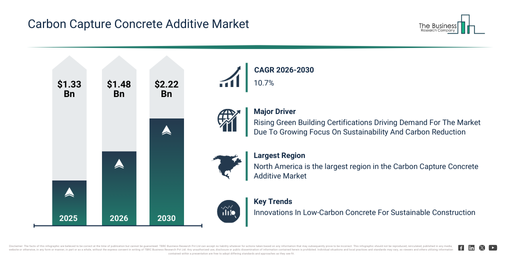
The carbon capture concrete additive market has experienced rapid expansion in recent years. Projections indicate that this market will expand from $1.33 billion in 2025 to $1.48 billion in 2026, demonstrating a compound annual growth rate (CAGR) of 10.9%. Historically, this market’s growth can be linked to factors such as an increasing embrace of low-carbon concrete, greater investment in sustainable building materials, a rising need for carbon sequestration within concrete, the broadened use of industrial concrete applications, and tighter government regulations concerning carbon emissions.
The carbon capture concrete additive market is projected to experience substantial expansion in the coming years. This market is anticipated to reach $2.22 billion by 2030, exhibiting a compound annual growth rate (CAGR) of 10.7%. Factors contributing to this growth during the forecast period include the rising implementation of AI-based carbon monitoring, the incorporation of bio-based and mineral additives, the broadening scope of carbon-neutral concrete applications, the creation of hybrid and high-performance additive solutions, and the increase in infrastructure projects aimed at reducing carbon. Key trends foreseen over this period encompass the widespread use of carbon-sequestering concrete mixtures, the integration of AI-based systems for carbon capture oversight, the deployment of smart manufacturing techniques for low-carbon concrete, the scaling up of robotics-supported concrete manufacturing, and the establishment of interconnected carbon tracking platforms.
Download A Free Sample Report For Comprehensive Market Insights:
Carbon Capture Concrete Additive Market Opportunity Drivers: What Is Creating New Revenue Potential?
The increased uptake of green building certifications is anticipated to propel the growth of the carbon capture concrete additive market in the coming period. These certifications represent formal recognition for buildings that adhere to specific standards regarding sustainability, energy efficiency, and overall environmental performance. The proliferation of green building certifications is attributed to escalating environmental awareness, as a greater number of stakeholders are requesting structures that are energy-efficient, sustainable, and low in carbon emissions. Carbon capture concrete additives provide support for green building certifications by sequestering CO2 within concrete, which leads to a reduction in overall greenhouse gas emissions and an improvement in the building’s environmental performance scores. For instance, in July 2024, data from the Green Building Council, a US-based non-profit organization, indicated that more than 46,000 residential projects obtained LEED green building certification, reflecting an approximate 5% rise in new registrations compared to 2023. Therefore, the expanding adoption of green building certifications is acting as a key driver for the carbon capture concrete additive market’s expansion.
Carbon Capture Concrete Additive Market Segment Analysis: What Are The Major Market Categories?
The carbon capture concrete additive market covered in this report is segmented –
1) By Product Type: Mineral-Based Additives, Chemical-Based Additives, Bio-Based Additives, Other Product Type
2) By Distribution Channel: Direct Sales, Distributors, Online Sales, Other Distribution Channel
3) By Application: Residential, Commercial, Industrial, Infrastructure
4) By End-User: Construction, Transportation, Energy, Other End-User
Subsegments:
1) By Mineral-Based Additives: Limestone Or Calcined Limestone Fillers, Natural Pozzolans (Volcanic Ash, Metakaolin), Carbonate Mineral Additives
2) By Chemical-Based Additives: CO2-Reactive Polymers Or Binders, Nanomaterial Additives
3) By Bio-Based Additives: Biochar From Agricultural Or Forest Biomass, Algae-Derived Biomass Additives, Microbial-Mediated Additives
4) By Other Product Types: Hybrid Additives, Geopolymer-Based Additives, Carbon-Mineralisation-Specific Additives
Carbon Capture Concrete Additive Market Innovation Trends Driving Future Development
Leading firms within the carbon capture concrete additive market are concentrating on creating innovative technologies, such as carbon-sequestering concrete, to enhance ecological efficiency and facilitate the shift towards construction with reduced carbon emissions. Carbon-sequestering concrete is defined as a material capable of absorbing and retaining carbon dioxide (CO2) from the air or industrial discharge during its hardening phase, consequently lowering the total carbon impact of building components. An example of this is NCP Industries, a manufacturing company based in the US, which introduced a new commercial concrete product line in November 2023 that absorbs carbon, utilizing CaptureCrete to cut CO2 levels in construction projects. This innovation converts conventional concrete into a material that actively draws in and permanently holds atmospheric CO2, substantially diminishing greenhouse gas output. Furthermore, it boosts the long-term endurance and robustness of concrete, aligning with sustainable building objectives without sacrificing effectiveness. Such advancements aid in mitigating the ecological effects of concrete production and are consistent with green construction benchmarks, positioning it as an effective approach for lowering the carbon footprint within the building sector.
Carbon Capture Concrete Additive Market Leading Companies Driving Competitive Growth
Major companies operating in the carbon capture concrete additive market are CRH plc, LafargeHolcim Ltd., Taiheiyo Cement Corporation, Fortera, CarbonCure Technologies Inc., Carbon Upcycling Technologies Inc., CarbiCrete Inc., Carbon8 Systems Ltd., Prometheus Materials Inc., CarbonBuilt Inc., Partanna Global, Inc., Carbon Limit Inc., Betolar Oy, Blue Planet Ltd., Concrete4Change Inc., E-Concrete Ltd, Solid Carbon Products LLC, CarStorCon Technologies GmbH, Econcreed GmbH, Seratech Ltd.
Access The Complete Carbon Capture Concrete Additive Market Report:
#Carbon Capture Concrete Additive Market Largest Region: Which Geography Holds The Highest Market Share?
North America was the largest region in the carbon capture concrete additive market in 2025. Asia-Pacific is expected to be the fastest-growing region in the forecast period. The regions covered in the carbon capture concrete additive market report are Asia-Pacific, South East Asia, Western Europe, Eastern Europe, North America, South America, Middle East, Africa.
Get in touch with us:
The Business Research Company: https://www.thebusinessresearchcompany.com/
Americas: +1 310-496-7795
Asia: +44 7882 955267 & +91 8897263534
Europe: +44 7882 955267
Email us at: marketing@tbrc.info
Follow us on:
LinkedIn: https://in.linkedin.com/company/the-business-research-company
YouTube: https://www.youtube.com/channel/UC24_fI0rV8cR5DxlCpgmyFQ
Global Market Model: https://www.thebusinessresearchcompany.com/global-market-model

Wasay has over a decade of experience in market research, data modelling, and analytics, with prior experience at GlobalData and Decision Tree Consulting Services. At The Business Research Company , he leads research operations across syndicated studies, customized consulting engagements, and the Global Market Model platform. His professional experience includes supporting organizations such as Boston Consulting Group, KPMG, and Ernst & Young. Wasay holds a degree in Electronics and Communications Engineering, postgraduate management qualifications from International Management Institute Belgium and Indian School of Business and Entrepreneurship, and completed the Integrated Program in Business Analytics from Indian Institute of Management Indore.