
Through market attractiveness analysis, total addressable market evaluation, company benchmarking matrices, interactive Excel dashboards, expanded supply chain intelligence, emerging startup coverage, and detailed product insights, The Business Research Company’s 2026 market reports provide more actionable and strategically valuable research.
Carbon Capture Low-Carbon Cement Additive Market Size Outlook: How Fast Will Revenue Grow Through 2030?
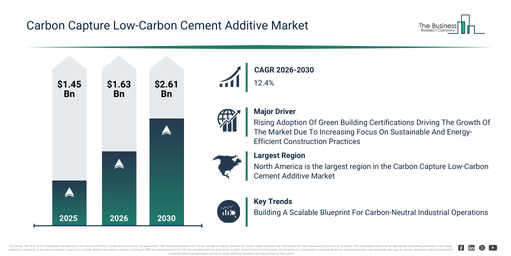
The carbon capture low-carbon cement additive market size has observed substantial growth in recent years. It is anticipated to increase from $1.45 billion in 2025 to $1.63 billion in 2026, progressing at a compound annual growth rate (CAGR) of 12.7%. The expansion witnessed in the historic period can be attributed to the rising adoption of carbon-reducing cement additives, increasing use of mineralized CO2 aggregates, expansion of low-carbon concrete projects, reliance on supplementary cementitious materials, and the development of CO2-infused precast panels.
The carbon capture low-carbon cement additive market is projected to experience substantial expansion over the coming years. Its valuation is anticipated to reach $2.61 billion by 2030, demonstrating a compound annual growth rate (CAGR) of 12.4%. This projected increase during the forecast period is driven by factors such as the rising output of bio-based and chemical additives, the expanding integration of intelligent cement production methods, the proliferation of carbon capture technologies, the creation of advanced high-performance low-carbon cement additives, and increased utilization in residential, commercial, and infrastructure developments. Key developments expected in this period encompass the incorporation of carbon capture cement additives, the deployment of CO2-infused precast concrete panels, the embrace of mineralized CO2 aggregates, the broadening availability of bio-based and chemical additives, and the implementation of smart monitoring for cement production.
Download A Free Sample Report For Comprehensive Market Insights:
#Carbon Capture Low-Carbon Cement Additive Market Growth Drivers And Industry Catalysts
The increasing acceptance of green building certifications is projected to boost the expansion of the carbon capture low-carbon cement additive market moving ahead. These certifications officially acknowledge that a structure fulfills defined criteria for environmental responsibility, efficient energy use, and the welfare of its occupants. The uptake of green building certifications is fueled by their focus on energy efficiency, which leads to reduced resource usage and decreased operational expenditures. Carbon capture low-carbon cement additives support green building certifications by lowering the carbon impact of building materials, thus aiding in the creation of greener and more sustainable structures. For example, data from February 2024, provided by the US Green Building Council (a US-based non-profit organization advocating for eco-friendly construction and creator of the LEED certification system), indicated a 9% increase in LEED certifications in 2023 compared to the prior year, alongside an extra 21 certifications granted for single-family homes. Furthermore, new LEED project registrations saw a significant 51% surge, demonstrating substantial expansion. Consequently, the increasing prevalence of green building certifications is propelling the expansion of the carbon capture low-carbon cement additive market.
Carbon Capture Low-Carbon Cement Additive Market Segments: Where Are The Largest Growth Opportunities?
The carbon capture low-carbon cement additive market covered in this report is segmented –
1) By Product Type: Mineral-Based Additives, Chemical-Based Additives, Bio-Based Additives, Other Product Types
2) By Technology: Carbon Capture And Storage, Carbon Capture And Utilization, Direct Air Capture, Other Technologies
3) By Distribution Channel: Direct Sales, Distributors, Online Sales, Other Distribution Channels
4) By Application: Residential Construction, Commercial Construction, Infrastructure, Other Applications
5) By End-User: Construction Companies, Cement Manufacturers, Government And Municipalities, Other End-Users
Subsegments:
1) By Mineral-Based Additives: Fly Ash, Ground Granulated Blast Furnace Slag (GGBFS), Silica Fume, Limestone Powder, Natural Pozzolans, Calcined Clay
2) By Chemical-Based Additives: Carbonation Accelerators, Superplasticizers, Shrinkage-Reducing Agents, Corrosion Inhibitors, Air-Entraining Agents, Setting Retarders, Water-Reducing Agents
3) By Bio-Based Additives: Microalgae-Derived Additives, Lignin-Based Additives, Cellulose Nanomaterials, Biochar, Enzyme-Based Additives, Bacterial Carbonation Agents
4) By Other Product Types: Recycled Concrete Fines, Nano-Additives, Graphene-Based Additives, Geopolymer Additives, CO2-Infused Aggregates
#Carbon Capture Low-Carbon Cement Additive Market Trends Influencing Long-Term Demand
Leading companies in the carbon capture low-carbon cement additive market are prioritizing innovation, particularly through a full-value-chain approach that integrates CO2 capture, transport, liquefaction, and permanent geological storage to lower emissions across the entire cement production process. This methodology encompasses the coordination of all carbon management stages within one integrated system, from CO2 capture at the plant to its transportation, processing, and ultimate permanent storage or reuse. For example, in March 2025, the Vicat group, a France-based producer of mineral-based construction materials including cement, ready-mixed concrete, and aggregates, launched the Vicat Advanced Industrial Alliance (VAIA) project. This initiative aims to capture and utilize 1.2 million tonnes of CO2 annually, accounting for nearly 100% of the plant’s emissions. The project reinforces Vicat’s broader decarbonization strategy, which also includes reducing clinker content, replacing fossil fuels, and enhancing energy efficiency. The captured CO2, equivalent to removing 75,000 combustion-engine cars from circulation each year, will be transported via an existing pipeline converted into a carbon pipeline to Fos-sur-Mer, where it will be liquefied and permanently stored in geological reservoirs.
Carbon Capture Low-Carbon Cement Additive Market Major Participants And Competitive Dynamics
Major companies operating in the carbon capture low-carbon cement additive market are Thyssenkrupp AG, CRH plc, Holcim Ltd, Heidelberg Materials AG, CEMEX S.A.B. de C.V., The Siam Cement Public Company Limited (SCG), Adani Group, Titan Cement International S.A., Calix Limited, Carbon Upcycling Technologies Inc., CarbonCure Technologies Inc., CarbiCrete Inc., Brimstone Energy Inc., Ecocem Materials Limited, CarbonBuilt Inc., Blue Planet Systems Corporation, Neocrete Limited, Alithic Limited, Terra CO2 Technologies Inc., Mineral Carbonation International Pty Ltd, Solid Carbon Inc.
Access The Complete Carbon Capture Low-Carbon Cement Additive Market Report:
Carbon Capture Low-Carbon Cement Additive Market Geographic Landscape: Which Region Dominates Industry Growth?
North America was the largest region in the carbon capture low-carbon cement additive market in 2025. The regions covered in the carbon capture low-carbon cement additive market report are Asia-Pacific, South East Asia, Western Europe, Eastern Europe, North America, South America, Middle East, Africa.
Get in touch with us:
The Business Research Company: https://www.thebusinessresearchcompany.com/
Americas: +1 310-496-7795
Asia: +44 7882 955267 & +91 8897263534
Europe: +44 7882 955267
Email us at: marketing@tbrc.info
Follow us on:
LinkedIn: https://in.linkedin.com/company/the-business-research-company
YouTube: https://www.youtube.com/channel/UC24_fI0rV8cR5DxlCpgmyFQ
Global Market Model: https://www.thebusinessresearchcompany.com/global-market-model

Wasay has over a decade of experience in market research, data modelling, and analytics, with prior experience at GlobalData and Decision Tree Consulting Services. At The Business Research Company , he leads research operations across syndicated studies, customized consulting engagements, and the Global Market Model platform. His professional experience includes supporting organizations such as Boston Consulting Group, KPMG, and Ernst & Young. Wasay holds a degree in Electronics and Communications Engineering, postgraduate management qualifications from International Management Institute Belgium and Indian School of Business and Entrepreneurship, and completed the Integrated Program in Business Analytics from Indian Institute of Management Indore.