Featuring market attractiveness scoring, total addressable market sizing, company benchmarking matrices, interactive Excel dashboards, deeper supply chain intelligence, emerging startup tracking, and granular product-level insights, The Business Research Company’s 2026 market reports are built to deliver research that is both more actionable and more strategically valuable.
Low-Altitude Infrastructure Market Size, Value And Growth Trajectory Through 2030
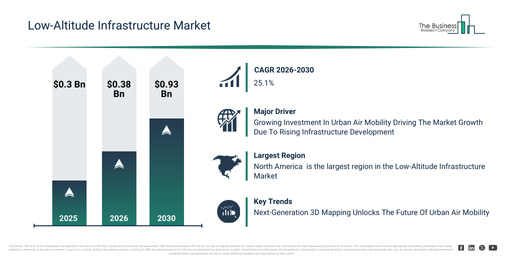
The low-altitude infrastructure market has experienced significant expansion recently. This market is projected to expand from $0.3 billion in 2025 to $0.38 billion in 2026, demonstrating a compound annual growth rate (CAGR) of 26.7%. Historically, this expansion has been driven by factors such as the increasing adoption of low-altitude infrastructure for drones, its growing application in urban air mobility, wider deployment in logistics and delivery services, the expansion of air traffic management systems, and the rising demand for drone navigation and safety solutions.
The low-altitude infrastructure market is projected to experience substantial growth in the upcoming years. It is forecast to expand to $0.93 billion by 2030, achieving a compound annual growth rate (CAGR) of 25.1%. This expansion during the forecast period is primarily driven by the advancement of AI-powered navigation, the increase in solar-powered charging infrastructure, the greater deployment of GPS and communication systems, the rising adoption of cybersecurity solutions, and the integration of IoT-enabled monitoring and management platforms. Significant trends anticipated in this period include the incorporation of AI-powered air traffic management systems, the implementation of IoT-based low-altitude vehicle monitoring, the expansion of drone fleet operation services, the deployment of real-time data analytics and monitoring platforms, and the development of sustainable low-altitude infrastructure solutions.
Get A Free Sample Report With In-Depth Market Insights:
Low-Altitude Infrastructure Market Growth Factors: What’s Supporting Expansion?
The increasing funding directed towards urban air mobility is projected to stimulate the expansion of the low-altitude infrastructure market in the future. This investment involves providing capital for the development of aerial transport systems designed to enhance efficient, low-altitude urban travel and overall connectivity. Such investments in urban air mobility are growing as cities actively seek quicker and more effective transportation methods to reduce travel durations, alleviate traffic issues, decrease emissions, and foster intelligent, sustainable urban development. By integrating aerial transit with existing ground networks, investment in urban air mobility reinforces low-altitude infrastructure, thereby boosting connectivity, efficiency, and accessibility within congested urban areas, while simultaneously easing traffic and supporting smart city development and the more rapid movement of people and goods. As an illustration, in June 2025, the UK Ministry of Defence, a UK-based government department, confirmed that the UK is allocating a record $473 million(£350 million) to augment Ukraine’s drone supply, aiming to escalate the number of drones provided from 10,000 in 2024 to 100,000 in 2025. Hence, the increasing financial commitment to urban air mobility is a significant driver for the growth of the low-altitude infrastructure market.
Low-Altitude Infrastructure Market Segment Landscape: Which Areas Lead Development?
The low-altitude infrastructure market covered in this report is segmented –
1) By Type: Low-Altitude Physical Infrastructure, Low-Altitude Air Management System
2) By Technology: Artificial Intelligence-Powered Navigation, Solar-Powered Charging, Global Positioning System And Communication Systems, Cybersecurity Solutions
3) By Application: Tourism, Logistics, Medical, Inspection, Other Applications
4) By Distribution Channel: Direct Sales, Distributors, Online Platforms
5) By End-User: Government, Commercial Enterprises, Logistics Companies, Agriculture Sector, Emergency Services
Subsegments:
1) By Low-Altitude Physical Infrastructure: Vertiports, Charging Stations, Landing Pads, Maintenance Facilities
2) By Low-Altitude Air Management System: Traffic Monitoring Systems, Navigation Platforms, Collision Avoidance Systems, Communication Networks
Low-Altitude Infrastructure Market Industry Trends: What’s Reshaping Demand?
Key companies operating within the low-altitude infrastructure market are concentrating on developing advanced technology, such as 3D digital mapping, to enhance navigation accuracy and support autonomous aerial operations. 3D digital mapping refers to the technology and process for creating three-dimensional digital models of real-world objects, environments, or terrain by capturing, processing, and interpreting spatial data. For instance, in July 2025, Amap, a China-based navigation company, launched Air Amap, a low-altitude navigation product in Shenzhen’s Longgang District. It integrates 3D digital mapping and a temporal-spatial base to provide precise, real-time navigation for drones and aerial vehicles. This marks an important stride toward establishing smart airspace infrastructure for urban mobility. The platform improves flight safety and spatial coordination in low-altitude environments.
Low-Altitude Infrastructure Market Industry Leaders And Competitive Landscape
Major companies operating in the low-altitude infrastructure market are Raytheon Technologies Corporation, Airbus SE, Thales S.A., L3Harris Technologies Inc., Leonardo S.p.A, Elbit Systems Ltd., Saab AB, Indra Sistemas, S.A., Rafael Advanced Defense Systems Ltd., Sichuan Jiuzhou Electric Group Co. Ltd., Lilium GmbH, Unifly NV, Airspace Link Inc., EHang Holdings Limited., Altitude Angel Ltd., ANRA Technologies Inc., Vizzbee Robotic Solutions Private Limited., Shanghai Volant Aviation Technology Co. Ltd., Joby Aviation Inc., AutoNavi Software Co. Ltd.
View The Full Low-Altitude Infrastructure Market Report:
Low-Altitude Infrastructure Market Regional Breakdown: Where Is Demand Concentrated?
North America was the largest region in the low-altitude infrastructure market in 2025. Asia-Pacific is expected to be the fastest-growing region in the forecast period. The regions covered in the low-altitude infrastructure market report are Asia-Pacific, South East Asia, Western Europe, Eastern Europe, North America, South America, Middle East, Africa.
Reach Out To Our Team:
The Business Research Company: https://www.thebusinessresearchcompany.com/
Americas: +1 310-496-7795
Asia: +44 7882 955267 & +91 8897263534
Europe: +44 7882 955267
Email us at: marketing@tbrc.info
Follow us on:
LinkedIn: https://in.linkedin.com/company/the-business-research-company
YouTube: https://www.youtube.com/channel/UC24_fI0rV8cR5DxlCpgmyFQ
Global Market Model: https://www.thebusinessresearchcompany.com/global-market-model

Wasay has over a decade of experience in market research, data modelling, and analytics, with prior experience at GlobalData and Decision Tree Consulting Services. At The Business Research Company , he leads research operations across syndicated studies, customized consulting engagements, and the Global Market Model platform. His professional experience includes supporting organizations such as Boston Consulting Group, KPMG, and Ernst & Young. Wasay holds a degree in Electronics and Communications Engineering, postgraduate management qualifications from International Management Institute Belgium and Indian School of Business and Entrepreneurship, and completed the Integrated Program in Business Analytics from Indian Institute of Management Indore.