Built to provide research that’s more actionable and strategically valuable, The Business Research Company’s 2026 market reports include market attractiveness analysis, total addressable market sizing, company benchmarking matrices, interactive Excel dashboards, broader supply chain intelligence, emerging startup tracking, and in-depth product insights.
Low Heat Cements Market CAGR Outlook And Future Development
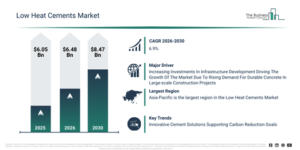
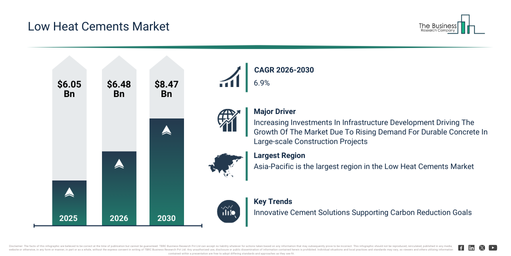
The market for low heat cements has demonstrated significant growth in recent years. It is projected to increase from $6.05 billion in 2025 to $6.48 billion in 2026, exhibiting a compound annual growth rate (CAGR) of 7.2%. This historical expansion can be attributed to factors such as a rising demand for temperature-controlled concrete, the increasing adoption of low-heat cement in massive structures, a reliance on specialized additives, the expansion of infrastructure projects, and a growing need for thermal-crack resistant concrete.
The low heat cements market is anticipated to experience substantial expansion in the coming years, reaching a valuation of $8.47 billion by 2030, driven by a compound annual growth rate (CAGR) of 6.9%. This projected growth over the forecast period can be attributed to several factors including the rising production of low-heat cements, the development of advanced low-heat formulations, their increased adoption in large-scale construction projects, the integration of digital hydration monitoring, and the broadening of their use in industrial and marine applications. Significant trends expected during this period involve the implementation of low heat cement technologies, the widespread adoption of AI-enhanced temperature monitoring systems, the deployment of smart hydration control solutions, the integration of digital production tracking, and the expansion of low thermal-crack concrete applications.
Get A Free Sample Report With In-Depth Market Insights:
Low Heat Cements Market Demand Drivers: What’s Powering Industry Growth?
Increased spending on infrastructure development is projected to boost the low heat cements market moving forward. These investments are growing due to the need to support urbanization and economic expansion in both emerging and established regions. Infrastructure development investments significantly propel the demand for low-heat cements, as these materials are crucial for minimizing thermal cracking during the construction of large concrete structures such as dams, bridges, and deep foundations. For example, in July 2024, the Office for National Statistics (ONS), a UK-based statistical institute, stated that infrastructure investment in 2023 reached $17.66 billion (£13.8 billion), indicating a 3.9% increase over 2022. Thus, the escalating investments in infrastructure development are fueling the growth of the low heat cements market.
Low Heat Cements Market Segments: Where Is Growth Concentrated?
The low heat cements market covered in this report is segmented –
1) By Type: Low Heat Portland Cement, Low-Heat Slag Cement, Low-Heat Pozzolanic Cement, Low-Heat Portland Composite Cement, Low-Heat Fly Ash Cement
2) By Production Process: Traditional Methods, Modern Techniques, Eco-Friendly Manufacturing
3) By Distribution Channel: Direct Sales, Distributors And Wholesalers, Online Sales Platforms, Retail Markets
4) By Application: Residential Construction, Commercial Construction, Infrastructure Projects, Industrial Applications
5) By End-User Industry: Building And Construction, Road And Highway Construction, Marine Applications, Oil And Gas Sector
Subsegments:
1) By Low Heat Portland Cement: Type II Low Heat Portland Cement, Type IV Low Heat Cement, Low Alkali Low Heat Cement, Blended Low Heat Cement
2) By Low-Heat Slag Cement: Granulated Blast Furnace Slag-Based Low Heat Cement, High-Slag Low Heat Composite Cement
3) By Low-Heat Pozzolanic Cement: Fly Ash-Based Low Heat Cement, Natural Pozzolana Low Heat Cement, Calcined Clay Low Heat Cement
4) By Low-Heat Portland Composite Cement: Limestone Composite Low Heat Cement, Mixed Mineral Admixture Low Heat Cement
5) By Low-Heat Fly Ash Cement: Class F Fly Ash Low Heat Cement, Class C Fly Ash Low Heat Cement
Low Heat Cements Market Innovation Trends: What Developments Are Reshaping The Industry?
Major companies active in the low heat cements market are concentrating on developing advanced products, including blast furnace slag cement, with the goals of improving sustainability, cutting carbon emissions, and boosting the thermal performance and longevity of concrete in major construction projects. Blast furnace slag cement itself is a blended cement created by either intergrinding or mixing Portland cement clinker with granulated blast furnace slag, resulting in a material that features a lower heat of hydration, enhanced durability, and a reduced carbon footprint. For example, in November 2025, Bamburi Cement Limited, a cement manufacturer based in Kenya, launched DURAPLUS, a next-generation CEM III/A 42.5 N cement developed to offer over 45% lower CO2 emissions than traditional Ordinary Portland Cement (OPC). This product, formulated using blast furnace slag from the iron industry, aligns with circular economy tenets and supports both Kenya’s Vision 2030 and the UN Sustainable Development Goals (SDGs). Designed for superior performance and resilience, DURAPLUS provides exceptional resistance to chlorides and sulfates, exhibits a low heat of hydration to prevent thermal cracking, and is optimized for challenging environments such as coastal and geothermal regions.
Low Heat Cements Market Key Participants And Competitive Landscape
Major companies operating in the low heat cements market are China National Building Material Group Co. Ltd., Heidelberg Materials AG, Anhui Conch Cement Company Limited, Cemex S.A.B. de C.V., UltraTech Cement Limited, Taiheiyo Cement Corporation, Vicat S.A., Mitsubishi UBE Cement Corporation, Shree Cement Limited, Dalmia Bharat Limited, The Siam Cement Public Company Limited (SCG), J.K. Cement Limited, The Ramco Cements Limited, Cement Australia Pty Limited, Buzzi Unicem S.p.A., JSW Cement Limited, Cockburn Cement Limited, Ecocem Materials Limited, Northern Cement Pty Limited, Rain Cements Limited (RCL).
View The Full Low Heat Cements Market Report:
Low Heat Cements Market Geographic Landscape: Which Region Leads Industry Growth?
Asia-Pacific was the largest region in the low heat cements market in 2025, and it is expected to be the fastest-growing region in the forecast period. The regions covered in the low heat cements market report are Asia-Pacific, South East Asia, Western Europe, Eastern Europe, North America, South America, Middle East, Africa.
Reach Out To Our Team:
The Business Research Company: https://www.thebusinessresearchcompany.com/
Americas: +1 310-496-7795
Asia: +44 7882 955267 & +91 8897263534
Europe: +44 7882 955267
Email us at: marketing@tbrc.info
Follow us on:
LinkedIn: https://in.linkedin.com/company/the-business-research-company
YouTube: https://www.youtube.com/channel/UC24_fI0rV8cR5DxlCpgmyFQ
Global Market Model: https://www.thebusinessresearchcompany.com/global-market-model

Wasay has over a decade of experience in market research, data modelling, and analytics, with prior experience at GlobalData and Decision Tree Consulting Services. At The Business Research Company , he leads research operations across syndicated studies, customized consulting engagements, and the Global Market Model platform. His professional experience includes supporting organizations such as Boston Consulting Group, KPMG, and Ernst & Young. Wasay holds a degree in Electronics and Communications Engineering, postgraduate management qualifications from International Management Institute Belgium and Indian School of Business and Entrepreneurship, and completed the Integrated Program in Business Analytics from Indian Institute of Management Indore.