Through market attractiveness analysis, total addressable market evaluation, company benchmarking matrices, interactive Excel dashboards, expanded supply chain intelligence, emerging startup coverage, and detailed product insights, The Business Research Company’s 2026 market reports provide more actionable and strategically valuable research.
Negative Carbon Portland Cement Market Size, Value And Growth Trends Through 2030
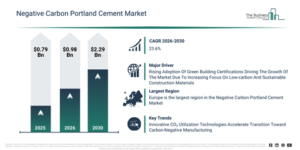
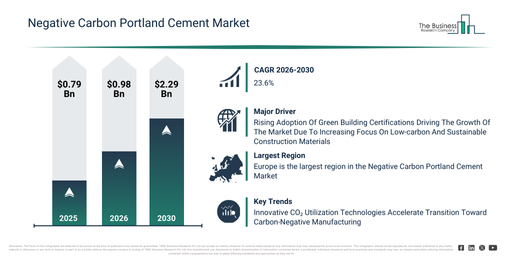
The negative carbon portland cement market has seen significant expansion in recent years. This market is projected to grow from $0.79 billion in 2025 to $0.98 billion in 2026, reflecting a compound annual growth rate (CAGR) of 23.9%. This historical growth can be attributed to an increased emphasis on reducing carbon in cement production, a greater incorporation of industrial by-products, rising demand for environmentally friendly construction, the expansion of sustainable infrastructure projects, and developments in low-clinker cement formulations.
The market size for negative carbon portland cement is projected to experience substantial growth in the coming years. It is expected to expand to $2.29 billion by 2030, achieving a compound annual growth rate (CAGR) of 23.6%. This anticipated growth can be attributed to the increasing implementation of carbon-capturing cement technologies, a rising adoption of smart production monitoring, the advancement of sophisticated supplementary cementitious materials, an expansion in commercial and residential construction, and innovations in negative emission additives. Significant trends within this forecast period encompass the widespread adoption of carbon-capturing portland cement, the integration of supplementary cementitious materials, the deployment of negative emission additives, the implementation of smart production monitoring, and the broadening of eco-friendly cement formulations.
Download A Free Sample Report For Comprehensive Market Insights:
#Negative Carbon Portland Cement Market Growth Drivers And Industry Catalysts
The increasing acceptance of green building certifications is anticipated to boost the negative carbon portland cement market in the future. These certifications formally acknowledge that structures adhere to specific criteria for environmental responsibility, efficient energy use, and inhabitant health. The increasing prevalence of green building certifications stems from their focus on energy efficiency, which leads to reduced resource use and decreased running expenses. Within green building certifications, negative carbon portland cement is employed to lessen the embodied carbon in construction materials, thereby assisting projects in securing sustainability credits and fulfilling low-carbon certification requirements. A notable example is data from February 2024, provided by the US Green Building Council, a US-based non-profit dedicated to advancing environmentally friendly construction and the originator of the Leadership in Energy and Environmental Design (LEED) certification program. Their report indicated a 9% increase in LEED certifications in 2023 compared to the prior year, alongside an extra 21 certifications for individual family residences. Furthermore, new registrations for LEED projects saw a significant leap of 51%, demonstrating substantial expansion. Consequently, the expanding uptake of green building certifications is fueling the growth of the negative carbon portland cement additive market.
Negative Carbon Portland Cement Market Segment Outlook: Which Categories Are Expanding The Fastest?
The negative carbon portland cement market covered in this report is segmented –
1) By Type: Magnesium Oxide, Iron Oxide, Fly Ash, Calcium Carbonate
2) By Raw Or Feed Material Type: Natural Raw Materials, Industrial-Waste Raw Materials, Alternative Calcium Sources Or Novel Binders
3) By Application: Textiles, Chemical, Construction, Other Applications
4) By End-Use Sector: Residential Construction, Commercial Construction, Infrastructure Development, Environmental Services
Subsegments:
1) By Magnesium Oxide: Reactive Magnesium Oxide, Dead-Burned Magnesium Oxide, Fused Magnesium Oxide, Caustic-Calcined Magnesium Oxide
2) By Iron Oxide: Red Iron Oxide (Fe2O3), Black Iron Oxide (Fe3O4), Yellow Iron Oxide (FeOOH), Brown Iron Oxide
3) By Fly Ash: Class F Fly Ash (Low Calcium), Class C Fly Ash (High Calcium), Processed Fly Ash, Blended Fly Ash
4) By Calcium Carbonate: Ground Calcium Carbonate (GCC), Precipitated Calcium Carbonate (PCC), Nano Calcium Carbonate, Coated Calcium Carbonate
#Negative Carbon Portland Cement Market Trends Influencing Long-Term Demand
Leading companies operating in the negative carbon portland cement market are prioritizing technological advancements, such as CO2-cured precast concrete solutions, to enable large-scale carbon mineralization and reduce reliance on clinker-based cement. This production method involves directly injecting captured carbon dioxide into the curing chamber as concrete hardens, thereby permanently storing CO2 as stable carbonates, improving material strength, and reducing the carbon footprint. For instance, in May 2025, Elematic Oyj, a Finland-based precast concrete technology company, and Carbonaide, a Finland-based materials technology firm, jointly launched the world’s first commercial CO2-cured precast concrete solution. This innovative system integrates carbon dioxide into the curing process of hollow-core slabs and wall panels, leading to a reduction in cement consumption by up to 20% and ensuring permanent CO2 storage within the concrete matrix. The solution is compatible with existing precast production lines, requires minimal retrofitting, and enables manufacturers to produce carbon-negative concrete elements at scale, marking a significant step toward industrial decarbonization in the cement sector. Through the integration of automated CO2-curing systems with adaptable precast manufacturing technology, the Elematic and Carbonaide solution offers a highly scalable and energy-efficient method for creating carbon-negative concrete elements within the cement industry.
Negative Carbon Portland Cement Market Key Companies And Competitive Benchmarking
Major companies operating in the negative carbon portland cement market are Dalmia Bharat Limited, Sublime Systems, Solidia Technologies Inc., CarbiCrete, Carbon8 Systems Limited, Blue Planet Systems Corporation, Prometheus Materials, GreenJams, CarbonBuilt, Partanna, Travertine Technologies, Brimstone Energy, Carbon Re, EMC Cement Co., Zeobond, Geopolymer Solutions LLC, Carbonaide, Low Carbon Materials (LCM Tree), Calix Ltd, IronKast Technologies.
Access The Complete Negative Carbon Portland Cement Market Report:
Negative Carbon Portland Cement Market Leading Geography: Which Region Generates The Most Revenue?
Europe was the largest region in the negative carbon portland cement market in 2025. The regions covered in the negative carbon portland cement market report are Asia-Pacific, South East Asia, Western Europe, Eastern Europe, North America, South America, Middle East, Africa.
Get in touch with us:
The Business Research Company: https://www.thebusinessresearchcompany.com/
Americas: +1 310-496-7795
Asia: +44 7882 955267 & +91 8897263534
Europe: +44 7882 955267
Email us at: marketing@tbrc.info
Follow us on:
LinkedIn: https://in.linkedin.com/company/the-business-research-company
YouTube: https://www.youtube.com/channel/UC24_fI0rV8cR5DxlCpgmyFQ
Global Market Model: https://www.thebusinessresearchcompany.com/global-market-model

Wasay has over a decade of experience in market research, data modelling, and analytics, with prior experience at GlobalData and Decision Tree Consulting Services. At The Business Research Company , he leads research operations across syndicated studies, customized consulting engagements, and the Global Market Model platform. His professional experience includes supporting organizations such as Boston Consulting Group, KPMG, and Ernst & Young. Wasay holds a degree in Electronics and Communications Engineering, postgraduate management qualifications from International Management Institute Belgium and Indian School of Business and Entrepreneurship, and completed the Integrated Program in Business Analytics from Indian Institute of Management Indore.