Enhanced with market attractiveness analysis, total addressable market evaluation, company benchmarking matrices, interactive Excel dashboards, expanded supply chain intelligence, emerging startup coverage, and detailed product insights, The Business Research Company’s 2026 market reports deliver more actionable and strategically valuable research.
Net-Zero Energy Buildings Market Size Outlook: How Fast Will Revenue Grow Through 2030?
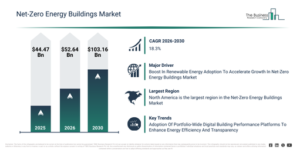
The net-zero energy buildings market has seen rapid expansion in recent years. This market is anticipated to increase from $44.47 billion in 2025 to $52.64 billion in 2026, achieving a compound annual growth rate (CAGR) of 18.4%. The historical growth in this sector is largely due to factors such as the rise in sustainable construction adoption, the early incorporation of renewable systems, stricter building efficiency requirements, the expansion of green certification programs, and an increasing need for energy-resilient buildings.
The net-zero energy buildings market is anticipated to experience substantial expansion in the coming years. This market is projected to reach a valuation of $103.16 billion by 2030, exhibiting a compound annual growth rate (CAGR) of 18.3%. Key factors driving this growth during the forecast period include the greater implementation of buildings utilizing renewable energy, the broadening of smart building environments, the increasing embrace of net-zero design requirements, the progress in integrating energy storage solutions, and a rise in capital allocated to high-efficiency building materials. Significant trends observed over the forecast period encompass a wider uptake of energy-efficient building systems, the incorporation of intelligent energy monitoring instruments, an increase in AI-powered building optimization, the enlargement of IoT-connected renewable energy setups, and advancements in digital design and modeling practices.
Download A Free Sample Report For Comprehensive Market Insights:
Net-Zero Energy Buildings Market Expansion Supported By Key Demand Factors
The increasing demand for renewable energy sources is anticipated to drive the expansion of the net-zero energy buildings market moving forward. Renewable power options like solar, wind, and hydropower are naturally replenishable over time. This heightened demand for renewable energy stems from factors such as social influence, decentralized power generation, corporate sustainability commitments, growing public health awareness, and efforts toward climate change mitigation. Net-zero energy buildings are designed and constructed for optimal energy efficiency, minimizing consumption while producing renewable energy on-site to fulfill their own power needs. These structures serve as a benchmark for energy efficiency and environmental responsibility, making them vital for transitioning to a more sustainable future. For instance, in 2022, a report from the US Department of Energy projected that domestic solar energy generation would escalate by 75%, rising from 163 billion kilowatt-hours (kWh) in 2023 to 286 billion kWh in 2025. Thus, the greater adoption of renewable energy sources fuels the net-zero energy buildings market.
Net-Zero Energy Buildings Market Segmentation And Category Breakdown
The net-zero energy buildings market covered in this report is segmented –
1) By Equipment: Lighting, Walls And Roofs, Heating, Ventilation, And Air Conditioning (HVAC) Systems, Other Equipment
2) By Service: Software, Consulting And Designing
3) By Construction Phase: New Construction, Renovation Or Retrofit, Hybrid Approach
4) By Technology Integration: Passive Design Strategies, Energy-Efficient Systems, Renewable Energy Sources
5) By End-User: Residential, Non-Residential
Subsegments:
1) By Lighting: LED Lighting, Smart Lighting Systems, Daylighting Systems
2) By Walls And Roofs: Insulated Walls, Green Roofs, Solar Roof Panels
3) By Heating, Ventilation, And Air Conditioning (HVAC) Systems: Energy-Efficient HVAC Units, Heat Pumps, Ventilation Systems With Energy Recovery
4) By Other Equipment: Renewable Energy Systems, Energy Storage Systems, Smart Building Management Systems
Net-Zero Energy Buildings Market Growth Trends Influencing Competitive Dynamics
Leading companies in the net-zero energy buildings market are prioritizing the development of innovative solutions, such as digital platforms for building performance across entire portfolios, to address the increasing demand for immediate operational visibility, energy and carbon emissions monitoring, and scalable optimization at the asset level. A portfolio-wide digital building performance platform functions as a cloud-based software system that gathers data from numerous buildings, providing a consolidated “single pane of glass” view of performance. This approach contrasts with traditional building management systems, which typically concentrate on individual buildings or isolated systems and lack comprehensive integration of IT, OT, energy, water, and emissions data. For instance, in March 2025, Siemens AG, a Germany-based technology company, unveiled “Building X Portfolio Manager,” a global SaaS offering designed to unify real estate, energy, sustainability, and operational data across multi-site portfolios. This product is structured as a modular, serverless cloud application that integrates IT/OT data, real-time analytics, and AI-driven insights. It features configurable dashboards for C-level sustainability managers and facility operators, supports emissions reporting, benchmarking, and audit-ready workflows, and can be implemented across diverse environments including offices, hospitals, airports, and malls. Its core aim is to enable organizations to optimize energy/resource utilization, track carbon emissions, and streamline operations, thereby directly supporting the objectives of net-zero energy buildings.
Net-Zero Energy Buildings Market Competitive Analysis Of Major Industry Participants
Major companies operating in the net-zero energy buildings market are Hitachi Ltd., Siemens AG, General Electric Company, Panasonic Corporation, Schneider Electric SE, Mitsubishi Electric Corporation, Honeywell International Inc., Deutsche Bank AG, Daikin Industries Ltd., Johnson Controls Inc., Carrier Global Corporation, Trane Technologies PLC, Skanska AB, Mahindra Group, Kingspan Group PLC, Lendlease Corp, Rockwool Group, CannonDesign Inc., Integral Group Inc., GI Quo Vadis Inc.
Access The Complete Net-Zero Energy Buildings Market Report:
Net-Zero Energy Buildings Market Regional Distribution: Which Areas Drive Market Expansion?
North America was the largest region in the net-zero energy buildings market in 2025. Europe is expected to be the fastest-growing region in the forecast period. The regions covered in the net-zero energy buildings market report are Asia-Pacific, South East Asia, Western Europe, Eastern Europe, North America, South America, Middle East, Africa.
Get in touch with us:
The Business Research Company: https://www.thebusinessresearchcompany.com/
Americas: +1 310-496-7795
Asia: +44 7882 955267 & +91 8897263534
Europe: +44 7882 955267
Email us at: marketing@tbrc.info
Follow us on:
LinkedIn: https://in.linkedin.com/company/the-business-research-company
YouTube: https://www.youtube.com/channel/UC24_fI0rV8cR5DxlCpgmyFQ
Global Market Model: https://www.thebusinessresearchcompany.com/global-market-model

Wasay has over a decade of experience in market research, data modelling, and analytics, with prior experience at GlobalData and Decision Tree Consulting Services. At The Business Research Company , he leads research operations across syndicated studies, customized consulting engagements, and the Global Market Model platform. His professional experience includes supporting organizations such as Boston Consulting Group, KPMG, and Ernst & Young. Wasay holds a degree in Electronics and Communications Engineering, postgraduate management qualifications from International Management Institute Belgium and Indian School of Business and Entrepreneurship, and completed the Integrated Program in Business Analytics from Indian Institute of Management Indore.