Through market attractiveness analysis, total addressable market evaluation, company benchmarking matrices, interactive Excel dashboards, expanded supply chain intelligence, emerging startup coverage, and detailed product insights, The Business Research Company’s 2026 market reports provide more actionable and strategically valuable research.
Carbon Dioxide (CO₂)-Based Ventilation Controller Market Value Analysis: What Growth Is Expected Over The Forecast Period?
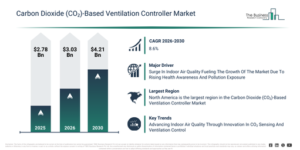
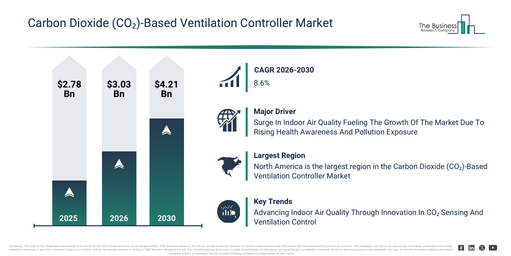
The market size for carbon dioxide (co2)-based ventilation controllers has experienced robust growth recently. This market is projected to expand from $2.78 billion in 2025 to $3.03 billion in 2026, demonstrating a compound annual growth rate (CAGR) of 8.8%. Historically, this expansion has been driven by factors such as heightened awareness of indoor air quality problems, the initial integration of HVAC automation within commercial structures, an increase in ventilation systems driven by occupancy, a strengthening regulatory emphasis on ventilation benchmarks, and the broader availability of NDIR sensors.
The market for carbon dioxide (co2)-based ventilation controllers is projected to experience substantial expansion over the coming years. This market is forecast to reach $4.21 billion by 2030, exhibiting a compound annual growth rate (CAGR) of 8.6%. This anticipated growth during the forecast timeframe stems from several factors, including the escalating demand for energy-efficient building solutions, the expansion of smart building retrofitting initiatives, the increasing incorporation of AI-driven ventilation management, more stringent environmental and air quality standards, and the growing implementation of co2 monitoring within residential properties. Key trends anticipated for this period encompass the increasing embrace of real-time ventilation optimization, a rise in the deployment of co2-responsive demand-controlled ventilation systems, a stronger inclination towards low-maintenance NDIR sensor technologies, enhanced integration of automated air quality balancing within structures, and the broader implementation of zone-based ventilation control across commercial environments.
Download A Free Sample Report For Comprehensive Market Insights:
#Carbon Dioxide (CO₂)-Based Ventilation Controller Market Growth Drivers And Industry Catalysts
A growing emphasis on indoor air quality is anticipated to drive the expansion of the carbon dioxide (CO2)-based ventilation controller market in the future. Indoor air quality pertains to the atmospheric state within structures, encompassing pollutants, temperature, humidity, and airflow, all of which influence the health and comfort of occupants. Heightened awareness of indoor air quality stems from greater health consciousness, given that improved indoor air can alleviate respiratory problems and enhance general well-being. Carbon dioxide (CO2)-based ventilation controllers contribute to better indoor air quality by automatically modifying airflow according to CO2 concentrations, thereby guaranteeing adequate ventilation and diminishing the level of indoor contaminants. As an illustration, in June 2025, data from GOV.UK, a UK government body, indicated that in 2024, the average yearly concentrations of NO2 fell by 8% at urban background locations and by 6% at roadside locations compared to 2023 figures. Such a reduction in external air pollutants underscores a broader increase in air quality consciousness. Consequently, the intensified attention on indoor air quality is propelling the expansion of the carbon dioxide (CO2)-based ventilation controller market.
Carbon Dioxide (CO₂)-Based Ventilation Controller Market Segment Analysis And Revenue Opportunities
The carbon dioxide (co₂)-based ventilation controller market covered in this report is segmented –
1) By Product Type: Standalone Controllers, Integrated Systems, Wireless Controllers, Wired Controllers
2) By Control Technology: Demand-Controlled Ventilation, Fixed Airflow Control, Hybrid Systems
3) By Sensor Type: NDIR, Chemical, Infrared, Others Sensor Types
4) By Application: Commercial Buildings, Residential Buildings, Industrial Facilities, Healthcare, Educational Institutions, Others Applications
5) By Distribution Channel: Direct Sales, Distributors, Online Retail, Others Distribution Channels
Subsegments:
1) By Standalone Controllers: Single Zone Controllers, Multi Zone Controllers, Programmable Controllers, Non-Programmable Controllers
2) By Integrated Systems: Building Management System Integrated Controllers, HVAC Integrated Controllers, Smart Home Integrated Controllers, Energy Management Integrated Controllers
3) By Wireless Controllers: Wi-Fi Enabled Controllers, Bluetooth Enabled Controllers, Zigbee Enabled Controllers, Cellular Network Controllers
4) By Wired Controllers: Ethernet Connected Controllers, Modbus Connected Controllers, BACnet Connected Controllers, RS485 Connected Controllers
Carbon Dioxide (CO₂)-Based Ventilation Controller Market Innovation Trends Driving Future Development
Leading firms within the carbon dioxide (CO₂)-based ventilation controller market are concentrating on creating advanced solutions, including NDIR sensors, to deliver exceptionally accurate and consistent carbon dioxide readings. This facilitates exact demand-controlled ventilation, boosts indoor air quality, and lowers energy usage. Specifically, an NDIR sensor is a non-dispersive infrared sensor designed to gauge gas concentrations, like CO₂, by recognizing the absorption of particular infrared light wavelengths. As an illustration, in March 2023, Vaisala Oyj, an industrial and environmental measurement solutions company based in Finland, broadened its HVAC product range by introducing the GMD110 duct-mounted CO₂ transmitter. This GMD110 model incorporates Vaisala’s sophisticated CARBOCAP NDIR sensor technology, providing sustained accuracy, reliability, and minimal maintenance needs. Featuring an IP65-rated enclosure, the transmitter ensures dependable operation even when subjected to dust, humidity, or chemical interference. Through its capacity for precise demand-controlled ventilation, the GMD110 improves energy efficiency, encourages environmental sustainability, and contributes to a healthier indoor air environment.
Carbon Dioxide (CO₂)-Based Ventilation Controller Market Leading Players Shaping Industry Direction
Major companies operating in the carbon dioxide (co₂)-based ventilation controller market are Siemens AG, Schneider Electric SE, Honeywell International Inc., ABB Ltd., Johnson Controls International plc, Trane Technologies plc, Delta Electronics Inc., Legrand SA, Vaisala Oyj, TROX GmbH, Dwyer Instruments Inc., Veris Industries LLC, KMC Controls Inc., Rotronic AG, Greystone Energy Systems Inc., Senseair AB, E+E Elektronik Ges.m.b.H., Belimo Holding AG, Ventilation Control Products Ltd., Calibration Technologies Inc., Sauter AG, CO2Meter.com.
Access The Complete Carbon Dioxide (CO₂)-Based Ventilation Controller Market Report:
Carbon Dioxide (CO₂)-Based Ventilation Controller Market Regional Analysis: Which Region Leads By Revenue?
North America was the largest region in the carbon dioxide (CO₂)-based ventilation controller market in 2025. Asia-Pacific is expected to be the fastest-growing region in the forecast period. The regions covered in the carbon dioxide (co₂)-based ventilation controller market report are Asia-Pacific, South East Asia, Western Europe, Eastern Europe, North America, South America, Middle East, Africa.
Get in touch with us:
The Business Research Company: https://www.thebusinessresearchcompany.com/
Americas: +1 310-496-7795
Asia: +44 7882 955267 & +91 8897263534
Europe: +44 7882 955267
Email us at: marketing@tbrc.info
Follow us on:
LinkedIn: https://in.linkedin.com/company/the-business-research-company
YouTube: https://www.youtube.com/channel/UC24_fI0rV8cR5DxlCpgmyFQ
Global Market Model: https://www.thebusinessresearchcompany.com/global-market-model

Wasay has over a decade of experience in market research, data modelling, and analytics, with prior experience at GlobalData and Decision Tree Consulting Services. At The Business Research Company , he leads research operations across syndicated studies, customized consulting engagements, and the Global Market Model platform. His professional experience includes supporting organizations such as Boston Consulting Group, KPMG, and Ernst & Young. Wasay holds a degree in Electronics and Communications Engineering, postgraduate management qualifications from International Management Institute Belgium and Indian School of Business and Entrepreneurship, and completed the Integrated Program in Business Analytics from Indian Institute of Management Indore.