Enhanced with market attractiveness analysis, total addressable market evaluation, company benchmarking matrices, interactive Excel dashboards, expanded supply chain intelligence, emerging startup coverage, and detailed product insights, The Business Research Company’s 2026 market reports deliver more actionable and strategically valuable research.
Carbon Dioxide Monitoring Equipment Market Growth Potential: How Will Market Size Change Through 2030?
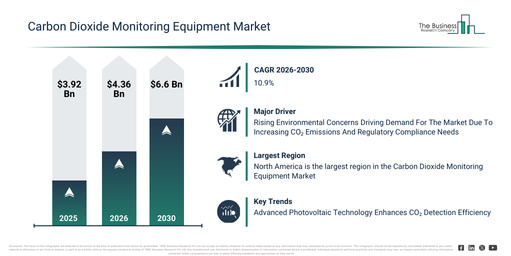
The carbon dioxide monitoring equipment market size has seen rapid expansion in recent years. It is forecast to grow from $3.92 billion in 2025 to $4.36 billion in 2026, achieving a compound annual growth rate (CAGR) of 11.2%. This historical growth can be attributed to several factors, including increasingly stringent workplace safety regulations, the early implementation of ndir co2 sensors, growing awareness of indoor air pollution, enhanced monitoring in industrial processes, and the expansion of environmental compliance requirements.
The carbon dioxide monitoring equipment market size is projected to experience substantial expansion in the coming years, reaching $6.6 billion by 2030, driven by a compound annual growth rate (CAGR) of 10.9%. This anticipated growth during the forecast period is fueled by factors such as an increasing need for real-time air quality surveillance, the expansion of smart agriculture uses, the greater incorporation of CO2 sensors into HVAC systems, more stringent building ventilation regulations, and a rise in consumer uptake of indoor air quality devices. Key trends during this period encompass a growing acceptance of highly accurate CO2 measurement for adherence to safety standards, the increased deployment of portable CO2 monitoring devices, a developing preference for air quality monitoring solutions that cover multiple parameters, an expanded application of CO2 monitoring within agricultural and greenhouse settings, and the broader installation of fixed CO2 monitors across industrial and commercial locations.
Download A Free Sample Report For Comprehensive Market Insights:
Carbon Dioxide Monitoring Equipment Market Expansion Supported By Key Demand Factors
Growing worries about the environment are anticipated to boost the expansion of the carbon dioxide monitoring equipment market in the future. These concerns encompass problems stemming from human or natural actions that negatively impact air, water, soil, ecosystems, and global sustainability. The escalation of environmental issues is fueled by population expansion, which in turn elevates the need for resources, boosts waste production, and places increased pressure on ecological systems. Carbon dioxide monitoring devices assist in tackling these issues by accurately measuring and monitoring CO2 concentrations in the atmosphere or industrial operations, facilitating prompt interventions to cut emissions, enhance air quality, and meet regulatory environmental standards. As an illustration, data from the School of Sustainability at Stanford University, a US-based institution, indicated in December 2023 that global carbon dioxide emissions were projected to surpass 40 billion tons in 2023, with almost 37 billion tons originating from fossil fuels. This marked a 1.1% rise compared to 2022 levels. Consequently, the increasing focus on environmental protection is stimulating the demand for the carbon dioxide monitoring equipment market.
Carbon Dioxide Monitoring Equipment Market Categorization By Product Type And Application
The carbon dioxide monitoring equipment market covered in this report is segmented –
1) By Product Type: Portable Carbon Dioxide Monitors, Fixed Carbon Dioxide Monitors, Infrared Carbon Dioxide Sensors, Non-Dispersive Infrared (NDIR) Sensors, Electrochemical Carbon Dioxide Sensors
2) By Technology: Non-Dispersive Infrared (NDIR), Chemical Sensor, Photoacoustic Spectroscopy, Solid State Sensor, Other Technologies
3) By Sales Channel: Direct Sales, Online Retailers, Distributors, Third-Party Resellers, Manufacturer Sales Representatives
4) By End-User: Industrial, Commercial, Residential, Environmental Monitoring, Agriculture
Subsegments:
1) By Portable Carbon Dioxide Monitors: Hand-Held Or Spot Monitors, Mobile Or Field Deployable Monitors, Wearable Or Personal Co₂ Monitors
2) By Fixed Carbon Dioxide Monitors: Wall-Mounted Fixed Monitors, Pipeline Or Duct-Mounted Fixed Monitors, Ceiling Or Room Fixed Monitors
3) By Infrared Carbon Dioxide Sensors: Single-Wavelength Infrared Carbon Dioxide Sensors, Multi-Wavelength Infrared Carbon Dioxide Sensors, Fiber-Optic Infrared Carbon Dioxide Sensors
4) By Non-Dispersive Infrared Sensors: Non-Dispersive Infrared Sensor Modules (Oem), Non-Dispersive Infrared Standalone Co₂ Sensing Units, Low-Cost Non-Dispersive Infrared For Consumer Applications
5) By Electrochemical Carbon Dioxide Sensors: Electrochemical Cell Carbon Dioxide Sensors For Portable Units, Fixed Electrochemical Carbon Dioxide Sensors For Indoor Air Quality, Hybrid Sensors Combining Electrochemicals
#Carbon Dioxide Monitoring Equipment Market Trends Influencing Long-Term Demand
Leading companies within the carbon dioxide monitoring equipment market are concentrating on developing sophisticated offerings, such as advanced photovoltaic CO₂ monitors, to enhance detection precision, energy efficiency, and continuous monitoring capabilities. These advanced photovoltaic carbon dioxide (CO₂) monitors are instruments that utilize light-based photovoltaic technology to accurately identify CO₂ concentrations with significant sensitivity and minimal power usage. For instance, in October 2024, Reef Technologies, a US-based digital solutions company, introduced AIR-sense-IQ, an advanced photovoltaic carbon dioxide (CO₂) monitor powered by Epishine’s printed organic indoor solar cells. This device continuously tracks indoor carbon dioxide levels, operating without external power or battery replacements by harvesting energy from indoor lighting, making it highly efficient and maintenance-free. AIR-sense-IQ notifies users when carbon dioxide levels rise, thereby fostering optimal air quality and comfort, especially within office environments.
Carbon Dioxide Monitoring Equipment Market Company Landscape And Strategic Competition
Major companies operating in the carbon dioxide monitoring equipment market are Siemens AG, General Electric Company, Thermo Fisher Scientific Inc., Honeywell International Inc, ABB Ltd., Koninklijke Philips N.V., Amphenol Advanced Sensors, Ametek Inc., Teledyne Technologies Incorporated, Endress+Hauser Group Services AG, Horiba Ltd., Masimo Corporation, Nihon Kohden Corporation, Testo SE & Co. KGaA, Vaisala Oyj, Sensirion AG, Senseair AB, Aeroqual Limited, Gas Sensing Solutions Ltd., Drägerwerk AG & Co. KGaA
Access The Complete Carbon Dioxide Monitoring Equipment Market Report:
Carbon Dioxide Monitoring Equipment Market Regional Analysis: Which Region Leads By Revenue?
North America was the largest region in the carbon dioxide monitoring equipment market in 2025. Asia-Pacific is expected to be the fastest-growing region in the forecast period. The regions covered in the carbon dioxide monitoring equipment market report are Asia-Pacific, South East Asia, Western Europe, Eastern Europe, North America, South America, Middle East, Africa.
Get in touch with us:
The Business Research Company: https://www.thebusinessresearchcompany.com/
Americas: +1 310-496-7795
Asia: +44 7882 955267 & +91 8897263534
Europe: +44 7882 955267
Email us at: marketing@tbrc.info
Follow us on:
LinkedIn: https://in.linkedin.com/company/the-business-research-company
YouTube: https://www.youtube.com/channel/UC24_fI0rV8cR5DxlCpgmyFQ
Global Market Model: https://www.thebusinessresearchcompany.com/global-market-model

Wasay has over a decade of experience in market research, data modelling, and analytics, with prior experience at GlobalData and Decision Tree Consulting Services. At The Business Research Company , he leads research operations across syndicated studies, customized consulting engagements, and the Global Market Model platform. His professional experience includes supporting organizations such as Boston Consulting Group, KPMG, and Ernst & Young. Wasay holds a degree in Electronics and Communications Engineering, postgraduate management qualifications from International Management Institute Belgium and Indian School of Business and Entrepreneurship, and completed the Integrated Program in Business Analytics from Indian Institute of Management Indore.