
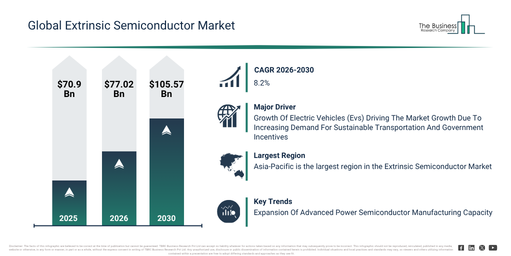
Featuring market attractiveness scoring, total addressable market sizing, company benchmarking matrices, interactive Excel dashboards, deeper supply chain intelligence, emerging startup tracking, and granular product-level insights, The Business Research Company’s 2026 market reports are built to deliver research that is both more actionable and more strategically valuable.
Extrinsic Semiconductor Market Revenue Growth On Track For A 8.2% CAGR Through 2030
The extrinsic semiconductor market has demonstrated robust expansion recently. It is projected to expand from $70.9 billion in 2025 to $77.02 billion in 2026, exhibiting a compound annual growth rate (CAGR) of 8.6%. Historically, this growth can be attributed to a heightened demand for semiconductor devices, the increasing adoption of transistor-based electronics, the wider application of silicon semiconductor materials, an expansion in semiconductor manufacturing capabilities, and a growing need for controlled electrical conductivity.
The extrinsic semiconductor market is poised for substantial expansion over the coming years. Its value is projected to reach $105.57 billion by 2030, expanding at a compound annual growth rate (CAGR) of 8.2%. This growth during the forecast period is primarily driven by factors such as the increasing need for high-performance doped semiconductor materials, greater adoption of wide bandgap semiconductor technologies, the growing necessity for precise doping control, the ongoing development of advanced semiconductor devices, and the increasing requirement for high-efficiency electronic components. Key trends anticipated during this period encompass the increasing integration of advanced doping techniques, a growing demand for high-purity semiconductor materials, the ongoing evolution of wide bandgap doped semiconductors, a heightened need for precise carrier concentration control, and the increasing implementation of advanced semiconductor fabrication processes.
Get A Free Sample Report With In-Depth Market Insights:
Extrinsic Semiconductor Market Growth Drivers: What’s Behind The Acceleration?
The increasing prevalence of electric vehicles (EVs) is anticipated to fuel the expansion of the extrinsic semiconductor market in the future. These vehicles, primarily operating on electric motors powered by stored battery energy, are seeing increased adoption due to aims for sustainability, reduced emissions, and breakthroughs in battery innovation. The growing embrace of electric vehicles stems from their decreased operational expenses, given that they demand less upkeep and run on electricity, typically more economical than gasoline or diesel, thereby lowering overall ownership costs. This heightened EV adoption is propelling the extrinsic semiconductor sector forward through increased demand for sophisticated semiconductor parts essential for power electronics, battery management, inverters, charging networks, and vehicle control systems, all of which necessitate improved efficiency, dependability, and performance. For example, in January 2025, new electric vehicle sales reached 102,243 units, a 29.9% rise from the previous year’s corresponding period, as reported by Cox Automotive, a US-based system software firm. Consequently, the expansion of electric vehicles (EVs) is a significant catalyst for the growth of the extrinsic semiconductor market.
Extrinsic Semiconductor Market Segment Outlook: Which Categories Are Growing Fastest?
The extrinsic semiconductor market covered in this report is segmented –
1) By Type: N Type Semiconductor, P Type Semiconductor
2) By Material Type: Silicon, Germanium, Gallium Arsenide, Indium Phosphide
3) By Device Type: Transistors, Diodes, Integrated Circuits, Sensors
4) By End Use Sector Type: Automotive, Consumer Electronics, Healthcare, Aerospace
Subsegments:
1) By N Type Semiconductors: Donor Doped Semiconductors, Electron Majority Carrier Semiconductors, Wide Bandgap N Type Semiconductors
2) By P Type Semiconductors: Acceptor Doped Semiconductors, Hole Majority Carrier Semiconductors, Wide Bandgap P Type Semiconductors
Extrinsic Semiconductor Market Trends: What’s Defining The Industry’s Next Phase?
Leading companies in the extrinsic semiconductor market are increasingly concentrating on boosting semiconductor manufacturing capabilities, developing advanced power semiconductor technologies, implementing digitalized production methods, and creating energy-efficient chip solutions. This strategic focus aims to satisfy the escalating demand stemming from artificial intelligence (AI) data centers, renewable energy systems, electric vehicles, power grids, and various other industrial uses. These advancements consequently enhance the availability of doped semiconductor materials and devices, which are essential for controlling and managing electrical power within contemporary electronic systems. A notable example occurred in July 2026, when Infineon Technologies AG, a Germany-based semiconductor firm, inaugurated its Smart Power Fab in Dresden, Germany, following a substantial €5 billion investment. This new facility effectively doubles Infineon’s manufacturing output at the Dresden location. Its primary purpose is to produce intelligent power semiconductors and analog/mixed-signal technologies, catering to applications such as AI data centers, renewable energy systems, power grids, and software-defined vehicles. Furthermore, the fab incorporates advanced technologies like digital twins, AI-supported system and process clearance, and a One Virtual Fab connection with Infineon’s Villach site, all designed to expedite production ramp-up. By increasing the production of power semiconductors and facilitating more efficient and intelligent electrical systems, the Smart Power Fab plays a crucial role in addressing the increasing demand for semiconductor devices across energy management, automotive, industrial, and power infrastructure applications, consequently fostering the expansion of the extrinsic semiconductor market.
Extrinsic Semiconductor Market Leading Companies And Competitive Benchmarking
Major companies operating in the extrinsic semiconductor market are SK hynix Inc, Intel Corporation, Sumitomo Electric Industries Ltd, Shin-Etsu Chemical Co Ltd, Infineon Technologies AG, STMicroelectronics NV, Coherent Corp, ON Semiconductor Corporation, ROHM Co Ltd, SUMCO Corporation, GlobalWafers Co Ltd, Siltronic AG, Soitec SA, Wolfspeed Inc, Wafer Works Corporation, IQE plc, AXT Inc, Navitas Semiconductor Corporation, SK Siltron Co Ltd, Shanghai Simgui Technology Co Ltd
View The Full Extrinsic Semiconductor Market Report:
Extrinsic Semiconductor Market Top Region By Revenue And Market Share
Asia-Pacific was the largest region in the extrinsic semiconductor market in 2025. Asia-Pacific is expected to be the fastest-growing region in the forecast period. The regions covered in the extrinsic semiconductor market report are Asia-Pacific, South East Asia, Western Europe, Eastern Europe, North America, South America, Middle East, Africa.
Reach Out To Our Team:
The Business Research Company: https://www.thebusinessresearchcompany.com/
Americas: +1 310-496-7795
Asia: +44 7882 955267 & +91 8897263534
Europe: +44 7882 955267
Email us at: marketing@tbrc.info
Follow us on:
LinkedIn: https://in.linkedin.com/company/the-business-research-company
YouTube: https://www.youtube.com/channel/UC24_fI0rV8cR5DxlCpgmyFQ
Global Market Model: https://www.thebusinessresearchcompany.com/global-market-model

Wasay has over a decade of experience in market research, data modelling, and analytics, with prior experience at GlobalData and Decision Tree Consulting Services. At The Business Research Company , he leads research operations across syndicated studies, customized consulting engagements, and the Global Market Model platform. His professional experience includes supporting organizations such as Boston Consulting Group, KPMG, and Ernst & Young. Wasay holds a degree in Electronics and Communications Engineering, postgraduate management qualifications from International Management Institute Belgium and Indian School of Business and Entrepreneurship, and completed the Integrated Program in Business Analytics from Indian Institute of Management Indore.