
Backed by market attractiveness analysis, total addressable market sizing, company benchmarking matrices, interactive Excel dashboards, wider supply chain intelligence, emerging startup coverage, and detailed product-level insights, The Business Research Company’s 2026 market reports are designed to offer research that is more actionable and strategically valuable than ever.
Fab Automation Market Forecast: Value Set To Climb From $26.92 Billion To $37.44 Billion
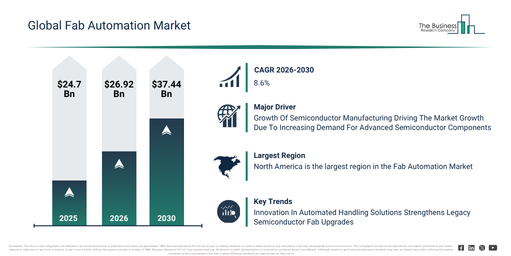
The fab automation market size has experienced robust growth in recent years. It is forecast to grow from $24.7 billion in 2025 to $26.92 billion in 2026, achieving a compound annual growth rate (CAGR) of 9.0%. Historically, this expansion has been driven by increasing semiconductor production volumes, a rising demand for manufacturing efficiency, the growing need to reduce manual intervention, an expansion in semiconductor fabrication capacity, and an increasing focus on consistent production quality.
The fab automation market is anticipated to experience substantial growth in the upcoming years. It is projected to reach $37.44 billion in 2030, exhibiting a compound annual growth rate (CAGR) of 8.6%. This expansion during the forecast period is driven by a heightened demand for sophisticated semiconductor fabrication capabilities, an increasing necessity for improved manufacturing throughput, the expanding adoption of automated material movement, a growing requirement for real-time production oversight, and an escalating need for operational precision and process consistency. Significant trends expected in this period encompass the greater uptake of automated material handling solutions, a rising need for continuous equipment monitoring, the increasing imperative for automated process management, an elevated demand for semiconductor manufacturing traceability, and the wider deployment of automated wafer handling and transport systems.
Get A Free Sample Report With In-Depth Market Insights:
Fab Automation Market Demand Drivers: What’s Powering Industry Growth?
The expansion of semiconductor manufacturing is anticipated to drive the advancement of the fab automation market in the future. This process involves the creation of integrated circuits and semiconductor devices via intricate fabrication methods, demanding rigorous precision, operational efficiency, and stringent quality control. Its growth is fueled by a rising need for sophisticated electronic gadgets that depend on more compact, quicker, and energy-efficient semiconductor chips to provide superior performance, enhanced features, and greater computational power. This sector promotes the adoption of fab automation solutions, driven by a growing imperative for automated wafer handling, precise process control, comprehensive equipment monitoring, and optimized manufacturing operations. These measures aim to boost production efficiency, minimize human error, elevate yield rates, and facilitate the manufacturing of advanced semiconductor chips. An example of this trend is seen in June 2024, when the Semiconductor Equipment and Materials International, a US-based industry association, projected that the semiconductor manufacturing industry’s capacity would expand by 6% in 2024 and further by 7% in 2025. Consequently, the expansion of semiconductor manufacturing is a key factor propelling the growth of the fab automation market.
Fab Automation Market Segmentation And Category Overview
The fab automation market covered in this report is segmented –
1) By Component: Hardware, Software, Services
2) By Wafer Size: Less Than 150 Millimeters, 200 Millimeters, 300 Millimeters
3) By Deployment Type: Greenfield Fabs, Brownfield Fabs
4) By Application: Equipment Automation, Material Handling Automation, Process Automation
5) By End User: Integrated Device Manufacturers, Foundries, Outsourced Semiconductor Assembly And Test Providers, Research Fabs
Subsegments:
1) By Hardware: Industrial Robots, Automated Material Handling Systems, Machine Vision Systems, Sensors And Actuators, Programmable Logic Controllers, Automated Storage And Retrieval Systems
2) By Software: Manufacturing Execution Software, Factory Automation Control Software, Equipment Monitoring Software, Production Scheduling Software, Data Analytics And Reporting Software, Digital Twin Software
3) By Services: System Integration Services, Installation And Commissioning Services, Maintenance And Support Services, Consulting Services, Training And Education Services, Remote Monitoring Services
Fab Automation Market Innovation Trends: What Developments Are Reshaping The Industry?
Major companies operating in the fab automation market are prioritizing the development of innovative products, such as automated material handling and wafer transfer systems, to improve semiconductor manufacturing efficiency, contamination control, process reliability, and the automation of legacy fabrication facilities. These automated material handling and wafer transfer systems are advanced solutions for semiconductor factory automation that enable the secure movement, opening, identification, and transfer of wafer carriers between transport systems and processing equipment. This significantly reduces manual handling requirements and enhances production consistency compared to traditional operator-assisted workflows. For instance, in April 2026, Fabmatics GmbH, a Germany-based semiconductor automation solutions company, introduced its Box Opening Transfer Unit for box-based 200 mm semiconductor fabs. This system is designed to manage the interface between protected HA200 box-based wafer transport and open wafer cassette handling at semiconductor process tools. The solution automatically opens HA200 boxes within the transport system and transfers wafer cassettes to downstream handling or tool-loading systems, all while keeping the box inside the conveyor. This ensures a controlled and repeatable material handover without manual intervention. It can be integrated into existing fab layouts, eliminating local buffer areas, maintaining continuous material flow, reducing contamination risks, and improving process stability.
Fab Automation Market Competitive Analysis Of Leading Industry Participants
Major companies operating in the fab automation market are Siemens AG, Schneider Electric SE, Honeywell International Inc., Mitsubishi Electric Corporation, ABB Ltd., Applied Materials Inc., Atlas Copco AB, Ebara Corporation, Rockwell Automation Inc., Daifuku Co. Ltd., FANUC LTD., Teradyne Inc., Murata Machinery Ltd., SFA Engineering Corp., KUKA AG, Mirle Automation Corporation, INFICON Holding AG, PEER Group Inc., Stratus Automation Inc.
View The Full Fab Automation Market Report:
Fab Automation Market Geographic Spread And Regional Opportunities
North America was the largest region in the fab automation market in 2025. Asia-Pacific is expected to be the fastest-growing region in the forecast period. The regions covered in the fab automation market report are Asia-Pacific, South East Asia, Western Europe, Eastern Europe, North America, South America, Middle East, Africa.
Reach Out To Our Team:
The Business Research Company: https://www.thebusinessresearchcompany.com/
Americas: +1 310-496-7795
Asia: +44 7882 955267 & +91 8897263534
Europe: +44 7882 955267
Email us at: marketing@tbrc.info
Follow us on:
LinkedIn: https://in.linkedin.com/company/the-business-research-company
YouTube: https://www.youtube.com/channel/UC24_fI0rV8cR5DxlCpgmyFQ
Global Market Model: https://www.thebusinessresearchcompany.com/global-market-model

Wasay has over a decade of experience in market research, data modelling, and analytics, with prior experience at GlobalData and Decision Tree Consulting Services. At The Business Research Company , he leads research operations across syndicated studies, customized consulting engagements, and the Global Market Model platform. His professional experience includes supporting organizations such as Boston Consulting Group, KPMG, and Ernst & Young. Wasay holds a degree in Electronics and Communications Engineering, postgraduate management qualifications from International Management Institute Belgium and Indian School of Business and Entrepreneurship, and completed the Integrated Program in Business Analytics from Indian Institute of Management Indore.