
Built to provide research that’s more actionable and strategically valuable, The Business Research Company’s 2026 market reports include market attractiveness analysis, total addressable market sizing, company benchmarking matrices, interactive Excel dashboards, broader supply chain intelligence, emerging startup tracking, and in-depth product insights.
Green Electronics Manufacturing Market Growth Analysis: How Will Revenue Trend Over The Forecast Period?
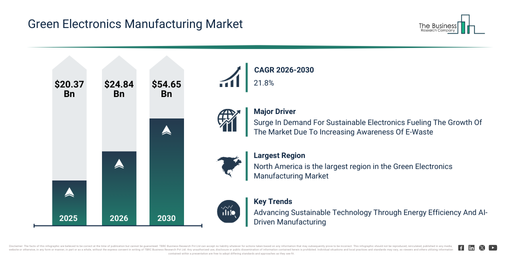
The market size of green electronics manufacturing has seen substantial expansion in recent years. It is projected to grow from $20.37 billion in 2025 to $24.84 billion in 2026, at a compound annual growth rate (CAGR) of 22.0%. This growth in the past can be attributed to regulatory mandates on e-waste disposal, increasing consumer awareness on sustainability, the adoption of energy-efficient components, government incentives for green electronics, and the rising cost of non-renewable resources.
The green electronics manufacturing market size is projected to experience substantial growth over the coming years. It is predicted to expand to $54.65 billion by 2030, exhibiting a compound annual growth rate (CAGR) of 21.8%. This growth during the forecast period can be attributed to advancements in biodegradable and recyclable materials, the integration of AI for energy optimization, the expansion of renewable-powered manufacturing facilities, the proliferation of modular and repairable electronics, and the rising demand for low-power consumption devices. Prominent trends in the forecast period include the adoption of eco-friendly materials, the implementation of energy-efficient manufacturing processes, various waste minimization techniques, comprehensive sustainable electronics lifecycle management, and green supply chain optimization.
Get A Free Sample Report With In-Depth Market Insights:
Green Electronics Manufacturing Market Opportunity Drivers: What’s Unlocking New Revenue Potential?
The expansion of the green electronics manufacturing market is anticipated, fueled by the increasing need for sustainable electronic items. These products are conceived, created, and discarded in ways that reduce environmental harm and enhance long-term resource utilization. This rising demand stems from a heightened understanding of electronic waste (e-waste) and its environmental consequences. Rapid technological progress encourages frequent device replacements by consumers, resulting in a proliferation of discarded electronics containing dangerous substances such as lead, mercury, and cadmium. Such toxic elements can pollute soil and water, presenting significant health and ecological dangers. Green electronics manufacturing supports sustainable electronics by concentrating on environmentally sound production methods and components that lessen the environmental impact of electronic gadgets across their entire lifespan. For example, in 2024, a report from Uswitch Limited, a UK-based price comparison service, indicated that sustainable electronics constituted around 18.5% of the consumer-packaged goods (CPG) in 2023, representing a 1.2% rise from 2022 (17.3%). Consequently, the increased call for sustainable electronics products is propelling the expansion of the green electronics manufacturing market.
Green Electronics Manufacturing Market Breakdown By Product Type And Application
The green electronics manufacturing market covered in this report is segmented –
1) By Product: Green Computers, Green Smartphones, Green Smart Home Appliances, Green Wearable Electronics, Green Industrial Electronics
2) By Material: Bioplastics, Plant-Based Materials, Aluminum, Borosilicate Glass, Graphene, Iron Alloy, Sustainable Wood, Recycled Glass, Recycled Plastics
3) By Process: Life Cycle Assessment (LCA), Design for Environment (DfE), Waste Reduction Techniques, Energy Conservation Measures, Zero Waste Manufacturing
4) By Technology: Lead Free, Halogen Free
5) By End-user: Consumer Electronics, Healthcare, Automotive, Industrial, Government
Subsegments:
1) By Green Computers: Energy-Efficient Laptops, Solar-Powered Computers, Eco-Friendly Desktops, Recyclable Computer Components, Low-Power Consumption Servers, Biodegradable Computer Accessories
2) By Green Smartphones: Solar-Powered Smartphones, Recycled-Material Smartphones, Energy-Efficient Batteries, Modular And Repairable Phones, Biodegradable Phone Cases And Accessories
3) By Green Smart Home Appliances: Energy-Efficient Refrigerators, Eco-Friendly Washing Machines, Smart Energy-Saving Air Conditioners, Solar-Powered Water Heaters, Low-Power Consumption Light Emitting Diode (LED) Lighting, Smart Thermostats With Artificial Intelligence (AI) Optimization, Eco-friendly Kitchen Appliances
4) By Green Wearable Electronics: Solar-Powered Smartwatches, Energy-Efficient Fitness Trackers, Biodegradable Or Recycled-Material Wearables, Kinetic-Powered Wearable Devices, Low-Emission Bluetooth Earbuds And Headphones
5) By Green Industrial Electronics: Energy-Efficient Industrial Control Systems, Low-Power Automation Equipment, Eco-Friendly Circuit Boards, Sustainable Semiconductor Manufacturing, Smart Grid And Renewable Energy Electronics, Industrial Internet Of Things (IoT) For Energy Optimization
Green Electronics Manufacturing Market Innovation Trends Shaping Future Development
Companies playing a significant role in the green electronics manufacturing market are increasingly prioritizing sustainable technology to diminish environmental impact and elevate efficiency. Sustainable technology involves innovations, processes, and products crafted to minimize ecological harm while concurrently advancing long-term resource efficiency, economic viability, and social equity. For example, in May 2023, Infineon Technologies AG, a Germany-based semiconductor enterprise specializing in the design and production of energy-efficient chips and electronic solutions, initiated two European ventures to champion sustainable technology. The ‘ALL2GaN’ project was dedicated to creating gallium nitride (GaN) chips, achieving a 30% improvement in energy efficiency and subsequently cutting 218 million tons of CO2 emissions. Meanwhile, the ‘AIMS5.0’ project utilized artificial intelligence (AI) to optimize resource-efficient manufacturing and supply chains. Both initiatives, with a combined worth of 130 million euros, brought together 98 partners from 18 countries and secured funding through industry investments, national grants, and the European Key Digital Technologies program.
Green Electronics Manufacturing Market Company Landscape And Competitive Strategy
Major companies operating in the green electronics manufacturing market are Apple Inc, Dell Technologies Inc, Sony Corporation, Siemens AG, Lenovo, LG Electronics Inc, HP Inc, GE Vernova, Nokia, Koninklijke Philips NV, Philips, STMicroelectronics N.V., Sharp Corporation, Acer Inc, EInk Holdings Inc., Panasonic Corporation, Skeleton Technologies, Fairphone, Toshiba Corporation, Samsung Electronics Co Ltd.
View The Full Green Electronics Manufacturing Market Report:
Green Electronics Manufacturing Market Regional Analysis: Which Geography Leads On Revenue?
North America was the largest region in the green electronics manufacturing market in 2025. Asia-Pacific is expected to be the fastest-growing region in the forecast period. The regions covered in the green electronics manufacturing market report are Asia-Pacific, South East Asia, Western Europe, Eastern Europe, North America, South America, Middle East, Africa.
Reach Out To Our Team:
The Business Research Company: https://www.thebusinessresearchcompany.com/
Americas: +1 310-496-7795
Asia: +44 7882 955267 & +91 8897263534
Europe: +44 7882 955267
Email us at: marketing@tbrc.info
Follow us on:
LinkedIn: https://in.linkedin.com/company/the-business-research-company
YouTube: https://www.youtube.com/channel/UC24_fI0rV8cR5DxlCpgmyFQ
Global Market Model: https://www.thebusinessresearchcompany.com/global-market-model

Wasay has over a decade of experience in market research, data modelling, and analytics, with prior experience at GlobalData and Decision Tree Consulting Services. At The Business Research Company , he leads research operations across syndicated studies, customized consulting engagements, and the Global Market Model platform. His professional experience includes supporting organizations such as Boston Consulting Group, KPMG, and Ernst & Young. Wasay holds a degree in Electronics and Communications Engineering, postgraduate management qualifications from International Management Institute Belgium and Indian School of Business and Entrepreneurship, and completed the Integrated Program in Business Analytics from Indian Institute of Management Indore.