Featuring market attractiveness scoring, total addressable market sizing, company benchmarking matrices, interactive Excel dashboards, deeper supply chain intelligence, emerging startup tracking, and granular product-level insights, The Business Research Company’s 2026 market reports are built to deliver research that is both more actionable and more strategically valuable.
Grid- Tied Inverters Market Revenue Outlook: What CAGR Lies Ahead Through 2030?
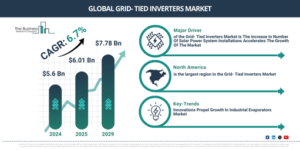
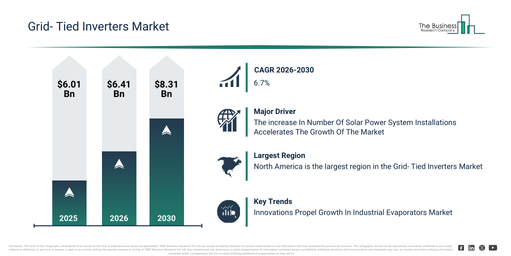
The market for grid-tied inverters has seen robust expansion in recent years. It is anticipated to expand from $6.01 billion in 2025 to $6.41 billion in 2026, achieving a compound annual growth rate (CAGR) of 6.6%. This past growth can be linked to factors like the initial uptake of grid-connected solar facilities, an increase in distributed renewable electricity generation, a growing requirement for steady AC power output, governmental support for solar installations, and the enlargement of inverter manufacturing capabilities.
The grid-tied inverters market size is projected to experience substantial expansion over the upcoming years. This market is anticipated to reach a valuation of $8.31 billion by 2030, exhibiting a compound annual growth rate (CAGR) of 6.7%. Key drivers for this growth during the forecast period include the increasing need for smart grid infrastructure, a surge in rooftop photovoltaic (PV) system installations, continuous improvements in inverter semiconductor technologies, the expansion of solar initiatives in industrial and commercial sectors, and a growing transition towards energy systems with reduced carbon emissions. Significant trends expected during this timeframe involve the wider adoption of transformerless high-frequency inverters, enhanced integration of inverter solutions compatible with smart grids, increased utilization of advanced MPPT technologies, the proliferation of utility-scale solar grid-tie setups, and a noticeable move towards inverter designs that offer high efficiency and minimal loss.
Get A Free Sample Report With In-Depth Market Insights:
Grid- Tied Inverters Market Growth Catalysts And Demand Drivers
The grid-tied inverter market is expected to experience growth due to an increasing number of solar power system installations. A solar power system refers to a mechanism that captures solar radiation and converts it into either usable electrical or thermal energy. Solar panels are linked to a grid-tied inverter (GTI), which then transforms the direct current (DC) they generate into alternating current (AC). For example, in October 2025, according to GreenMatch, a UK-based solar energy company, the UK recorded 1,735,000 solar panel installations in 2025, predominantly in the domestic sector. This represented a 6.8% rise compared to the previous year. Therefore, the expanding volume of solar power system installations is propelling the growth of the grid-tied inverter market.
Grid- Tied Inverters Market Segment Landscape And Growth Outlook
The grid- tied inverters market covered in this report is segmented –
1) By Type: Low Frequency Inverter, High Frequency Inverter
2) By Application: DC Voltage Source, Grid Connection, Other Application
3) By End-Use: Residential, Commercial, Industrial, Other End-Uses
Subsegments:
1) By Low Frequency Inverter: Transformer-Based Inverters, Applications In Large-Scale Systems
2) By High Frequency Inverter: Transformerless Inverters, Applications In Residential And Commercial Systems
Grid- Tied Inverters Market Trends Shaping Long-Term Demand
Leading companies within the grid-tied inverter market are innovating solutions, such as grid-tied residential energy storage options, to strengthen their market standing. The integration of new grid-tied residential energy storage significantly boosts the grid-tied inverter market growth by stimulating demand, driving technological advancements, and enabling seamless integration of energy storage systems across diverse grid environments. For instance, in September 2023, Canadian Solar Inc., a Canada-based Renewable energy company, introduced the EP Cube Lite, an affordable residential energy storage solution, at RE+ in Las Vegas. This product, a smaller version of the EP Cube, aims to enhance financial advantages for U.S. households adopting combined solar and battery storage. The compact, grid-tied system allows users to optimize their energy consumption, thereby reducing evening costs. With capacities scalable from 6.6 kWh to 19.9 kWh, it is compatible with existing PV systems, encouraging customization. Featuring an integrated hybrid inverter and stackable storage modules, its lightweight components facilitate quick installation, ultimately aiming to make energy storage more accessible and promote sustainable practices.
Grid- Tied Inverters Market Competitive Landscape: Who Leads The Industry?
Major companies operating in the grid- tied inverters market are Mitsubishi Electric Corporation, Huawei Technologies Co Ltd., Hitachi Ltd., Schneider Electric SE, ABB Ltd., Toshiba Corporation, Emerson Electric Co, Delta Electronics, Chint Power Systems Co Ltd., Omron Corporation, Sungrow Power Supply Co Ltd., KACO New Energy GmbH, SolarEdge Technologies Inc., Enphase Energy Inc., Advanced Energy Industries Inc., Ginlong Technologies Co Ltd., TMEIC International Corporation, SMA Solar Technology AG, Power Electronics España SL, Darfon Electronics Corporation, Luminous Power Technology Pvt Ltd., Fronius International GmbH, FIMER SpA, Altenergy Power System Inc., Growatt New Energy Technology Co Ltd., Sputnik Engineering AG
View The Full Grid- Tied Inverters Market Report:
Grid- Tied Inverters Market Largest Region: Which Geography Holds The Biggest Share?
North America was the largest region in the grid tied inverters market in 2025. The regions covered in the grid- tied inverters market report are Asia-Pacific, South East Asia, Western Europe, Eastern Europe, North America, South America, Middle East, Africa.
Reach Out To Our Team:
The Business Research Company: https://www.thebusinessresearchcompany.com/
Americas: +1 310-496-7795
Asia: +44 7882 955267 & +91 8897263534
Europe: +44 7882 955267
Email us at: marketing@tbrc.info
Follow us on:
LinkedIn: https://in.linkedin.com/company/the-business-research-company
YouTube: https://www.youtube.com/channel/UC24_fI0rV8cR5DxlCpgmyFQ
Global Market Model: https://www.thebusinessresearchcompany.com/global-market-model

Wasay has over a decade of experience in market research, data modelling, and analytics, with prior experience at GlobalData and Decision Tree Consulting Services. At The Business Research Company , he leads research operations across syndicated studies, customized consulting engagements, and the Global Market Model platform. His professional experience includes supporting organizations such as Boston Consulting Group, KPMG, and Ernst & Young. Wasay holds a degree in Electronics and Communications Engineering, postgraduate management qualifications from International Management Institute Belgium and Indian School of Business and Entrepreneurship, and completed the Integrated Program in Business Analytics from Indian Institute of Management Indore.