Through market attractiveness analysis, total addressable market evaluation, company benchmarking matrices, interactive Excel dashboards, expanded supply chain intelligence, emerging startup coverage, and detailed product insights, The Business Research Company’s 2026 market reports provide more actionable and strategically valuable research.
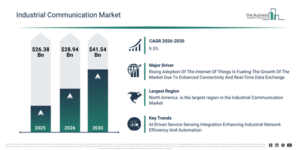
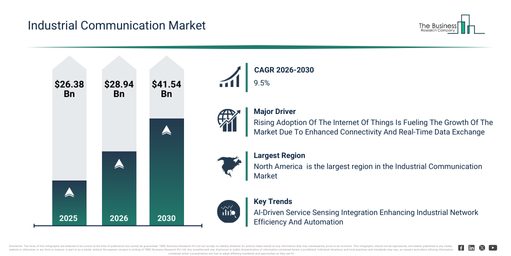
Industrial Communication Market Growth From $28.94 Billion In 2026 To $41.54 Billion By 2030 At A CAGR Of 9.5%
The industrial communication market has demonstrated strong growth over recent years. It is anticipated to increase from $26.38 billion in 2025 to $28.94 billion in 2026, registering a compound annual growth rate (CAGR) of 9.7%. This historic expansion can be attributed to several factors, including the adoption of programmable logic controllers, industrial automation growth in manufacturing, development of fieldbus communication, demand for process optimization, and expansion of industrial ethernet networks.
The industrial communication market is anticipated to experience significant growth in the upcoming years, with its size projected to reach $41.54 billion by 2030, at a compound annual growth rate (CAGR) of 9.5%. This growth throughout the forecast period is largely driven by factors such as the integration of AI in industrial communication, the proliferation of wireless industrial networks, the adoption of edge computing, the increasing demand for predictive maintenance solutions, and the expansion of smart factories and connected devices. Noteworthy trends during this period encompass real-time industrial data monitoring, the development of low-latency communication networks, secure industrial communication protocols, advancements in predictive maintenance and analytics, and the widespread application of edge computing for industrial automation.
Download A Free Sample Report For Comprehensive Market Insights:
Industrial Communication Market Development Factors: Which Trends Are Supporting Demand?
Increased integration of the internet of things is projected to drive expansion in the industrial communication market in the future. The internet of things encompasses a system of physical items equipped with sensors, software, and connection capabilities, enabling them to gather, share, and utilize data via the internet or other communication infrastructures, without direct human intervention. The proliferation of the internet of things is fueled by sophisticated connectivity, which facilitates smooth data transfer between devices, leading to enhanced decision-making and instantaneous automation. The widespread use of the internet of things (IoT) boosts the need for industrial communication because IoT devices generate substantial amounts of live data that require swift, dependable communication networks to ensure uninterrupted connectivity, effective data exchange, and coordinated industrial processes. For example, as reported by the European Commission (EC), a governmental organization situated in Belgium, in July 2025, the quantity of IoT-linked devices is anticipated to climb at an annual rate of 7% from more than 40 billion in 2023 to 49 million by 2026. Consequently, the increasing embrace of the internet of things is propelling the expansion of the industrial communication market.
Industrial Communication Market Segmentation: How Is The Market Structured Across Key Categories?
The industrial communication market covered in this report is segmented –
1) By Component: Software, Hardware, Services
2) By Communication Protocol: Fieldbus, Industrial Ethernet, Wireless
3) By Control Mechanism: Programmable Logic Controller, Supervisory Control And Data Acquisition, Distributed Control System, Other Control Mechanisms
4) By Functional Level: Device Or Field Level, Control Level, Information Or Operational Or Supervisory Level
5) By Application: Automotive And Transportation, Electrical And Electronics, Aerospace And Defense, Oil And Gas, Food And Beverages, Energy And Power, Chemical, Pharmaceutical, Industrial Manufacturing, Other Applications
Subsegments:
1) By Software: Industrial Ethernet Configuration Tools, Network Monitoring And Management Software, Data Analysis And Visualization Tools, Programmable Logic Controller (PLC), Supervisory Control And Data Acquisition (SCADA)
2) By Hardware: Routers, Switches, Gateways, Controllers, Connectors, Communication Interfaces
3) By Services: Professional Services, Consulting, Integration And Deployment, Training And Support, Managed Services
Industrial Communication Market Trends: What Is Shaping Future Industry Growth?
Leading companies operating in the industrial communication market are focusing on developing advanced strategies, such as artificial intelligence (AI)-driven service sensing integration, to equip enterprises and industrial sectors with intelligent, reliable, and efficient network solutions. These solutions aim to enhance automation, facilitate real-time data exchange, and improve operational efficiency across numerous applications. Artificial intelligence (AI)-driven service sensing integration is defined as a network solution that utilizes artificial intelligence (AI) algorithms to analyze, predict, and optimize service demands in real time, thereby enabling intelligent, automated, and efficient integration of enterprise or industrial network operations. For instance, in March 2025, Huawei Technologies Co. Ltd., a technology company based in China, introduced the Enterprise Network Solution 5.2. This solution features a cutting-edge integration of artificial intelligence (AI)-driven automation and ultra-low latency 5G connectivity. It leverages connections, artificial intelligence (AI), intelligent algorithms, and coordinated scheduling to enable the service-intelligent reconstruction of industry customers and assist them in building efficient, reliable, and intelligently resilient networks.
Industrial Communication Market Competitive Landscape And Leading Companies
Major companies operating in the industrial communication market are Siemens AG, GE Grid Solutions LLC, Cisco Systems Inc., Schneider Electric, Mitsubishi Electric Corporation, Asea Brown Boveri, Texas Instruments Incorporated, TE Connectivity, Infineon Technologies AG, Emerson Electric Co, Rockwell Automation, Omron Corporation, FANUC America Corporation, Endress+Hauser Group Services AG, Belden Inc., Advantech Co. Ltd., SICK AG, NATIONAL INSTRUMENTS CORP, ifm electronic gmbh, HMS Networks, Moxa Inc.
Access The Complete Industrial Communication Market Report:
Industrial Communication Market Geographic Landscape: Which Region Dominates Industry Growth?
North America was the largest region in the industrial communication market in 2025. Asia-Pacific is expected to be the fastest-growing region in the forecast period. The regions covered in the industrial communication market report are Asia-Pacific, South East Asia, Western Europe, Eastern Europe, North America, South America, Middle East, Africa.
Get in touch with us:
The Business Research Company: https://www.thebusinessresearchcompany.com/
Americas: +1 310-496-7795
Asia: +44 7882 955267 & +91 8897263534
Europe: +44 7882 955267
Email us at: marketing@tbrc.info
Follow us on:
LinkedIn: https://in.linkedin.com/company/the-business-research-company
YouTube: https://www.youtube.com/channel/UC24_fI0rV8cR5DxlCpgmyFQ
Global Market Model: https://www.thebusinessresearchcompany.com/global-market-model

Wasay has over a decade of experience in market research, data modelling, and analytics, with prior experience at GlobalData and Decision Tree Consulting Services. At The Business Research Company , he leads research operations across syndicated studies, customized consulting engagements, and the Global Market Model platform. His professional experience includes supporting organizations such as Boston Consulting Group, KPMG, and Ernst & Young. Wasay holds a degree in Electronics and Communications Engineering, postgraduate management qualifications from International Management Institute Belgium and Indian School of Business and Entrepreneurship, and completed the Integrated Program in Business Analytics from Indian Institute of Management Indore.