Enhanced with market attractiveness analysis, total addressable market evaluation, company benchmarking matrices, interactive Excel dashboards, expanded supply chain intelligence, emerging startup coverage, and detailed product insights, The Business Research Company’s 2026 market reports deliver more actionable and strategically valuable research.
Optical Interconnect Market Revenue Outlook: What CAGR Is Expected Through 2030?
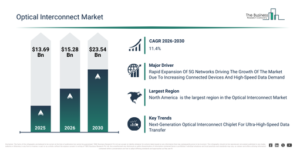
The optical interconnect market size has experienced rapid growth in recent years. It is projected to expand from $13.69 billion in 2025 to $15.28 billion in 2026, achieving a compound annual growth rate (CAGR) of 11.6%. The expansion observed in the historic period can be ascribed to an increasing demand for high-speed data transfer, the widespread adoption of fiber optic networks in telecom, the proliferation of data centers, the expansion of hpc infrastructure, and continuous improvements in optical transceiver technology.
The optical interconnect market size is anticipated to undergo substantial growth in the coming years. It is projected to expand to $23.54 billion by 2030, exhibiting a compound annual growth rate (CAGR) of 11.4%. This expected growth can be attributed to several factors, including the surge in AI and ML workloads, the increasing adoption of cloud computing services, the demand for ultra-low latency networks, the expansion of automotive connectivity, and the proliferation of photonic integrated circuits. Prominent trends for the forecast period encompass high-speed optical data transmission, photonics-based interconnect solutions, low-latency communication networks, energy-efficient optical interconnects, and next-generation optical switching.
Download A Free Sample Report For Comprehensive Market Insights:
Optical Interconnect Market Development Factors: Which Trends Are Supporting Demand?
The swift spread of 5G networks is expected to drive the future expansion of the optical interconnect market. These fifth-generation mobile communication systems deliver quicker data speeds, reduced latency, and the capability to support extensive device connectivity and advanced applications such as IoT and smart cities. 5G networks are seeing rapid deployment to manage the increasing quantity of connected devices within the Internet of Things ecosystem, thereby enabling seamless communication, real-time data exchange, and more sophisticated automation across various sectors. Optical interconnects bolster 5G networks by establishing fast, low-latency, and reliable data links between network components, which in turn supports efficient connectivity for high-density networks and real-time services. As an illustration, in March 2025, 5G Americas, a US-based trade association, indicated that North America is anticipated to have 289 million 5G connections by the end of 2024, showing a 67% year-over-year growth from the 196 million connections recorded at the close of 2023. Hence, the accelerated expansion of 5G networks is a primary catalyst for the growth of the optical interconnect market.
#Optical Interconnect Market Segment Landscape And Growth Potential
The optical interconnect market covered in this report is segmented –
1) By Product Type: Cable Assemblies, Connectors, Optical Transceivers, Silicon Photonics, Optical Engines, Photonic Integrated Circuits-Based Interconnects, Free Space Optics, Fibers And Waveguides
2) By Fiber Type: Single-Mode Fiber (SMF), Multimode Fiber (MMF)
3) By Interconnect Level: Metro And Long-Haul, Board Or Rack-level, Chip Or Board-level
4) By Technology Type: Optical Waveguide Technology, Optical Fiber Technology, Vertical Cavity Surface Emitting Lasers (VCSELs), Optical Transceivers, Optical Switches
5) By Application Area: Data Centers, Telecommunications, High-Performance Computing, Consumer Electronics, Automotive
Subsegments:
1) By Cable Assemblies, Single Mode Cable, Multi Mode Cable, Armored Cable, Breakout Cable, Ribbon Cable
2) By Connectors, Lucent Connector, Straight Tip Connector, Subscriber Connector, Mechanical Transfer Registered Jack, Small Form Factor Pluggable Connector
3) By Optical Transceivers, Small Form Factor Pluggable Transceiver, Quad Small Form Factor Pluggable Transceiver, Enhanced Small Form Factor Pluggable Transceiver, Compact Small Form Factor Pluggable Transceiver
4) By Silicon Photonics, Transmitters, Receivers, Modulators, Photodetectors, Waveguides
5) By Optical Engines, Analog Optical Engine, Digital Optical Engine, Hybrid Optical Engine
6) By Photonic Integrated Circuits-Based Interconnects, Monolithic Photonic Integrated Circuits, Hybrid Photonic Integrated Circuits, Heterogeneous Photonic Integrated Circuits
7) By Free Space Optics, Point To Point Free Space Optics, Point To Multipoint Free Space Optics
8) By Fibers And Waveguides, Optical Fibers, Planar Waveguides, Photonic Crystal Fibers, Hollow Core Fibers
Optical Interconnect Market Growth Trends Influencing Competitive Dynamics
Leading firms in the optical interconnect market are concentrating on creating novel solutions, including optical interconnect chiplets, with the aim of boosting data transfer rates, minimizing latency, and optimizing energy consumption across high-performance computing and data center environments. An optical interconnect chiplet is defined as a small semiconductor component that utilizes light signals to facilitate rapid data exchange either between or inside chips, thereby enhancing bandwidth, decreasing latency, and diminishing power usage. As an illustration, in April 2025, Ayar Labs, a high-performance computing enterprise situated in the US, introduced the globe’s inaugural Universal Chiplet Interconnect Express (UCIe) optical chiplet, named the TeraPHY optical I/O chiplet. This pioneering chiplet combines silicon photonics with conventional CMOS production methods, providing a remarkable 8 Tbps bandwidth, driven by a 16-wavelength SuperNova light source. Tailored to support AI scale-up architectures, it resolves data limitations by facilitating ultra-fast optical connections among chiplets, thus lowering both latency and power consumption. The chiplet is compatible with the UCIe open standard, guaranteeing interoperability and promoting an economical environment for optical technologies.
Optical Interconnect Market Competitive Landscape: Who Are The Leading Companies?
Major companies operating in the optical interconnect market are Huawei Technologies Co. Ltd., Cisco Systems Inc., Sumitomo Electric Industries Ltd., Mitsubishi Electric Corporation, Broadcom Inc., ZTE Corporation, TE Connectivity Ltd., Corning Incorporated, Amphenol Corporation, Furukawa Electric Co. Ltd., Ciena Corporation, Lumentum Holdings Inc., ADTRAN Inc., POET Technologies Inc., Accelink Technologies Co. Ltd., Linktel Technologies, Fibermall Technologies Co. Ltd., Ayar Labs Inc., LightSpeed Photonics Inc., FluxLight Inc., Ranovus Inc., Lightwave Logic Inc., Yuanjie Technology Co. Ltd.
Access The Complete Optical Interconnect Market Report:
Optical Interconnect Market Largest Region By Revenue And Market Share
North America was the largest region in the optical interconnect market in 2025. Asia-Pacific is expected to be the fastest-growing region in the forecast period. The regions covered in the optical interconnect market report are Asia-Pacific, South East Asia, Western Europe, Eastern Europe, North America, South America, Middle East, Africa.
Get in touch with us:
The Business Research Company: https://www.thebusinessresearchcompany.com/
Americas: +1 310-496-7795
Asia: +44 7882 955267 & +91 8897263534
Europe: +44 7882 955267
Email us at: marketing@tbrc.info
Follow us on:
LinkedIn: https://in.linkedin.com/company/the-business-research-company
YouTube: https://www.youtube.com/channel/UC24_fI0rV8cR5DxlCpgmyFQ
Global Market Model: https://www.thebusinessresearchcompany.com/global-market-model

Wasay has over a decade of experience in market research, data modelling, and analytics, with prior experience at GlobalData and Decision Tree Consulting Services. At The Business Research Company , he leads research operations across syndicated studies, customized consulting engagements, and the Global Market Model platform. His professional experience includes supporting organizations such as Boston Consulting Group, KPMG, and Ernst & Young. Wasay holds a degree in Electronics and Communications Engineering, postgraduate management qualifications from International Management Institute Belgium and Indian School of Business and Entrepreneurship, and completed the Integrated Program in Business Analytics from Indian Institute of Management Indore.