Built to provide research that’s more actionable and strategically valuable, The Business Research Company’s 2026 market reports include market attractiveness analysis, total addressable market sizing, company benchmarking matrices, interactive Excel dashboards, broader supply chain intelligence, emerging startup tracking, and in-depth product insights.
Open-Source Hardware Market Growth From $31 Billion In 2026 To $45.33 Billion By 2030 At A CAGR Of 10%
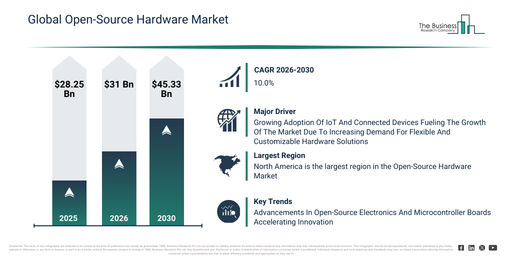
The open-source hardware market has experienced significant expansion in recent years. It is projected to increase from $28.25 billion in 2025 to $31 billion in 2026, achieving a compound annual growth rate (CAGR) of 9.7%. This historical growth can be attributed to several factors, including the growth of maker and DIY communities, the availability of low-cost prototyping tools, the expansion of open-source licensing practices, the rise of educational robotics programs, and the increased use of microcontrollers in hobbyist projects.
The open-source hardware market size is anticipated to undergo substantial growth in the coming years. It is projected to reach $45.33 billion in 2030, showing a compound annual growth rate (CAGR) of 10.0%. This expansion during the forecast period can be attributed to corporate demand for adaptable hardware platforms, the increase in smart home and IoT device development, a heightened interest in sustainable and repairable hardware, the widening of STEM education initiatives, and the growing requirement for rapid hardware prototyping solutions. Major trends expected in the forecast period include the increasing popularity of open hardware design repositories and community collaboration, a rise in the adoption of open source microcontrollers and single-board computers in DIY projects, an increasing need for customizable hardware platforms for education and research, the expansion of open firmware and device driver ecosystems for hardware interoperability, and the growth of online marketplaces that enable the distribution of open hardware kits and components.
Get A Free Sample Report With In-Depth Market Insights:
Open-Source Hardware Market Growth Catalysts And Demand Drivers
The increasing integration of IoT and connected devices is projected to boost the expansion of the open-source hardware market moving forward. These devices represent physical objects embedded with sensors, software, and network connectivity, allowing them to gather, exchange, and act upon data over the internet or other communication networks. This functionality enables real-time monitoring, remote control, and automated decision-making across consumer, industrial, and enterprise applications. The proliferation of IoT and connected devices stems from the rising demand for live monitoring and automation across various industries and consumer uses. Open-source hardware supports these IoT and connected devices by providing transparent, customizable, and interoperable hardware designs, which in turn reduce development time and costs while fostering rapid innovation for IoT applications. For instance, in May 2023, according to IoT Analytics GmbH, a UK-based IoT research firm, the count of connected IoT devices surged by 18% in 2022 to 14.3 billion, and this figure is anticipated to reach 16.7 billion in 2023. Consequently, the rising adoption of IoT and connected devices is a primary driver for the growth of the open-source hardware market.
Open-Source Hardware Market Segment Breakdown: Which Categories Lead On Revenue?
The open-source hardware market covered in this report is segmented –
1) By Component: Hardware, Software And Firmware, Services
2) By Deployment: On-Premises, Cloud-Integrated, Hybrid
3) By Sales Channel: Direct Sales, Distributor Sales, Online Marketplaces, Retail Electronics Stores
4) By Application: Large Enterprises, Small And Medium Enterprises, Personal Do It Yourself (DIY), Other Applications
5) By End User: Individuals, Enterprises, Educational Institutions, Other End-Users
Subsegments:
1) By Hardware: Open-Source Microcontrollers, Open-Source Single Board Computers, Open-Source Sensor Modules, Open-Source Communication Boards
2) By Software And Firmware: Open-Source Operating Systems, Open-Source Embedded Firmware, Open-Source Development Tools, Open-Source Device Drivers
3) By Services: Design Consulting, Customization Services, Integration Support, Maintenance And Technical Assistance
Open-Source Hardware Market Trends Shaping Long-Term Demand
Major entities within the open-source hardware market are concentrating on developing innovative solutions, such as next-generation microcontroller architecture platforms, to broaden the capabilities for embedded computing, automation, and IoT applications. Next-generation microcontroller architecture platforms refer to advanced microcontroller system designs that integrate improved processing performance, energy efficiency, security features, connectivity support, and flexible development ecosystems, enabling smarter, more scalable, and more secure embedded computing for modern applications like IoT, industrial automation, robotics, and edge intelligence. For example, in June 2023, Arduino Uno, an Italy-based company providing open-source software and hardware, launched new 32-bit Arduino Uno boards designed to significantly enhance processing performance, memory capacity, and scalability while maintaining compatibility with the existing Arduino ecosystem and form factor. These boards ensure full backward compatibility with the Arduino Uno form factor and development ecosystem, allowing existing shields, libraries, and projects to scale seamlessly without redesign. The enhanced features include improved power efficiency, advanced peripheral integration, stronger security capabilities, and broader connectivity support, enabling developers to build more capable IoT, industrial, robotics, and edge-computing solutions while preserving Arduino’s open-source hardware philosophy and ease of use.
Open-Source Hardware Market Leading Players And Competitive Positioning
Major companies operating in the open-source hardware market are Qualcomm Incorporated, Texas Instruments Incorporated, STMicroelectronics N.V., NXP Semiconductors N.V., SparkFun Electronics Inc., Seeed Studio Co. Ltd., BeagleBoard.org Foundation, Mycroft AI Inc., OpenBCI Inc., ITEAD Intelligent Systems Co. Ltd., Arduino S.r.l., UDOO S.r.l., Purism SPC, Olimex Ltd., Pine Microsystems Inc., Bunnie Studios LLC, Open Source Ecology Inc., Libre Computer Project LLC, Octavo Systems Inc., Pimoroni Ltd.
View The Full Open-Source Hardware Market Report:
Open-Source Hardware Market Regional Split: Which Areas Are Fueling Growth?
North America was the largest region in the open-source hardware market in 2025. Asia-Pacific is expected to be the fastest-growing region in the forecast period. The regions covered in the open-source hardware market report are Asia-Pacific, South East Asia, Western Europe, Eastern Europe, North America, South America, Middle East, Africa.
Reach Out To Our Team:
The Business Research Company: https://www.thebusinessresearchcompany.com/
Americas: +1 310-496-7795
Asia: +44 7882 955267 & +91 8897263534
Europe: +44 7882 955267
Email us at: marketing@tbrc.info
Follow us on:
LinkedIn: https://in.linkedin.com/company/the-business-research-company
YouTube: https://www.youtube.com/channel/UC24_fI0rV8cR5DxlCpgmyFQ
Global Market Model: https://www.thebusinessresearchcompany.com/global-market-model

Wasay has over a decade of experience in market research, data modelling, and analytics, with prior experience at GlobalData and Decision Tree Consulting Services. At The Business Research Company , he leads research operations across syndicated studies, customized consulting engagements, and the Global Market Model platform. His professional experience includes supporting organizations such as Boston Consulting Group, KPMG, and Ernst & Young. Wasay holds a degree in Electronics and Communications Engineering, postgraduate management qualifications from International Management Institute Belgium and Indian School of Business and Entrepreneurship, and completed the Integrated Program in Business Analytics from Indian Institute of Management Indore.