Backed by market attractiveness analysis, total addressable market sizing, company benchmarking matrices, interactive Excel dashboards, wider supply chain intelligence, emerging startup coverage, and detailed product-level insights, The Business Research Company’s 2026 market reports are designed to offer research that is more actionable and strategically valuable than ever.
Packet Optical Networking Equipment Market Poised To Hit $12.57 Billion By 2030 With A 8.1% CAGR
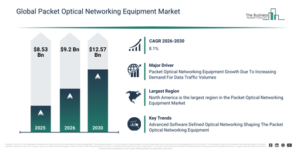
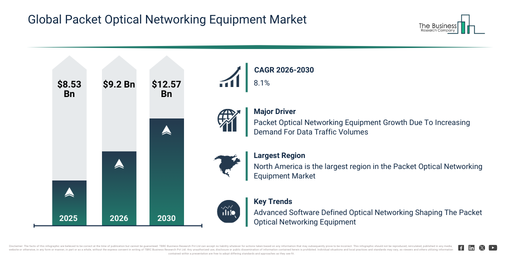
The packet optical networking equipment market has experienced robust expansion recently. It will grow from $8.53 billion in 2025 to $9.2 billion in 2026 at a compound annual growth rate (CAGR) of 7.9%. Historically, this expansion was fueled by factors such as the increasing use of broadband internet, the development of fiber optic infrastructure, a surge in mobile data traffic, the adoption of cloud computing services, and the demand for low latency communication networks.
The packet optical networking equipment market size is projected to demonstrate strong growth over the next few years, reaching $12.57 billion in 2030, at a compound annual growth rate (CAGR) of 8.1%. This anticipated growth during the forecast period is driven by an increase in hyperscale data center deployments, the expansion of 5G and future mobile backhaul requirements, the rising adoption of edge computing infrastructure, the demand for energy-efficient optical networks, and the broadening of AI-driven traffic optimization. Major trends expected in this period include a transition towards disaggregated packet optical architectures, the increasing deployment of reconfigurable optical add drop multiplexers in metro networks, a rising demand for high-capacity optical transponders to handle data-intensive traffic, the integration of packet and optical layers for simplified network management, and the growing adoption of software-defined networking for optical transport control.
Get A Free Sample Report With In-Depth Market Insights:
Packet Optical Networking Equipment Market Demand Drivers Opening New Revenue Streams
The packet optical networking equipment market is projected to grow, driven by the increasing volume of data traffic. Data traffic volumes represent the quantity of data transferred across a network over a specific timeframe, indicating the extent of information being exchanged. This surge in data traffic is fueled by greater internet engagement in bandwidth-intensive activities like video streaming, cloud computing, online gaming, remote work, and connected devices, each producing and utilizing substantial data. Packet optical networking equipment facilitates the management of these expanding data traffic volumes by allowing for high-capacity, low-latency transmission of significant data quantities via optical fiber networks, thereby assisting network operators in increasing backbone capacity and effectively mitigating congestion. As an illustration, the International Telecommunication Union (ITU), headquartered in Switzerland, reported in December 2024 that global mobile broadband traffic exceeded 1 zettabyte (ZB) for the first time in 2023, reaching almost 1.3 ZB in 2024. Simultaneously, fixed broadband traffic grew to approximately 6 ZB in 2024 from 5.1 ZB in the previous year. Consequently, the expanding volume of data traffic is a key driver for the growth of the packet optical networking equipment market.
Packet Optical Networking Equipment Market Segments: Where Is Growth Concentrated?
The packet optical networking equipment market covered in this report is segmented –
1) By Component: Hardware, Software, Services
2) By Product Type: Packet Optical Transport Systems, Optical Packet Switches, Optical Transport Hardware
3) By Technology: Wavelength Division Multiplexing (WDM), Synchronous Optical Networking (SONET), Optical Transport Network (OTN)
4) By Application: Telecommunications, Data Centers, Enterprises, Government, Other Applications
5) By End-User: Banking Financial Services And Insurance, Healthcare, Information Technology And Telecommunications, Manufacturing, Other End-Users
Subsegments:
1) By Hardware: Packet Optical Transport Systems, Optical Packet Switches, Transponders, Muxponders, Reconfigurable Optical Add Drop Multiplexers, Integrated Packet Optical Platforms
2) By Software: Network Management Software, Network Control And Orchestration Software, Traffic Monitoring And Analytics Software, Configuration And Provisioning Software, Fault And Performance Management Software
3) By Services: Installation And Deployment Services, Network Design And Planning Services, Maintenance And Support Services, Managed Network Services, Training And Consulting Services
Packet Optical Networking Equipment Market Trends Powering Strategic Industry Growth
Major companies within the packet optical networking equipment market are prioritizing the development of advanced software-defined optical networking solutions, particularly those incorporating artificial intelligence (AI)-driven network intelligence. These AI-powered capabilities enable networks to autonomously plan and optimize traffic, manage faults, and allocate bandwidth, while ensuring low latency and providing intelligent monitoring and analytics for comprehensive optical connectivity. Artificial intelligence (AI)-driven network intelligence fundamentally involves utilizing artificial intelligence technologies to make a network self-aware and self-healing, allowing it to manage and optimize itself automatically with reduced reliance on human intervention. For instance, in June 2025, Huawei Technologies Co., Ltd., a China-based telecommunications and networking company specializing in optical networking, is scheduled to launch its F5G-A Optical + artificial intelligence (AI) platform. This platform is a next-generation all-optical networking solution that integrates high-performance optical infrastructure with artificial intelligence (AI)-driven network intelligence. Additionally, it offers intelligent optical sensing for environment and infrastructure monitoring, seamless integration with enterprise and industrial networks, and enhanced reliability and resilience through artificial intelligence (AI)-driven fault detection and predictive maintenance.
Packet Optical Networking Equipment Market Key Participants And Competitive Landscape
Major companies operating in the packet optical networking equipment market are Mitsubishi Electric Corporation, ZTE Corporation, NXP Semiconductors N.V., Corning Incorporated, Furukawa Electric Co. Ltd., Ciena Corporation, Nippon Electric Company Limited, ADTRAN Holdings Inc., Ribbon Communications Inc., Evertz Technologies Limited, Ekinops S.A., Ceragon Networks Ltd., PacketLight Networks Ltd., Padtec Holding S.A., SIAE Microelettronica, Skorpios Technologies Inc., Smartoptics Group ASA
View The Full Packet Optical Networking Equipment Market Report:
Packet Optical Networking Equipment Market Geographic Analysis: Where Is Demand Rising Fastest?
North America was the largest region in the packet optical networking equipment market in 2025. Asia-Pacificis expected to be the fastest-growing region in the forecast period. The regions covered in the packet optical networking equipment market report are Asia-Pacific, South East Asia, Western Europe, Eastern Europe, North America, South America, Middle East, Africa.
Reach Out To Our Team:
The Business Research Company: https://www.thebusinessresearchcompany.com/
Americas: +1 310-496-7795
Asia: +44 7882 955267 & +91 8897263534
Europe: +44 7882 955267
Email us at: marketing@tbrc.info
Follow us on:
LinkedIn: https://in.linkedin.com/company/the-business-research-company
YouTube: https://www.youtube.com/channel/UC24_fI0rV8cR5DxlCpgmyFQ
Global Market Model: https://www.thebusinessresearchcompany.com/global-market-model

Wasay has over a decade of experience in market research, data modelling, and analytics, with prior experience at GlobalData and Decision Tree Consulting Services. At The Business Research Company , he leads research operations across syndicated studies, customized consulting engagements, and the Global Market Model platform. His professional experience includes supporting organizations such as Boston Consulting Group, KPMG, and Ernst & Young. Wasay holds a degree in Electronics and Communications Engineering, postgraduate management qualifications from International Management Institute Belgium and Indian School of Business and Entrepreneurship, and completed the Integrated Program in Business Analytics from Indian Institute of Management Indore.