
Featuring market attractiveness scoring, total addressable market sizing, company benchmarking matrices, interactive Excel dashboards, deeper supply chain intelligence, emerging startup tracking, and granular product-level insights, The Business Research Company’s 2026 market reports are built to deliver research that is both more actionable and more strategically valuable.
Power Electronics For Renewable Energy Market Size And Revenue Outlook Through 2030
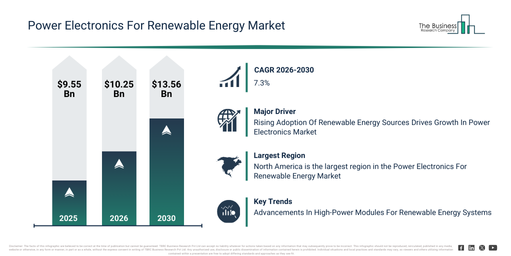
The power electronics for renewable energy market size has seen robust expansion in recent times. It is anticipated to increase from $9.55 billion in 2025 to $10.25 billion in 2026, exhibiting a compound annual growth rate (CAGR) of 7.3%. The market’s past expansion is linked to factors such as an increase in renewable energy installations, the decreasing cost of solar PV and wind turbines, the implementation of grid modernization programs, progress in semiconductor devices, and early government incentives for renewable energy.
The power electronics for renewable energy market is anticipated to experience substantial expansion over the coming years. This market is projected to reach $13.56 billion by 2030, demonstrating a compound annual growth rate (CAGR) of 7.3%. Factors contributing to this growth during the forecast period include the increasing demand for energy storage solutions, the expanding electrification of transport, the widespread deployment of smart grids, a heightened emphasis on carbon neutrality, and the adoption of AI-driven energy management systems. Key trends anticipated over the forecast period encompass grid integration and optimization, the advancement of power conversion technologies, greater energy storage integration, the development of modular and scalable power electronics, and improvements in reliability and efficiency.
Get A Free Sample Report With In-Depth Market Insights:
Power Electronics For Renewable Energy Market Expansion Drivers: What’s Shaping Future Growth?
The growing embrace of renewable energy sources is projected to fuel expansion in the power electronics for renewable energy market. These sources encompass naturally replenishing energy types like solar, wind, hydro, geothermal, and biomass, which are harnessed for sustainable electricity production. Factors driving this increased adoption include environmental worries and climate change, the ease of access to and availability of renewable energy, demographic trends, and the pursuit of energy security and independence. Within renewable energy systems, power electronics play a crucial role in the efficient conversion and regulation of electrical power from installations like solar panels and wind turbines, facilitating optimal energy delivery and integration into the grid. For example, data from June 2024, reported by the Department for Energy Security and Net Zero, a governmental body in the UK, revealed that renewable electricity constituted 50.9% of the UK’s overall generation, yielding 39.2 TWh in Quarter 1 of 2024, marking a 3.7% rise compared to Quarter 1 of 2023. This uptick in generation was primarily due to a 7.4% surge in onshore wind generation, linked to elevated wind speeds. Consequently, the growing incorporation of renewable energy sources is propelling the power electronics for renewable energy market.
Power Electronics For Renewable Energy Market Segment Outlook: Which Categories Are Growing Fastest?
The power electronics for renewable energy market covered in this report is segmented –
1) By Type: Converters, Inverters, Voltage Control Devices, Other Types
2) By Power Range: Up to 1 MW, 1 MW to 3 MW, 3 MW to 5 MW, Above 5 MW
3) By Application: Power Generation, Power Transmission, Power Distribution, Power Control
4) By End Use: Solar Photovoltaic (PV), Wind, Hydro, Fuel Cell, Other End Uses
Subsegments:
1) By Converters: AC-DC Converters, DC-DC Converters, DC-AC Converters, Bidirectional Converters, Photovoltaic (PV) Converters, Wind Power Converters, Grid-Tied Converters, Isolated Converters
2) By Inverters: Central Inverters, String Inverters, Microinverters, Hybrid Inverters, Battery-Based Inverters, Grid-Tied Inverters, Off-Grid Inverters, Multilevel Inverters
3) By Voltage Control Devices: Voltage Regulators, Power Factor Correction Devices, Reactive Power Controllers, Static VAR Compensators (SVC), Surge Protection Devices, Voltage Stabilizers, Dynamic Voltage Restorers (DVR)
4) By Other Types: Energy Storage Systems, Power Distribution Units, DC Distribution Systems, Frequency Converters, Protection And Monitoring Systems, Smart Grid Power Electronics
Power Electronics For Renewable Energy Market Strategic Trends: What Defines The Next Growth Phase?
Leading firms within the power electronics for renewable energy market are concentrating on creating advanced high-power modules for significant power converters. This effort aims to boost energy efficiency, elevate system reliability, and aid the integration of renewable energy sources into the existing electrical network. Such a high-performance power module is defined as a sophisticated electronic element engineered for the effective management and regulation of substantial electrical power in challenging scenarios, including renewable energy setups and electric automobiles. As an illustration, in April 2024, Fuji Electric Co. Ltd., a Japanese manufacturer of power semiconductor modules, introduced the HPnC X series 1700 V, 3,300 V Class module. This particular power module is specifically designed for use in large power converters that operate in the range of DC 1700 V to 3.3 kV. The HPnC X series is available in two distinct voltage classifications: 1700 V and 3300 V. These modules provide a rated current capacity ranging from 1200 A to 1800 A, varying by model, and possess dimensions of 100 mm x 144 mm x 40 mm. This size is considered notably compact given their substantial current ratings. The modules incorporate Fuji Electric’s newest generation of IGBT chips, which have been refined to ensure superior heat dissipation.
Power Electronics For Renewable Energy Market Leading Companies And Competitive Benchmarking
Major companies operating in the power electronics for renewable energy market are Siemens AG, Hitachi Ltd., Mitsubishi Electric Corporation, ABB Ltd, Toshiba International Corporation, Eaton Corporation, Texas Instruments Incorporated, STMicroelectronics NV, Infineon Technologies AG, NXP Semiconductors NV, Analog Devices Inc., Renesas Electronics Corporation, ON Semiconductor Corp, Microchip Technology Inc., Fuji Electric Co. Ltd., Qorvo Inc, ROHM CO. LTD., Vishay Intertechnology Inc., Littelfuse Inc., Microsemi Corporation, WOLFSPEED INC., SEMIKRON International GmbH, Navitas Semiconductor Inc, Transphorm Inc., Efficient Power Conversion Corporation
View The Full Power Electronics For Renewable Energy Market Report:
Power Electronics For Renewable Energy Market Regional Analysis And Top Geography
North America was the largest region in the power electronics for renewable energy market in 2025. Europe is expected to be the fastest-growing region in the forecast period. The regions covered in the power electronics for renewable energy market report are Asia-Pacific, South East Asia, Western Europe, Eastern Europe, North America, South America, Middle East, Africa.
Reach Out To Our Team:
The Business Research Company: https://www.thebusinessresearchcompany.com/
Americas: +1 310-496-7795
Asia: +44 7882 955267 & +91 8897263534
Europe: +44 7882 955267
Email us at: marketing@tbrc.info
Follow us on:
LinkedIn: https://in.linkedin.com/company/the-business-research-company
YouTube: https://www.youtube.com/channel/UC24_fI0rV8cR5DxlCpgmyFQ
Global Market Model: https://www.thebusinessresearchcompany.com/global-market-model

Wasay has over a decade of experience in market research, data modelling, and analytics, with prior experience at GlobalData and Decision Tree Consulting Services. At The Business Research Company , he leads research operations across syndicated studies, customized consulting engagements, and the Global Market Model platform. His professional experience includes supporting organizations such as Boston Consulting Group, KPMG, and Ernst & Young. Wasay holds a degree in Electronics and Communications Engineering, postgraduate management qualifications from International Management Institute Belgium and Indian School of Business and Entrepreneurship, and completed the Integrated Program in Business Analytics from Indian Institute of Management Indore.