Featuring market attractiveness scoring, total addressable market sizing, company benchmarking matrices, interactive Excel dashboards, deeper supply chain intelligence, emerging startup tracking, and granular product-level insights, The Business Research Company’s 2026 market reports are built to deliver research that is both more actionable and more strategically valuable.
Screenless Display Market Value Growth And Long-Term Outlook
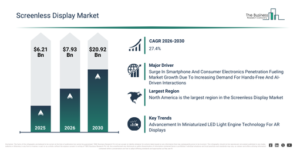
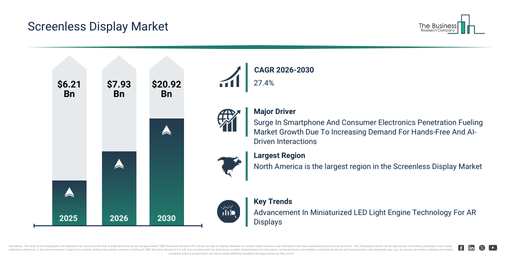
The screenless display market has experienced rapid expansion recently. It is projected to increase from $6.21 billion in 2025 to $7.93 billion in 2026, exhibiting a compound annual growth rate (CAGR) of 27.7%. This historic growth has been driven by the wider acceptance of portable electronics, the initial incorporation of holographic projection in consumer devices, advancements in laser and LED projection modules, the increasing need for immersive user interfaces, and augmented research and development investments in wearable display systems.
The screenless display market is projected to experience substantial expansion in the coming years, with its size anticipated to reach $20.92 billion by 2030, exhibiting a compound annual growth rate (CAGR) of 27.4%. This growth during the forecast period can be attributed to several factors, including the increasing deployment of hands-free interaction technologies, continuous advancements in AI-powered image processing, a rising demand for medical and assistive retinal displays, the growing integration into automotive HUD systems, and the development of defense-grade screenless communication solutions. Furthermore, major trends expected to define the market in the forecast period encompass AI-enabled screenless visualization, sophisticated AR/VR-integrated screenless interfaces, IoT-driven ambient and surface projection systems, cloud-based rendering combined with cybersecure screenless platforms, and intelligent manufacturing practices for next-generation screenless devices.
Get A Free Sample Report With In-Depth Market Insights:
Screenless Display Market Growth Catalysts And Demand Drivers
The expanding adoption of smartphones and consumer electronics is anticipated to accelerate the growth of the screenless display market. These categories encompass both portable and household devices designed to facilitate communication, entertainment, and daily convenience. The increase in smartphone and consumer electronics penetration is driven by factors such as enhanced internet connectivity, increasing digitalization, the rise of remote work practices, and advancements in e-learning. The wider integration of smartphones and consumer electronics fosters the development of screenless displays by incorporating features like voice assistants and artificial intelligence (AI)-powered interfaces. As users increasingly move towards hands-free interactions, the demand for screenless technology continues to grow. For example, the Japan Electronics and Information Technology Industries Association, a Japan-based trade association, reported that Japan’s electronic equipment production reached 771,457 million yen (approximately USD 5.6 billion) in May 2023. Consumer electronics output specifically rose to 32,099 million yen (around USD 233 million), marking an increase from 25,268 million yen (about USD 183 million) in May 2022. Furthermore, Ericsson, a Sweden-based telecommunications company, projected in June 2024 that the number of mobile subscriptions in the region would grow from 1.2 billion in 2023 to 1.3 billion by 2029. Consequently, the increasing penetration of smartphones and consumer electronics is a significant catalyst for the screenless display market’s expansion.
Screenless Display Market Segment Breakdown: Which Categories Lead On Revenue?
The screenless display market covered in this report is segmented –
1) By Type: Visual Image, Retinal Display, Synaptic Interface
2) By Display Size: Small Screenless Displays, Medium Screenless Displays, Large Screenless Displays
3) By Application: Holographic Projection, Head-Mounted Display, Head-Up Display, Other Applications
4) By End-Use: Consumer Electronics, Aerospace And Defense, Healthcare, Automotive, Other End-Uses
Subsegments:
1) By Visual Image: Laser-Based Visual Image Displays, LED-Based Visual Image Displays, Projection-Based Visual Image Displays
2) By Retinal Display: Direct Retinal Projection Displays, Scanning Laser Retinal Displays
3) By Synaptic Interface: Brain-Computer Interface (BCI), Neuromodulation-Based Synaptic Displays, Electromyographic (EMG) Interface Displays
Screenless Display Market Trends Shaping Long-Term Demand
Leading companies in the screenless display market are prioritizing the creation of advanced technologies, such as miniaturized light-emitting diode (LED) light engines, to boost display efficiency. A miniaturized LED light engine is a compact optical module that generates high-quality light for displays, enabling the development of lightweight and small-form-factor devices like augmented reality (AR) and virtual reality (VR) headsets. For instance, in May 2023, Dispelix Oy, a Finland-based developer of see-through waveguides for extended reality (XR), partnered with Avegant Corporation, a US-based company specializing in miniaturized LED light engines, to introduce an augmented reality (AR) reference display module. This module features the Dispelix Selvä, a thin, lightweight, and bright LED waveguide combiner that delivers high visual quality while resembling regular glasses. It is paired with the Avegant AG-30L2 light engine, a compact LED light engine that is significantly smaller than previous models. Together, these components facilitate the creation of true glasses-like AR products. The combination of a compact design and high-performance features sets a new standard for visual excellence and user comfort in everyday wearable augmented reality glasses.
Screenless Display Market Leading Players And Competitive Positioning
Major companies operating in the screenless display market are Samsung Electronics Co. Ltd., Microsoft Corporation, Sony Group Corporation, Panasonic Corporation, Intel Corporation, BAE Systems Inc., NVIDIA Corporation, LG Display Co. Ltd., Synaptics Incorporated, Magic Leap Inc., Eon Reality Inc., Leia Inc., Vuzix Corporation, QD Laser Inc., Avegant Corporation, Seereal Technologies S.A, Holoxica Ltd., Ceres Holographics Ltd., RealView Imaging Ltd., MicroVision Inc.
View The Full Screenless Display Market Report:
Screenless Display Market Geographic Analysis: Where Is Demand Rising Fastest?
North America was the largest region in the screenless display market in 2025. Asia-Pacific is expected to be the fastest-growing region in the forecast period. The regions covered in the screenless display market report are Asia-Pacific, South East Asia, Western Europe, Eastern Europe, North America, South America, Middle East, Africa.
Reach Out To Our Team:
The Business Research Company: https://www.thebusinessresearchcompany.com/
Americas: +1 310-496-7795
Asia: +44 7882 955267 & +91 8897263534
Europe: +44 7882 955267
Email us at: marketing@tbrc.info
Follow us on:
LinkedIn: https://in.linkedin.com/company/the-business-research-company
YouTube: https://www.youtube.com/channel/UC24_fI0rV8cR5DxlCpgmyFQ
Global Market Model: https://www.thebusinessresearchcompany.com/global-market-model

Wasay has over a decade of experience in market research, data modelling, and analytics, with prior experience at GlobalData and Decision Tree Consulting Services. At The Business Research Company , he leads research operations across syndicated studies, customized consulting engagements, and the Global Market Model platform. His professional experience includes supporting organizations such as Boston Consulting Group, KPMG, and Ernst & Young. Wasay holds a degree in Electronics and Communications Engineering, postgraduate management qualifications from International Management Institute Belgium and Indian School of Business and Entrepreneurship, and completed the Integrated Program in Business Analytics from Indian Institute of Management Indore.