With a focus on actionable insights and strategic value, The Business Research Company’s 2026 market reports include market attractiveness scoring, total addressable market sizing, company benchmarking matrices, interactive Excel dashboards, deeper supply chain intelligence, emerging startup tracking, and granular product-level insights.
Silicon Carbide Semiconductor Device Market Size Analysis: Historical Growth And Future Revenue Projections
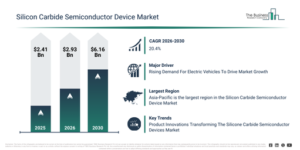
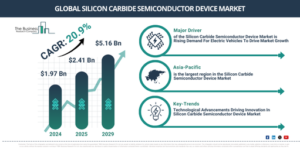
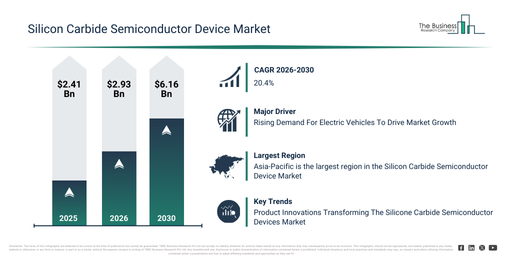
The market size for silicon carbide semiconductor devices has seen substantial growth in recent years. It is forecast to increase from $2.41 billion in 2025 to $2.93 billion in 2026, exhibiting a compound annual growth rate (CAGR) of 21.4%. The expansion observed in prior periods can be attributed to the historical application of silicon carbide substrates in high-power systems, the expanding use of silicon carbide diodes in industrial applications, the early incorporation of silicon carbide MOSFETs in automotive inverters, the growing deployment of silicon carbide in aerospace power modules, and the advancement of silicon carbide-based detectors for sensing purposes.
The silicon carbide semiconductor device market is projected for substantial expansion in the coming years. This market is anticipated to reach $6.16 billion in 2030, exhibiting a compound annual growth rate (CAGR) of 20.4%. Factors contributing to this growth during the projected timeframe include increasing demand for electric vehicle powertrains, the expansion of renewable energy conversion systems, a growing need for high-temperature semiconductor performance, the proliferation of 5G and high-frequency communication devices, and the greater adoption of wide-bandgap semiconductor technologies. Key trends anticipated over this period involve the advancement of electric mobility power devices, the expansion of energy-efficient semiconductor manufacturing processes, the integration of SiC devices into autonomous platforms, the development of high-performance power electronics, and the rising uptake of smart manufacturing techniques for SiC components.
Preview The Silicon Carbide Semiconductor Device Market Report With A Free Sample:
Silicon Carbide Semiconductor Device Market Drivers: What Is Fueling Demand Through 2030?
The silicon carbide semiconductor device market is anticipated to experience growth driven by the increasing demand for electric vehicles. An electric vehicle is defined as a motorized vehicle that operates on electricity from a battery and can be externally charged. Silicon carbide semiconductor devices offer advantages in electric vehicle (EV) powertrains by providing higher power densities and switching efficiency, thus, the escalating demand for electric vehicles directly boosts the demand for these devices. For example, in 2024, the International Energy Agency (IEA), a France-based autonomous intergovernmental organization, reported that electric car sales in 2023 surpassed those in 2022 by 3.5 million, representing a 35% year-on-year increase. Furthermore, under the Net Zero Emissions by 2050 Scenario, more than 300 million electric cars are projected to be on the road by 2030, making up 60% of all new car sales. Consequently, the rising demand for electric vehicles propels the silicon carbide semiconductor device market.
Silicon Carbide Semiconductor Device Market Segmentation Analysis: Core Categories And Subcategories
The silicon carbide semiconductor device market covered in this report is segmented –
1) By Type: SIC Diode, SIC Transistor, Other Types
2) By Wafer Size: 1 Inch To 4 Inches, 6 Inches, 8 Inches, 10 Inches And Above
3) By End-User: Automotive, Consumer Electronics, Aerospace And Defense, Medical Devices, Data And Communication Devices, Energy And Power, Other End-Users
Subsegments:
1) By SiC Diode: Schottky Barrier Diodes (SBD), PiN Diodes
2) By SiC Transistor: SiC MOSFET (Metal-Oxide-Semiconductor Field-Effect Transistor), SiC BJT (Bipolar Junction Transistor), SiC IGBT (Insulated Gate Bipolar Transistor)
3) By Other Types: SiC Rectifiers, SiC Modules, SiC Power Devices
Which Trends Will Define The Silicon Carbide Semiconductor Device Market Through 2030?
Leading companies within the silicon carbide semiconductor devices market are engaged in developing novel silicon carbide-based devices that feature reduced switching losses to secure a competitive advantage. Switching losses refer to the energy dissipation that takes place as a semiconductor device transitions between its active (conducting) and inactive (non-conducting) states. For instance, in August 2023, Toshiba Electronic Devices & Storage Corporation, an electronics company based in Japan, introduced its third-generation silicon carbide (SiC) MOSFETs through the release of the TWxxxZxxxC series. These components are specifically engineered for industrial applications, aiming to minimize losses in diverse environments such as servers, data centers, electric vehicle (EV) charging stations, photovoltaic (PV) inverters, and uninterruptible power supplies (UPS). Notably, the MOSFETs in this series are housed in a TO-247-4L(X) package which incorporates a fourth pin, enabling a Kelvin connection for the gate drive signal source terminal. This innovation serves to mitigate parasitic inductance effects, thereby enhancing high-speed switching performance. The series offers devices with 650V and 1200V VDSS ratings, guaranteeing low losses even in high-frequency operations. With the capacity to handle continuous drain currents up to 100A, these SiC MOSFETs represent a substantial advancement in power electronics technology for industrial applications.
Silicon Carbide Semiconductor Device Market Major Companies And Industry Participants
Major companies operating in the silicon carbide semiconductor device market are Infineon Technologies, ROHM Co., Ltd., STMicroelectronics, Wolfspeed Inc., Mitsubishi Electric Corporation, Toshiba Electronic Devices & Storage, onsemi, Microchip Technology / Microsemi, UnitedSiC, GeneSiC Semiconductor, Semikron Danfoss, Fuji Electric, Powerex Inc., TT Electronics, Renesas Electronics, BYD Semiconductor, InventChip Technology, II-VI (Coherent Corp.), Xiamen Sanan Integrated Circuit Co. Ltd., SK siltron CSS.
Buy The Full Silicon Carbide Semiconductor Device Global Market Report 2026:
Silicon Carbide Semiconductor Device Market Geographic Analysis: Which Region Accounts For The Biggest Share?
Asia-Pacific was the largest region in the silicon carbide semiconductor device market in 2025. The regions covered in the silicon carbide semiconductor device market report are Asia-Pacific, South East Asia, Western Europe, Eastern Europe, North America, South America, Middle East, Africa.
Reach Out To Our Team:
The Business Research Company: https://www.thebusinessresearchcompany.com/
Americas: +1 310-496-7795
Asia: +44 7882 955267 & +91 8897263534
Europe: +44 7882 955267
Email us at: marketing@tbrc.info
Follow us on:
LinkedIn: https://in.linkedin.com/company/the-business-research-company
YouTube: https://www.youtube.com/channel/UC24_fI0rV8cR5DxlCpgmyFQ
Global Market Model: https://www.thebusinessresearchcompany.com/global-market-model

Wasay has over a decade of experience in market research, data modelling, and analytics, with prior experience at GlobalData and Decision Tree Consulting Services. At The Business Research Company , he leads research operations across syndicated studies, customized consulting engagements, and the Global Market Model platform. His professional experience includes supporting organizations such as Boston Consulting Group, KPMG, and Ernst & Young. Wasay holds a degree in Electronics and Communications Engineering, postgraduate management qualifications from International Management Institute Belgium and Indian School of Business and Entrepreneurship, and completed the Integrated Program in Business Analytics from Indian Institute of Management Indore.