
Built to provide research that’s more actionable and strategically valuable, The Business Research Company’s 2026 market reports include market attractiveness analysis, total addressable market sizing, company benchmarking matrices, interactive Excel dashboards, broader supply chain intelligence, emerging startup tracking, and in-depth product insights.
Smart Charger Demand Response Market Size Outlook: How Quickly Will Revenue Expand Through 2030?
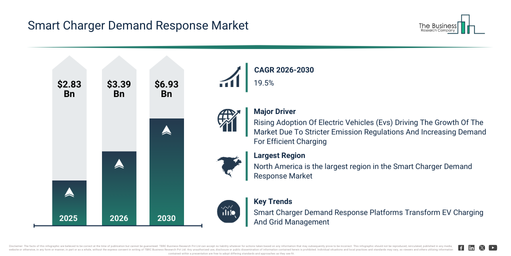
The smart charger demand response market has experienced rapid expansion in recent years. Its value is projected to climb from $2.83 billion in 2025 to $3.39 billion in 2026, achieving a compound annual growth rate (CAGR) of 19.8%. This historical growth can be attributed to factors such as early EV adoption coupled with rising residential charging demand, government incentives for EV charging infrastructure, the initial deployment of utility-managed demand response programs, an increase in smart meter installations, and escalating grid congestion challenges.
The smart charger demand response market size is anticipated to expand significantly over the coming years, projected to reach $6.93 billion by 2030, exhibiting a compound annual growth rate (CAGR) of 19.5%. This expansion during the forecast period is driven by several factors, including the increasing EV adoption within fleets and public infrastructure, the proliferation of vehicle-to-grid (V2G) charging solutions, more stringent regulations concerning grid stability and load management, ongoing investments in renewable energy-linked charging systems, and the growing requirement for dynamic load optimization at commercial charging locations. Key trends anticipated during this period encompass the increasing implementation of time-of-use (TOU) pricing for EV charging, enhanced integration of bidirectional charging capabilities, a greater demand for grid-balancing mechanisms stemming from concentrated EV loads, the broadening of smart charging deployments at public and fleet hubs, and the development of advanced energy management systems for predicting peak loads.
Get A Free Sample Report With In-Depth Market Insights:
Smart Charger Demand Response Market Demand Drivers Opening New Revenue Streams
The growing acceptance of electric vehicles (EVs) is set to stimulate the expansion of the smart charger demand response market moving forward. EVs are vehicles that operate on electricity stored in rechargeable batteries, rather than relying solely on conventional fuel engines. The uptake of electric vehicles (EVs) is seeing a notable rise as governments globally introduce progressively stricter emission standards, encouraging both manufacturers and consumers to transition towards cleaner, more sustainable modes of transportation. Smart charger demand response provides benefits to electric vehicles (EVs) by optimizing charging periods in line with grid demand and energy pricing, leading to reduced costs, prevention of overloads, and the efficient application of renewable energy, all while guaranteeing vehicles are fully charged as needed. For instance, in September 2025, the European Automobile Manufacturers’ Association, a trade association based in Belgium, reported that as of August 2025, battery-electric cars constituted 15.8% of the European Union market share, which was an increase from 12.6% in the corresponding timeframe of 2024. As a result, the increasing adoption of electric vehicles (EVs) is propelling the growth of the smart charger demand response market.
Smart Charger Demand Response Market Segment Performance And Emerging Opportunities
The smart charger demand response market covered in this report is segmented –
1) By Product Type: Alternating Current (AC) Slow Charger, Alternating Current (AC) Fast Charger, Direct Current (DC) Fast Chargers
2) By Connectivity: Wired, Wireless
3) By Application: Residential, Commercial, Public Charging Stations, Fleet Operations, Other Applications
4) By End-User: Individual Consumers, Utilities, Commercial Enterprises, Government And Municipalities
Subsegments:
1) By Alternating Current (AC) Slow Charger: Residential Alternating Current Slow Charger, Commercial Alternating Current Slow Charger, Fleet Alternating Current Slow Charger
2) By Alternating Current (AC) Fast Charger: Public Alternating Current Fast Charger, Workplace Alternating Current Fast Charger, Highway Alternating Current Fast Charger
3) By Direct Current (DC) Fast Chargers: Ultra-Rapid Direct Current Fast Charger, High-Power Direct Current Fast Charger, Battery-Integrated Direct Current Fast Charger
Smart Charger Demand Response Market Trends Powering Strategic Industry Growth
Major companies in the smart charger demand response market are concentrating on deploying innovative solutions, such as electric vehicle (EV) charging demand response platforms, to enhance the efficiency of EV charging infrastructure and create new revenue streams for service providers and station operators. Electric vehicle (EV) charging demand response platforms are digital systems designed to manage charging activities by adjusting, delaying, or shifting them based on grid conditions, aiming to balance electricity supply, prevent overloads, and optimize energy use. For instance, in October 2023, Spirii, a Denmark-based company specializing in EV charging solutions, launched its Demand Response solution. This technological platform for EV charging enables dynamic adjustments in electricity usage at charging stations. By operating as a digital hub that aggregates and manages charging points globally, the system allows grid operators to temporarily reduce or shift charging activity during periods of high demand or energy shortfall. This innovation not only helps stabilize the electric grid but also creates new revenue opportunities, supports the risk-free expansion of EV charging infrastructure, and turns charging stations into active contributors to grid reliability.
Smart Charger Demand Response Market Key Players: Which Companies Lead Industry Competition?
Major companies operating in the smart charger demand response market are Tesla, Inc., Siemens AG, Schneider Electric SE, ABB Ltd., Wallbox Chargers, Inc., ChargePoint, Inc., EVgo Services, LLC, Enel X S.p.A., AutoGrid Systems, Inc., Driivz Ltd., WeaveGrid, Inc., Jedlix B.V., General Electric Company, Honeywell International Inc., Danfoss A/S, The Tata Power Company Limited, Saft Groupe S.A., Nuvve Holding Corp., Blink Charging Co., Eaton Corporation, FLO EV Charging, Greenlots (Shell), Electrify America, OVO Energy, Octopus Energy
View The Full Smart Charger Demand Response Market Report:
Smart Charger Demand Response Market Top Region: Where Does Most Revenue Come From?
North America was the largest region in the smart charger demand response market in 2025. Asia-Pacific is expected to be the fastest-growing region in the forecast period. The regions covered in the smart charger demand response market report are Asia-Pacific, South East Asia, Western Europe, Eastern Europe, North America, South America, Middle East, Africa.
Reach Out To Our Team:
The Business Research Company: https://www.thebusinessresearchcompany.com/
Americas: +1 310-496-7795
Asia: +44 7882 955267 & +91 8897263534
Europe: +44 7882 955267
Email us at: marketing@tbrc.info
Follow us on:
LinkedIn: https://in.linkedin.com/company/the-business-research-company
YouTube: https://www.youtube.com/channel/UC24_fI0rV8cR5DxlCpgmyFQ
Global Market Model: https://www.thebusinessresearchcompany.com/global-market-model

Wasay has over a decade of experience in market research, data modelling, and analytics, with prior experience at GlobalData and Decision Tree Consulting Services. At The Business Research Company , he leads research operations across syndicated studies, customized consulting engagements, and the Global Market Model platform. His professional experience includes supporting organizations such as Boston Consulting Group, KPMG, and Ernst & Young. Wasay holds a degree in Electronics and Communications Engineering, postgraduate management qualifications from International Management Institute Belgium and Indian School of Business and Entrepreneurship, and completed the Integrated Program in Business Analytics from Indian Institute of Management Indore.