Through market attractiveness analysis, total addressable market evaluation, company benchmarking matrices, interactive Excel dashboards, expanded supply chain intelligence, emerging startup coverage, and detailed product insights, The Business Research Company’s 2026 market reports provide more actionable and strategically valuable research.
Smart Charger Demand Response Market Expansion From $3.39 Billion In 2026 To $6.93 Billion In 2030
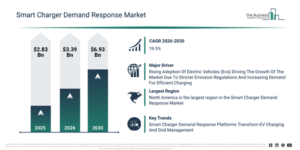
The smart charger demand response market has experienced swift expansion recently. Projections indicate its expansion from $2.83 billion in 2025 to $3.39 billion in 2026, demonstrating a compound annual growth rate (CAGR) of 19.8%. Factors contributing to its historical growth include the early adoption of electric vehicles and increased residential charging demand, government initiatives encouraging EV charging infrastructure, the initial rollout of utility-managed demand response programs, an increase in smart meter installations, and escalating challenges related to grid congestion.
The smart charger demand response market size is projected to experience substantial expansion in the coming years. This market is anticipated to reach $6.93 billion by 2030, exhibiting a compound annual growth rate (CAGR) of 19.5%. This expansion during the projection period stems from factors such as increasing EV adoption in fleets and public infrastructure, the spread of vehicle-to-grid (V2G) charging innovations, more stringent rules for grid stability and managing loads, financial commitments to charging systems incorporating renewable energy, and an escalating demand for flexible load management at commercial charging locations. Key developments expected over this forecast period involve wider implementation of time-of-use (TOU) tariffs for EV charging, enhanced incorporation of two-way charging functionalities, a heightened demand for grid stabilization methods owing to concentrated EV loads, the broadening of smart charging options at public and fleet facilities, and sophisticated energy management systems designed for predicting peak loads.
Download A Free Sample Report For Comprehensive Market Insights:
#Smart Charger Demand Response Market Demand Drivers Creating New Revenue Opportunities
The increasing integration of electric vehicles (EVs) is anticipated to stimulate the expansion of the smart charger demand response market going forward. Electric vehicles are defined as automobiles that operate on electricity stored in rechargeable batteries, rather than depending exclusively on conventional fuel engines. The rise in EV adoption is significant, driven by governments worldwide implementing progressively stricter emission regulations, which motivates both manufacturers and consumers to transition towards cleaner, more sustainable modes of transportation. Smart charger demand response provides benefits for electric vehicles by optimizing charging times based on grid requirements and energy costs, thereby reducing expenses, preventing overloads, and enabling the efficient utilization of renewable energy, all while guaranteeing vehicles are fully charged when required. For instance, in September 2025, data from the European Automobile Manufacturers’ Association, a Belgium-based trade association, indicated that as of August 2025, battery-electric cars constituted 15.8% of the European Union market share, an increase from 12.6% in the same period of 2024. Therefore, the expanding embrace of electric vehicles (EVs) is a primary catalyst for the smart charger demand response market’s growth.
Smart Charger Demand Response Market Segmentation Trends And Revenue Drivers
The smart charger demand response market covered in this report is segmented –
1) By Product Type: Alternating Current (AC) Slow Charger, Alternating Current (AC) Fast Charger, Direct Current (DC) Fast Chargers
2) By Connectivity: Wired, Wireless
3) By Application: Residential, Commercial, Public Charging Stations, Fleet Operations, Other Applications
4) By End-User: Individual Consumers, Utilities, Commercial Enterprises, Government And Municipalities
Subsegments:
1) By Alternating Current (AC) Slow Charger: Residential Alternating Current Slow Charger, Commercial Alternating Current Slow Charger, Fleet Alternating Current Slow Charger
2) By Alternating Current (AC) Fast Charger: Public Alternating Current Fast Charger, Workplace Alternating Current Fast Charger, Highway Alternating Current Fast Charger
3) By Direct Current (DC) Fast Chargers: Ultra-Rapid Direct Current Fast Charger, High-Power Direct Current Fast Charger, Battery-Integrated Direct Current Fast Charger
Smart Charger Demand Response Market Trends: What Is Shaping Future Industry Growth?
Leading enterprises within the smart charger demand response sector are prioritizing the implementation of cutting-edge solutions, notably electric vehicle (EV) charging demand response platforms. These initiatives aim to enhance the operational effectiveness of EV charging infrastructure while concurrently establishing fresh income streams for both service providers and station operators. Electric vehicle (EV) charging demand response platforms are essentially digital frameworks designed to govern charging operations by modifying, postponing, or reallocating them in response to prevailing grid conditions. This functionality serves to harmonize electricity supply, avert grid overloads, and maximize energy utilization. For instance, in October 2023, Spirii, a Danish firm specializing in electric vehicle (EV) charging technologies, introduced its Demand Response solution. This technological platform for electric vehicle (EV) charging facilitates real-time adjustments in power consumption at charging stations. Functioning as a centralized digital nexus that consolidates and oversees charging points globally, the system empowers grid operators to temporarily decrease or reconfigure charging activities during periods of elevated demand or energy scarcity. This breakthrough not only contributes to the stability of the electrical grid but also unlocks novel revenue prospects, facilitates the secure growth of EV charging infrastructure, and transforms charging stations into vital assets for grid dependability.
#Smart Charger Demand Response Market Industry Leaders: Which Organizations Are Driving Competition?
Major companies operating in the smart charger demand response market are Tesla, Inc., Siemens AG, Schneider Electric SE, ABB Ltd., Wallbox Chargers, Inc., ChargePoint, Inc., EVgo Services, LLC, Enel X S.p.A., AutoGrid Systems, Inc., Driivz Ltd., WeaveGrid, Inc., Jedlix B.V., General Electric Company, Honeywell International Inc., Danfoss A/S, The Tata Power Company Limited, Saft Groupe S.A., Nuvve Holding Corp., Blink Charging Co., Eaton Corporation, FLO EV Charging, Greenlots (Shell), Electrify America, OVO Energy, Octopus Energy
Access The Complete Smart Charger Demand Response Market Report:
Smart Charger Demand Response Market Regional Analysis And Leading Geography
North America was the largest region in the smart charger demand response market in 2025. Asia-Pacific is expected to be the fastest-growing region in the forecast period. The regions covered in the smart charger demand response market report are Asia-Pacific, South East Asia, Western Europe, Eastern Europe, North America, South America, Middle East, Africa.
Get in touch with us:
The Business Research Company: https://www.thebusinessresearchcompany.com/
Americas: +1 310-496-7795
Asia: +44 7882 955267 & +91 8897263534
Europe: +44 7882 955267
Email us at: marketing@tbrc.info
Follow us on:
LinkedIn: https://in.linkedin.com/company/the-business-research-company
YouTube: https://www.youtube.com/channel/UC24_fI0rV8cR5DxlCpgmyFQ
Global Market Model: https://www.thebusinessresearchcompany.com/global-market-model

Wasay has over a decade of experience in market research, data modelling, and analytics, with prior experience at GlobalData and Decision Tree Consulting Services. At The Business Research Company , he leads research operations across syndicated studies, customized consulting engagements, and the Global Market Model platform. His professional experience includes supporting organizations such as Boston Consulting Group, KPMG, and Ernst & Young. Wasay holds a degree in Electronics and Communications Engineering, postgraduate management qualifications from International Management Institute Belgium and Indian School of Business and Entrepreneurship, and completed the Integrated Program in Business Analytics from Indian Institute of Management Indore.