
Built to provide research that’s more actionable and strategically valuable, The Business Research Company’s 2026 market reports include market attractiveness analysis, total addressable market sizing, company benchmarking matrices, interactive Excel dashboards, broader supply chain intelligence, emerging startup tracking, and in-depth product insights.
Visual Odometry Cameras Market Size, Value And Growth Trajectory Through 2030
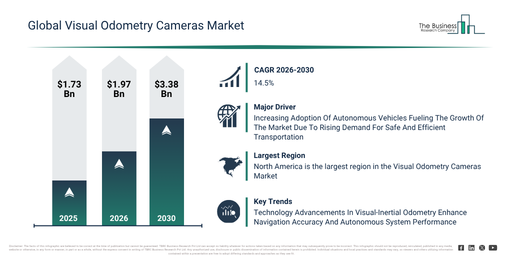
The market for visual odometry cameras has experienced significant expansion over the past few years. It will grow from $1.73 billion in 2025 to $1.97 billion in 2026 at a compound annual growth rate (CAGR) of 14.2%. Factors contributing to this growth in previous periods include the expanding use of autonomous vehicles, the increasing integration of robotics and drones, advancements in monocular and stereo camera technologies, the proliferation of industrial automation applications, and the demand for enhanced navigation accuracy.
The visual odometry cameras market size is anticipated to experience substantial growth in the upcoming years. It will grow to $3.38 billion by 2030 at a compound annual growth rate (CAGR) of 14.5%. This expansion over the forecast period is propelled by factors such as the increasing adoption of SLAM-based visual odometry, enhanced integration with AI-driven sensor fusion, the broadening scope of AR/VR applications, greater utilization within the aerospace and defense sectors, and the ongoing development of compact and high-resolution camera modules. Noteworthy trends for this period include a rising uptake of stereo and RGB-D visual odometry cameras, increasing demand for SLAM-based navigation solutions, the growing incorporation of low-light and high frame rate cameras, an expansion in drone and robotics applications, and an elevated focus on real-time environmental mapping and obstacle detection.
Get A Free Sample Report With In-Depth Market Insights:
Visual Odometry Cameras Market Growth Catalysts And Demand Drivers
The visual odometry cameras market is anticipated to expand due to the growing integration of autonomous vehicles. These self-driving vehicles, equipped with sophisticated sensors like cameras, radar, LiDAR, along with artificial intelligence and control systems, operate independently of human drivers. Their increasing prevalence stems from rapid progress in AI and sensor technologies, which significantly enhance their ability to perceive surroundings, make decisions, and ensure safety. Visual odometry cameras play a crucial role by enabling these autonomous ground and aerial systems to precisely estimate motion, detect obstacles, and navigate in real-time. For instance, data from GOV.UK in October 2023 indicated that by 2035, approximately 40% of vehicles in the UK are projected to possess self-driving capabilities. This could boost the UK’s autonomous vehicle market to around £42 billion (about $55.9 billion) by the same year, potentially creating up to 38,000 new jobs. Consequently, the rising adoption of autonomous vehicles is a key factor propelling the visual odometry cameras market. The increased deployment of drones is poised to boost the visual odometry cameras market in the foreseeable future. Drone deployment signifies the broader utilization of unmanned aerial vehicles (UAVs) across various sectors including commercial, industrial, and governmental applications such as surveillance, deliveries, and inspections. This growing adoption is largely fueled by advancements in automation and the expansion of commercial uses, as industries increasingly rely on UAVs for intricate operations, particularly in remote or GPS-denied environments. The escalating demand for drones consequently generates a significant need for visual odometry cameras, which are essential for enabling drones to accurately determine their location and navigate precisely by processing immediate visual information from their surroundings. For example, according to the House of Commons in August 2025, the UK had provided Ukraine with more than 70,000 uncrewed systems, including various types of drones, as of July 2025. Therefore, the expanding deployment of drones is a primary driver for the growth of the visual odometry cameras market.
Visual Odometry Cameras Market Segment Analysis: What Are The Core Market Categories?
The visual odometry cameras market covered in this report is segmented –
1) By Product Type: Monocular Cameras, Stereo Cameras, Red, Green, Blue-Depth (RGB-D) Cameras, Other Product Types
2) By Technology: Two-Dimensional (2D) Visual Odometry, Three-Dimensional (3D) Visual Odometry, Simultaneous Localization And Mapping (SLAM)-Based Visual Odometry, Other Technologies
3) By Distribution Channel: Online, Offline
4) By Application: Robotics, Autonomous Vehicles, Drones, Augmented Reality, Industrial Automation
5) By End-User: Automotive, Aerospace And Defense, Consumer Electronics, Industrial, Healthcare, Other End-Users
Subsegments:
1) By Monocular Cameras: Global Shutter Camera, Rolling Shutter Camera, High Frame Rate Camera, Low Light Camera, Wide Angle Camera
2) By Stereo Cameras: Long Baseline Stereo Camera, Short Baseline Stereo Camera, High Resolution Stereo Camera, Compact Stereo Camera, Industrial Stereo Camera
3) By Red, Green, Blue-Depth (RGB-D) Cameras: Time of Flight Camera, Structured Light Camera, Active Stereo Depth Camera, Multi-Depth Sensor Camera, Indoor RGB-D Camera
4) By Other Product Types: Omnidirectional Camera, Fisheye Camera, Event-Based Camera, Hybrid Sensor Camera, Multi-Camera Module
Visual Odometry Cameras Market Trends Shaping Long-Term Demand
Companies operating within the visual odometry cameras market are concentrating on technological improvements in visual-inertial odometry, such as the Visual Inertial Navigation Camera, to boost real-time positioning precision, ensure motion tracking steadiness, and elevate autonomous navigation capabilities across robotics, drones, and automotive platforms. A Visual Inertial Navigation Camera represents an advanced sensing solution that integrates a vision camera with an Inertial Measurement Unit to determine position, orientation, and movement accurately in real time. For instance, in July 2025, oToBrite Electronics, Inc., a Taiwan-based specialist in automotive and robotics vision-AI solutions, unveiled its Automotive VIO Camera. This product was introduced to improve high-precision localization, real-time motion tracking, and consistent navigation performance in autonomous vehicles and robotic platforms, utilizing integrated visual-inertial odometry technology. oToBrite’s Automotive VIO Camera incorporates a high-performance vision sensor alongside an embedded Inertial Measurement Unit, enabling robust visual-inertial fusion and guaranteeing precise localization, even in environments with limited visual features or rapid changes.
Visual Odometry Cameras Market Top Companies Driving Competitive Growth
Major companies operating in the visual odometry cameras market are Microsoft Corporation, Samsung Electronics Co. Ltd., Facebook Technologies LLC, Huawei Technologies Co. Ltd., Sony Corporation, Intel Corporation, Continental AG, Qualcomm Technologies Inc., Canon Inc., STMicroelectronics N.V., Hexagon AB, Nikon Corporation, SZ DJI Technology Co. Ltd., Trimble Inc., Xiaomi Corporation, Basler Aktiengesellschaft, Skydio Inc., NavVis GmbH, SLAMcore Limited, Fixposition AG.
View The Full Visual Odometry Cameras Market Report:
Visual Odometry Cameras Market Global Footprint: Which Region Leads The Industry?
North America was the largest region in the visual odometry cameras market in 2025. Asia-Pacific is expected to be the fastest-growing region in the forecast period. The regions covered in the visual odometry cameras market report are Asia-Pacific, South East Asia, Western Europe, Eastern Europe, North America, South America, Middle East, Africa.
Reach Out To Our Team:
The Business Research Company: https://www.thebusinessresearchcompany.com/
Americas: +1 310-496-7795
Asia: +44 7882 955267 & +91 8897263534
Europe: +44 7882 955267
Email us at: marketing@tbrc.info
Follow us on:
LinkedIn: https://in.linkedin.com/company/the-business-research-company
YouTube: https://www.youtube.com/channel/UC24_fI0rV8cR5DxlCpgmyFQ
Global Market Model: https://www.thebusinessresearchcompany.com/global-market-model

Wasay has over a decade of experience in market research, data modelling, and analytics, with prior experience at GlobalData and Decision Tree Consulting Services. At The Business Research Company , he leads research operations across syndicated studies, customized consulting engagements, and the Global Market Model platform. His professional experience includes supporting organizations such as Boston Consulting Group, KPMG, and Ernst & Young. Wasay holds a degree in Electronics and Communications Engineering, postgraduate management qualifications from International Management Institute Belgium and Indian School of Business and Entrepreneurship, and completed the Integrated Program in Business Analytics from Indian Institute of Management Indore.