
Backed by market attractiveness analysis, total addressable market sizing, company benchmarking matrices, interactive Excel dashboards, wider supply chain intelligence, emerging startup coverage, and detailed product-level insights, The Business Research Company’s 2026 market reports are designed to offer research that is more actionable and strategically valuable than ever.
Wireless Label Printer Market Poised To Hit $3.3 Billion By 2030 With A 9% CAGR
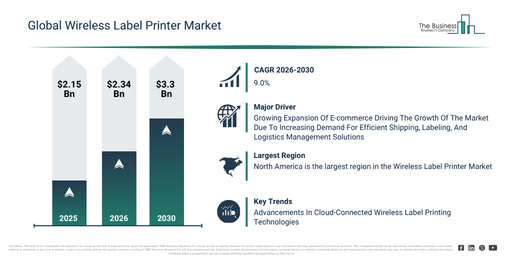
The wireless label printer market has experienced substantial growth in recent years. It is projected to expand from $2.15 billion in 2025 to $2.34 billion in 2026, exhibiting a compound annual growth rate (CAGR) of 8.8%. Historically, this growth can be attributed to the increasing adoption of desktop and industrial label printers, the expansion of logistics and retail sectors, a rising need for product identification and traceability, the broadening of healthcare and food labeling requirements, and the increasing utilization of barcode and RFID technologies.
The wireless label printer market size is expected to show significant expansion in the coming years. It is set to grow to $3.3 billion by 2030, achieving a compound annual growth rate (CAGR) of 9.0%. This growth throughout the forecast period can be attributed to several factors, including the increasing demand for wireless and mobile label printers, their rising integration with IoT-enabled devices, a growing need for real-time inventory labeling, the expansion of automated labeling practices in manufacturing, and the adoption of compact and portable printers for various field operations. Prominent trends for the forecast period include the increasing adoption of mobile and wireless label printers, a rising demand for thermal transfer and direct thermal printing solutions, greater integration with inventory and asset management systems, the broadening of on-demand and field-use printing solutions, and an increasing focus on compact, portable, and rugged printer designs.
Get A Free Sample Report With In-Depth Market Insights:
Wireless Label Printer Market Opportunity Drivers: What’s Unlocking New Revenue Potential?
The escalating expansion of e-commerce is projected to drive the growth of the wireless label printer market. E-commerce facilitates the purchase and sale of products and services via digital channels, offering businesses and consumers quicker and more convenient transactions. This surge in e-commerce is primarily fueled by rising internet accessibility and widespread smartphone adoption. Wireless label printers play a crucial role in e-commerce activities, enabling the printing of shipping labels, barcodes, and order tags without needing wired connections. This capability helps in expediting order processing, optimizing warehouse management, and streamlining last-mile logistics. For example, in March 2026, the United States Census Bureau, a US-based principal agency for collecting and analyzing population and economic data, reported that e-commerce sales in the fourth quarter of 2025 saw an estimated rise of 5.6% (±1.8%) compared to the same period in 2024. Consequently, the increasing reach of e-commerce is acting as a significant catalyst for the wireless label printer market.
Wireless Label Printer Market Segmentation: How Does The Market Break Down By Category?
The wireless label printer market covered in this report is segmented –
1) By Printer Type: Desktop Label Printers, Industrial Label Printers, Mobile Label Printers
2) By Printing Technology: Direct Thermal, Inkjet, Laser, Thermal Transfer
3) By Connectivity: Bluetooth, Cellular, Near Field Communication (NFC), Radio Frequency Identification (RFID), Wireless Fidelity (Wi-Fi)
4) By Distribution Channel: Direct Sales, Distributors, Online
5) By End User: Automotive, Food And Beverage, Healthcare, Logistics And Transportation, Manufacturing, Retail
Subsegments:
1) By Desktop Label Printers: Thermal Transfer Desktop Printers, Direct Thermal Desktop Printers, Inkjet Desktop Label Printers, Compact Or Portable Desktop Printers, Network Or Wireless Desktop Printers, Barcode Or Radio Frequency Identification (RFID)-Enabled Desktop Printers
2) By Industrial Label Printers: Heavy-Duty Thermal Transfer Industrial Printers, High-Speed Industrial Printers, Radio Frequency Identification (RFID) Industrial Printers, Near-Edge Or Edge-Type Industrial Printers, Wide-Format Industrial Printers, Print And Apply Industrial Systems, Network Or Wireless Industrial Printers
3) By Mobile Label Printers: Bluetooth Mobile Label Printers, Wireless Fidelity (Wi-Fi) Mobile Label Printers, USB Or Docking Mobile Printers, Rugged Or Field-Use Mobile Printers, Small-Form-Factor Pocket Printers, On-Demand Receipt And Label Mobile Printers
Wireless Label Printer Market Innovation Trends Shaping Future Development
Leading firms within the wireless label printer market are prioritizing technological innovations in wireless connectivity, particularly cloud-connected printers, aiming to boost remote printing functionalities, strengthen integration across various devices, and facilitate streamlined label administration via cloud-based frameworks. Such a printer is an internet-enabled apparatus, empowering users to dispatch print tasks from a distance through cloud services, thereby circumventing the exclusive dependence on direct links to nearby devices or networks. An example of this trend is the introduction in July 2025 by Star Micronics, a Japan-based provider of electronics and printing solutions, of the mC-Label2, a compact 2-inch direct thermal label printer specifically engineered for high-resolution results within limited spaces. This device offers 300 dpi printing for producing distinct barcodes, visual elements, and fine text, accommodates diverse media varieties including linerless, die-cut, continuous labels, and receipts, and provides connectivity choices like USB, LAN, WLAN, and Bluetooth. Furthermore, it integrates with cloud platforms such as CloudPRNT and Label Builder, enabling effortless label generation and output using cloud-driven and mobile applications.
Wireless Label Printer Market Top Companies Driving Competitive Growth
Major companies operating in the wireless label printer market are Honeywell International Inc., Canon Inc., Epson Corporation, Avery Dennison Corporation, Brother Industries Ltd., Zebra Technologies Corporation, Toshiba Tec Corporation, Urovo Technology Co. Ltd., Bixolon Co. Ltd, Primera Technology Inc., Xiamen Hanin Co. Ltd, Citizen Systems Japan Co. Ltd., Godex International Co. Ltd., SATO Holdings Corporation, Xprinter Technology Co. Ltd., Postek Electronics Co. Ltd., Tharo Systems Inc., Acural Solutions Pvt. Ltd., iDPRT, Munbyn Tech Co. Ltd.
View The Full Wireless Label Printer Market Report:
Wireless Label Printer Market Global Footprint: Which Region Leads The Market?
North America was the largest region in the wireless label printer market in 2025. Asia-Pacific is expected to be the fastest-growing region in the forecast period. The regions covered in the wireless label printer market report are Asia-Pacific, South East Asia, Western Europe, Eastern Europe, North America, South America, Middle East, Africa.
Reach Out To Our Team:
The Business Research Company: https://www.thebusinessresearchcompany.com/
Americas: +1 310-496-7795
Asia: +44 7882 955267 & +91 8897263534
Europe: +44 7882 955267
Email us at: marketing@tbrc.info
Follow us on:
LinkedIn: https://in.linkedin.com/company/the-business-research-company
YouTube: https://www.youtube.com/channel/UC24_fI0rV8cR5DxlCpgmyFQ
Global Market Model: https://www.thebusinessresearchcompany.com/global-market-model

Wasay has over a decade of experience in market research, data modelling, and analytics, with prior experience at GlobalData and Decision Tree Consulting Services. At The Business Research Company , he leads research operations across syndicated studies, customized consulting engagements, and the Global Market Model platform. His professional experience includes supporting organizations such as Boston Consulting Group, KPMG, and Ernst & Young. Wasay holds a degree in Electronics and Communications Engineering, postgraduate management qualifications from International Management Institute Belgium and Indian School of Business and Entrepreneurship, and completed the Integrated Program in Business Analytics from Indian Institute of Management Indore.