Backed by market attractiveness analysis, total addressable market sizing, company benchmarking matrices, interactive Excel dashboards, wider supply chain intelligence, emerging startup coverage, and detailed product-level insights, The Business Research Company’s 2026 market reports are designed to offer research that is more actionable and strategically valuable than ever.
Dehydrated Food Market Revenue Outlook: What CAGR Lies Ahead Through 2030?
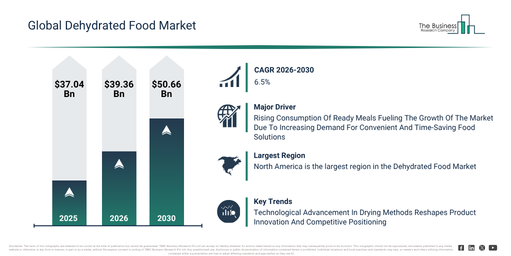
The dehydrated food market has shown strong growth in recent years. It is anticipated to increase from $37.04 billion in 2025 to $39.36 billion in 2026, at a compound annual growth rate (CAGR) of 6.3%. This historical growth can be attributed to the rising demand for long shelf life food preservation in rural regions, the limited availability of cold chain infrastructure, increasing urbanization and the resulting demand for convenient foods, a rise in military ration consumption, and traditional sun drying and preservation methods.
The dehydrated food market is projected to experience substantial growth in the coming years, with its size expected to reach $50.66 billion by 2030, exhibiting a compound annual growth rate (CAGR) of 6.5%. This anticipated expansion during the forecast period is driven by several factors, including the increasing need for space-efficient food storage, a global emphasis on disaster preparedness food reserves, the growing trend of health-conscious consumers seeking nutrient-dense options, the broadening of e-commerce channels for packaged foods, and continuous innovation in preserving flavor and texture. Key trends expected within this period encompass the increasing desire for lightweight and easily transportable food options for travel and outdoor pursuits, the escalating appeal of clean label and minimally processed dehydrated products, a rise in the consumption of plant-based dehydrated meals, the proliferation of premium gourmet and specialized dehydrated food items, and the growing embrace of emergency preparedness and survival food kits.
Get A Free Sample Report With In-Depth Market Insights:
Dehydrated Food Market Growth Catalysts And Demand Drivers
The increasing intake of ready meals is projected to fuel the expansion of the dehydrated food market in the future. Ready meals are defined as pre-cooked or partially cooked food items, typically packaged, that can be eaten immediately or require very little preparation by consumers. The rise in ready meal consumption stems from a growing need for convenient and efficient food options, as individuals increasingly seek to save time in their daily meal routines. Dehydrated food finds extensive application in ready meals because of its prolonged shelf life and its lower demands for storage and transport. This type of food facilitates rapid preparation, as components are readily rehydrated, largely preserving their taste and nutritional content. As an illustration, the Statistisches Bundesamt, a Germany-based statistical office, reported in January 2026 that ready-made meal production saw continued growth, reaching an estimated $4.9 billion in output during the first three quarters. This marked a nominal rise of 2.8% from the $4.8 billion registered in the corresponding period of 2024. Consequently, the expanding consumption of ready meals is anticipated to stimulate the growth of the dehydrated food market.
Dehydrated Food Market Segment Landscape: Which Areas Lead Development?
The dehydrated food market covered in this report is segmented –
1) By Type: Dehydrated Fruits, Dehydrated Vegetables, Dehydrated Meat, Dehydrated Seafood, Dehydrated Herbs
2) By Processing Method: Air Drying, Sun Drying, Freeze Drying, Drum Drying, Microwave Drying
3) By Packaging Type: Pouches And Sachets, Cans And Tins, Jars And Bottles, Bulk Packaging, Resealable Bags
4) By Distribution Channel: Online, Supermarkets, Convenience Stores, Specialty Stores
5) By End Use: Food And Beverage Industry, Retail, Food Service, Household
Subsegments:
1) By Dehydrated Fruits: Sun Dried Fruits, Freeze Dried Fruits, Air Dried Fruits, Infused Dehydrated Fruits, Organic Dehydrated Fruits
2) By Dehydrated Vegetables: Leafy Dehydrated Vegetables, Root Dehydrated Vegetables, Freeze Dried Vegetable Mixes, Air Dried Vegetable Products, Organic Dehydrated Vegetables
3) By Dehydrated Meat: Dried Red Meat Products, Dried Poultry Products, Freeze Dried Meat Products, Air Dried Meat Products, Cured Dehydrated Meat Products
4) By Dehydrated Seafood: Dried Fish Products, Dried Shellfish Products, Freeze Dried Seafood Products, Air Dried Seafood Products, Salt Cured Seafood Products
5) By Dehydrated Herbs: Dried Culinary Herbs, Whole Leaf Dehydrated Herbs, Crushed Dehydrated Herbs, Organic Dehydrated Herbs, Blended Herb Mixes
Dehydrated Food Market Trends Shaping Long-Term Demand
Major companies in the dehydrated food market are increasingly focusing on technological breakthroughs in drying methods, such as patented low-temperature dehydration, to gain a competitive advantage. Low-temperature dehydration is a regulated drying technique that extracts moisture from food at lower thermal levels, thus safeguarding the natural color, nutritional completeness, and sensory qualities of the original ingredient, benefits frequently diminished by conventional high-heat techniques. For example, in July 2025, BranchOut Food Inc., a US-based food technology company, introduced Sweet Potato Sticks Topped with Cinnamon, which was created using its exclusive GentleDry dehydration technology. The product offers a subtly sweet, crisp texture while preserving the lively natural color of sweet potatoes, maintaining their nutritional value without artificial additives, and achieving a shelf-stable form appropriate for widespread retail distribution across 1,952 store locations.
Dehydrated Food Market Key Players Shaping Industry Direction
Major companies operating in the dehydrated food market are Cargill Incorporated, Nestlé S.A., Archer Daniels Midland Company, Unilever PLC, Kraft Heinz Company, Olam Food Ingredients, Ajinomoto Co. Inc., McCormick & Company Incorporated, Döhler Group, Bühler Group, Mercer Foods LLC, Sensient Technologies Corporation, Jain Irrigation Systems Ltd., Van Drunen Farms, Meelunie B.V., European Freeze Dry, Paradise Fruits Solutions GmbH, Flex Foods Ltd., Tree Top Inc., Freeze-Dry Foods GmbH
View The Full Dehydrated Food Market Report:
Dehydrated Food Market Regional Analysis: Which Geography Leads On Revenue?
North America was the largest region in the dehydrated food market in 2025. Asia-Pacific is expected to be the fastest-growing region in the forecast period. The regions covered in the dehydrated food market report are Asia-Pacific, South East Asia, Western Europe, Eastern Europe, North America, South America, Middle East, Africa.
Reach Out To Our Team:
The Business Research Company: https://www.thebusinessresearchcompany.com/
Americas: +1 310-496-7795
Asia: +44 7882 955267 & +91 8897263534
Europe: +44 7882 955267
Email us at: marketing@tbrc.info
Follow us on:
LinkedIn: https://in.linkedin.com/company/the-business-research-company
YouTube: https://www.youtube.com/channel/UC24_fI0rV8cR5DxlCpgmyFQ
Global Market Model: https://www.thebusinessresearchcompany.com/global-market-model

Wasay has over a decade of experience in market research, data modelling, and analytics, with prior experience at GlobalData and Decision Tree Consulting Services. At The Business Research Company , he leads research operations across syndicated studies, customized consulting engagements, and the Global Market Model platform. His professional experience includes supporting organizations such as Boston Consulting Group, KPMG, and Ernst & Young. Wasay holds a degree in Electronics and Communications Engineering, postgraduate management qualifications from International Management Institute Belgium and Indian School of Business and Entrepreneurship, and completed the Integrated Program in Business Analytics from Indian Institute of Management Indore.